An Introduction to Laboratory Testing for Mpox

Share this article
As U.S. testing capacity for mpox has expanded, so too has the need for health care professionals to understand the process. On the podcast episode, “Mpox Testing in Your Laboratory,” Karie Brouillard, Special Pathogens Laboratory Coordinator at Providence Sacred Heart Medical Center & Children’s Hospital, and host Jill Morgan talk about the multi-step procedure for testing, how to mitigate the risks to laboratorians, and more. This podcast episode is for anyone who works in a heath care setting—whether you’re in a small clinic that has to ship specimens to a commercial laboratory or a large hospital with in-house testing facilities.
Diagnostic Testing for Mpox
Diagnostic testing for mpox virus is performed using a polymerase chain reaction (PCR) test of a specimen collected via a swab of lesions or lesion material.
Initially, the CDC developed the diagnostic test for mpox and distributed it through the Laboratory Response Network (LRN), a network of state and local public health, veterinary, military, and international labs.
Then in June 2022, the Department of Health and Human Services (HHS) expanded testing for mpox to five major commercial labs, including Quest, Labcorp (Labcorp, Accessed 2025, https://www.labcorp.com/infectious-disease/monkeypox), Aegis Sciences, Mayo Clinic, and Sonic Healthcare, in addition to the CDC’s laboratory response network.
While there are no commercially available tests currently, the CDC is working to expand access to hospital and clinical laboratories interested in testing for mpox at their facility.
Until that time, unless your facility is a designated lab, specimens have to be collected, packaged, and shipped to an LRN or commercial lab for testing.
See NETEC’s learning module to learn how to collect a specimen, label it, and ship it.
Key Takeaways From the Podcast
- There are two categories of laboratorians with corresponding levels of risk when testing for mpox. Laboratorians working with the lesion or swab, during specimen collection and analysis, have a higher risk of infection. These individuals should be should be vaccinated, if possible. However if lab personnel are not vaccinated, they should use biosafety level three practices (CDC, https://www.cdc.gov/cpr/infographics/biosafety.htm, Accessed 8/26/2022).
- Laboratorians testing other clinical specimens such as blood or urine, which have a low viral load, are at a lower risk. These individuals can work in a biosafety level two laboratory (CDC, https://www.cdc.gov/cpr/infographics/biosafety.htm, Accessed 8/26/2022) and because of the lower risk to this group the CDC does not recommend vaccination.
- Turnaround time for mpox testing varies based on when the lab receives the specimen. While awaiting results, patients should continue to quarantine, and health care workers can provide supportive care. A patient may also be considered for additional testing to rule out other illnesses.
- Any laboratory that performs diagnostics testing for mpox should report test results to state, local, territorial or tribal (STLT) health departments. See the CDC’s guide on what and how to report laboratory diagnostic test results (CDC, https://www.cdc.gov/poxvirus/monkeypox/lab-personnel/report-results.html, Accessed 8/26/20220.
- Laboratorians can apply most of the same precautions and processes to mpox that they do do other specimens.
- Communicate with your infection prevention team and develop strategies for informing internal stakeholders, including lab personnel, when a patient under investigation (PUI) is being assessed and treated. Be sure to maintain patient confidentiality in all communications.
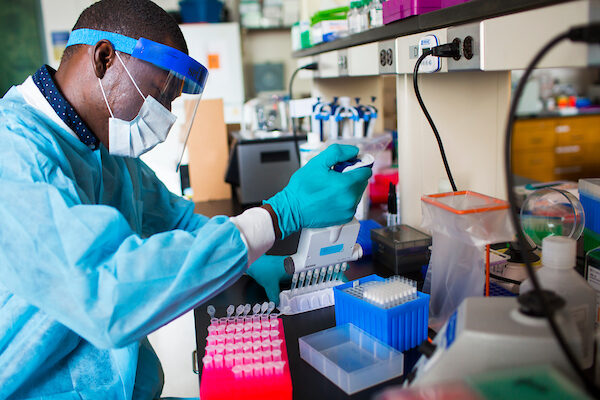
- Lab personal protective equipment (PPE) includes: a lab coat that hangs below the knee and is impermeable to water and has elastic cuffs; gloves that go over the elastic cuffs of the lab coat so there’s no exposed skin; and a mask.
For a full list of recommendations, see the CDC’s guide to laboratory procedures and biosafety (CDC, https://www.cdc.gov/poxvirus/monkeypox/lab-personnel/lab-procedures.html, Accessed 8/26/2022).