Situation Report: Ebola Cases Expand and Regional Risk Rises
Share this article
Ebola Continues to Spread in Uganda
On November 2, 2022, the World Health Organization (WHO) reported 130 confirmed cases of Ebola and 21 probable cases (WHO, Accessed 2024, https://www.who.int/director-general/speeches/detail/who-director-general-s-opening-remarks-at-media-briefing—2-november-2022). The number of confirmed deaths stands at 43, with 21 probable deaths. Forty-five people have recovered. Officials continue to follow up with more than 1,700 contacts within 10 districts. Mubende remains the most affected district, however Ebola cases have recently increased in two neighboring districts, and 17 cases have been confirmed in the capital city of Kampala.
Ebola Vaccines Head to Uganda
Three experimental vaccine candidates for the Sudan ebolavirus are being deployed to Uganda to help fight the outbreak, from Oxford University in the United Kingdom and Sabin Vaccine Institute and Merck in the United States. The Ugandan Ministry of Health has announced plans to vaccinate 3,000 contacts of the confirmed cases initially, using the ring vaccination strategy shown to be effective in previous outbreaks of the Zaire ebolavirus.
U.S. Preparations for Ebola
The global risk remains low and there are currently no confirmed cases of Ebola in the United States. Nonetheless, the Centers for Disease Control and Prevention (CDC) has activated its emergency response structure to increase domestic preparedness (COCA, https://emergency.cdc.gov/coca/ppt/2022/101222_slides.pdf, Accessed 2022) and airlines have started screening passengers arriving from Uganda for symptoms consistent with Ebola.
Health care providers in the United States should be prepared to evaluate patients suspected of having ebola virus disease (CDC, https://www.cdc.gov/vhf/ebola/clinicians/evaluating-patients/index.html, Accessed 11/2/2022): assessing for signs and symptoms consistent with Ebola virus infection; taking a thorough travel and exposure history to determine epidemiological risk factors such as history of travel to affected areas within 21 days before the onset of symptoms.
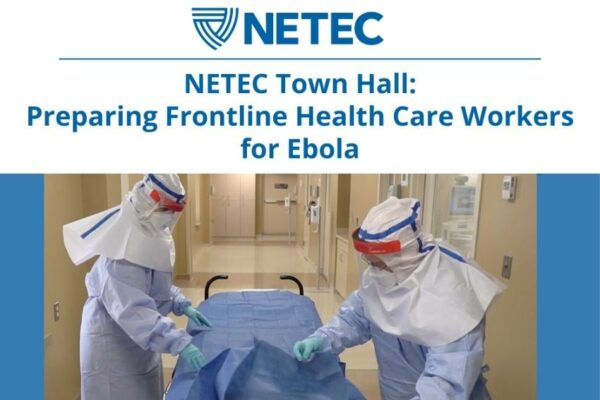
NETEC offers a range of resources, from training to consultations, for health care facilities to assess their preparedness.