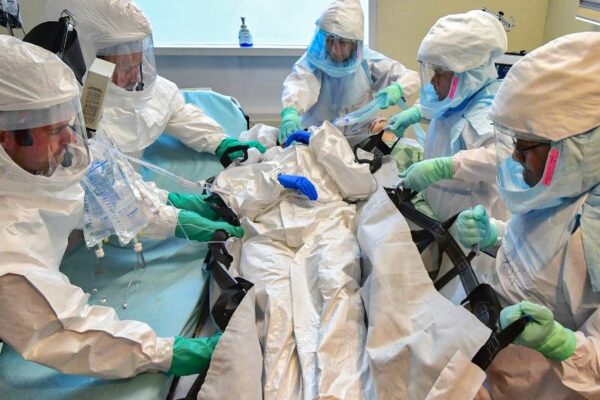
High-Level Containment Care of a Patient Infected with Sudan Ebolavirus
Share this article
A new video from NETEC, “Preliminary Strategic Guidance for High-Level Containment Care of a Patient Infected with Sudan Ebolavirus,” channels the expertise of NETEC infectious diseases and clinical care doctors to prepare health care workers to manage patients in a high-level containment care setting. The presentation includes an overview of the current outbreak in Uganda, a review of the epidemiology of Ebolaviruses, a summary of symptoms and differential diagnoses, and preliminary strategic guidance on the principles and practices of high-level containment care.
10 Things You Need to Know about High-Level Containment Care of a Patient Infected with Sudan Ebolavirus
1. The Ugandan government announced on November 30, 2022, that it had discharged its last known Ebola patient. As of December 4, there have been 142 confirmed cases and at least 20 probable cases, including 55 confirmed deaths. The last confirmed case was a stillborn on November 27, born to a mother who had previously recovered from Ebola.
2. Co-infections, specifically with Malaria, are extraordinarily common, and should not be missed in the initial workup for these patients.
3. An early and elective approach to performing invasive procedures should be undertaken to avoid emergent situations that can lead to operator exposure; the most experienced providers should perform procedures.
4. Multi-organ failure is the leading cause of death, and patients may rapidly become hypovolemic, with severe metabolic derangements; aggressive replenishment of volume and electrolytes is often needed.
5. Four vaccine medical countermeasures have reached clinical testing, but efficacy remains unknown; one therapeutic medical countermeasure exists with efficacy shown in non-human primate studies; three vaccines and the monoclonal antibody have been deployed in Uganda.
6. The need for central venous access (whether via central line placement, PICC line, or Hickman) must be evaluated and based on the individual patient, sites must be selected carefully, and timing is essential.
7. Intubation should be performed in a rapid sequence, prioritizing video laryngoscopy to decrease the risk of PPE contamination.
8. If renal failure occurs, utilize continuous renal replacement therapy (CRRT) over conventional hemodialysis.
9. The use of portable ultrasound for organ system assessment and procedural guidance is strongly recommended.
10. It is strongly recommended that sites create cardiac arrest care protocols and develop approaches from an ethical and operational standpoint, though this is an area of ongoing research.
About the Experts
Gavin Harris, MD
Gavin Harris is an infectious diseases and critical care physician at Emory University, as well as a staff physician of Emory’s Serious Communicable Diseases Unit, and an alumni fellow of the Johns Hopkins Center for Health Security Emerging Leaders in Biosecurity Initiative (ELBI).
Kelly Cawcutt, MD, MS
Kelly Cawcutt is an associate professor in the Division of Infectious Diseases, associate medical director of Infection Control & Epidemiology, co-director of Digital Innovation and Social Media Strategy, and medical director of Medical Quality at University of Nebraska Medical Center.