Personal Protective Equipment and Biocontainment for Lassa Fever
Share this article
PPE and Biocontainment Strategies for Lassa Fever Patient Care
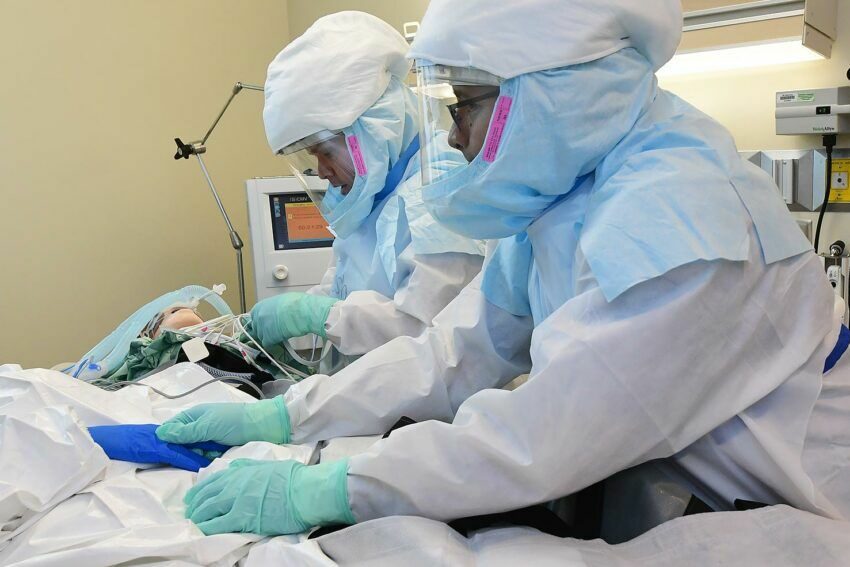
Because of the high degree of mortality associated with infection, patients infected with or suspected to be infected with Lassa virus should be cared for in a biocontainment unit and health care providers should follow personal protective equipment (PPE) guidance to prevent secondary person-to-person spread.
Caring for a Patient with Lassa Fever During Intake and Isolation
For assessing a potentially infected patient during intake, the steps outlined in NETEC’s webinar: The I’s Have It: Identify, Isolate, and Inform, can help to ensure that the safety of the patient and care providers remains at the forefront of the Lassa fever patient care process.
For patients with Lassa fever already in isolation, the WHO’s Pocket Guide for Frontline Health Workers (WHO, https://iris.who.int/items/0fb32f47-919f-469c-9e3c-5b1c95f0dd7b, 10/30/24), originally developed for the management of other viral hemorrhagic fever infections such as Ebola, is appropriate for managing patients with Lassa virus infection. Remember to review the signs and symptoms of Lassa fever (CDC, https://www.cdc.gov/lassa-fever/about/, accessed 10/30/24), the points of transmission, and recommended personal protective equipment (PPE).
How Lassa Virus is Transmitted Person-to-Person
- The incubation period for Lassa fever is 6-21 days; a person can transmit the virus during this time.
- Person-to-person transmission occurs through direct contact with the blood, urine, vomit, breast milk, semen, or saliva of a person sick with, or has died from, Lassa fever.
- Lassa virus can be detected in urine and semen for several weeks after a patient has recovered.
- There is no evidence of airborne spread between humans.
Recommended Personal Protective Equipment (PPE) when Caring for a Patient with Lassa Fever
Donning and doffing protocols for personal protective equipment should be used to minimize the risk of contamination. See the following resources to get started:
- PPE Donning and Doffing Flyer
- Containment Wrap in a Special Pathogen Isolation Area
- PPE: Confirmed Patients and Clinically Unstable Patients Suspected to have VHF (CDC, https://www.cdc.gov/viral-hemorrhagic-fevers/hcp/guidance/ppe-clinically-unstable.html, 10/30/24)
- PPE: Clinically Stable Patients Suspected to have VHF (CDC, https://www.cdc.gov/viral-hemorrhagic-fevers/hcp/guidance/ppe-clinically-stable-puis.html, 10/30/24)
Additionally, clinicians can implement the following guidance from the CDC (CDC, https://www.cdc.gov/viral-hemorrhagic-fevers/hcp/guidance/ppe-clinically-unstable.html, 10/3024) on the types of PPE to be used and the processes for donning and doffing PPE for all personnel entering the room of a patient:
- Fluid-resistant gown or coverall: Disposable gown extending to at least mid-calf or disposable coverall, preferably without an integrated hood.
- Respiratory protection: While airborne transmission of Lassa virus has not been documented, the CDC recommends that all health care workers use a NIOSH-certified, fit tested, N95 or higher respirator or a PAPR in case a potentially aerosol-generating procedure needs to be performed.
- Face/eye protection: An N95 or higher respirator should be worn in combination with a waterproof, disposable surgical hood extending to shoulders and a disposable full-face shield. If wearing a hooded PAPR with a full-face shield and reusable helmet or headpiece, cover the helmet or headpiece with a waterproof, disposable hood that extends to the shoulders and fully covers the neck, and is compatible with the PAPR.
- Disposable gloves with extended cuffs: Two pairs of gloves will allow for the removal and replacement of a heavily soiled outer glove during care.
- Disposable boot covers: Waterproof boot covers that extend to at least mid-calf. A second pair of disposable shoe covers worn over boot covers may make doffing easier and reduce contamination of the floor in the doffing area. Shoe covers may be used in lieu of boot covers only if used in combination with a coverall with integrated socks.
- Disposable apron: An apron that covers the torso down to mid-calf should be worn over a gown or coveralls if the patient has diarrhea or is vomiting.
Lassa Fever Waste Management
Waste management is a critical component in the care of patients potentially infected with special pathogens like Lassa fever. Download NETEC’s Basic Guidance for Category A Waste Management in Special Pathogen Isolation to gain insights into the proper classification of waste and explore practical approaches to develop and implement comprehensive waste management plans.
Have a question about how to effectively use your PPE? Get an answer from a NETEC expert: send us your question today!
About the Author
Brooke Henriksen BSN, RN, CCRN
Brooke Henriksen is the training and education coordinator in the Special Pathogens Unit at Providence Sacred Heart Medical Center.