Special Issue of “Health Security” Underscores the Importance of Global Collaboration to Managing High-Consequence Infectious Diseases
Share this article
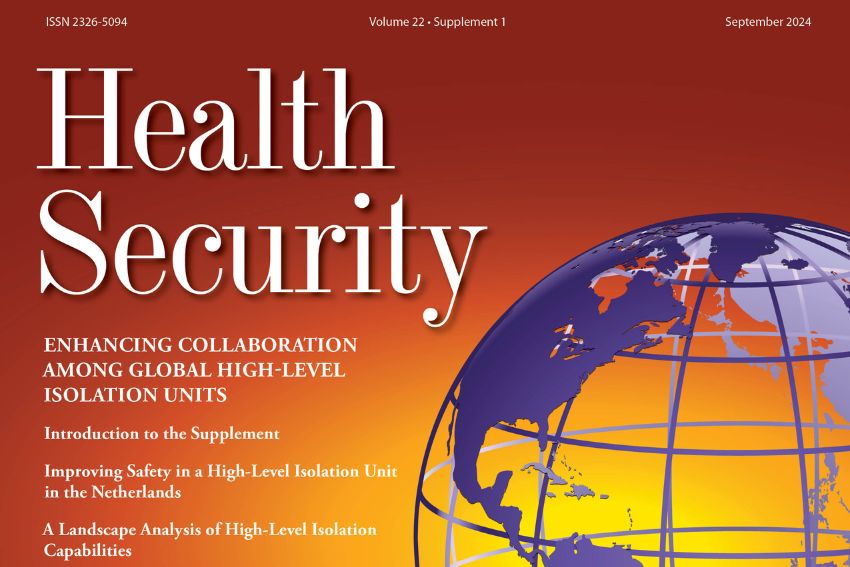
Health Security released a special issue of the peer-reviewed journal, sponsored by the National Emerging Special Pathogens Training and Education Center (NETEC), which features 14 manuscripts written by global high-level isolation unit (HLIU) colleagues. Jocelyn J. Herstein, Director of NETEC International Partnerships and Programs, and Lauren M. Sauer, Director of NETEC’s Special Pathogens Research Network were guest co-editors for the issue.
The special issue, Enhancing Collaboration Between Global High-Level Isolation Units, underscores the importance of global collaborative efforts to prepare and respond to high-consequence infectious diseases (HCIDs).
This supplement compiles global approaches to HCID preparedness and response, spotlighting the critical role HLIUs play in these efforts. It highlights the contributions of HLIUs in managing HCID events, addresses ongoing challenges, and explores innovative solutions through national and global research and collaboration. Additionally, it presents a vision for a future global HLIU network that could enhance national, regional, and global health security.
By sharing experiences and best practices, this collection aims to advance individual HLIU practices and the broader field of HCID management. Ultimately, it seeks to foster collaboration, extend HLIUs’ impact, and raise awareness of their essential role in global health security.
4 Must-Reads for U.S. Health Care Personnel by NETEC Authors
The special issue includes lessons learned, innovations, and research from HLIU and HCID programs in 11 different countries, including descriptions of HLIU networks in Germany and the United Kingdom, development of an HLIU program in Rwanda, adaptation of a readiness checklist to an Irish HLIU, and developing HCID transportation capacity in Europe. A few highlights from NETEC authors include:
“A Virtual Assessment Model for At-Home Evaluation of Suspected Viral Hemorrhagic Fever Cases”
The research shares the Denver Health High-Risk Infection Team (HITeam) virtual assessment model (VAM), a remote evaluation tool for individuals potentially infected with serious pathogens. The VAM extends assessment from HLIUs to suspect cases’ homes, allowing for in-field physical assessments, monitoring, and interventions. It enables HITeam responders to make informed decisions on hospitalization needs based on detailed onsite evaluations, thus enhancing patient comfort while reducing healthcare professional exposure risk. Learn more.
“The Importance of Networks and Relationships: Leveraging the Biocontainment Unit Leadership Workgroup for Special Pathogens Outbreak Response”
The article describes the weekly Outbreak Readiness calls convened by the NETEC Biocontainment Unit Leadership Workgroup and the Special Pathogens Research Network in response to the mpox, Sudan ebolavirus, and Marburg virus disease outbreaks in 2022. These calls included leaders of the Regional Emerging Special Pathogen Treatment Centers (RESPTCs) and federal partners who exchanged updates on the operational readiness of units, case counts, laboratory capacity, available medical countermeasures, and other pertinent information. This case study describes the framework of this communication model for use in future preparedness efforts. Read the article.
“High-Level Isolation: A Landscape Analysis of Global Capabilities and Opportunities to Advance the Field”
NETEC’s International Partnerships and Programs (IPP) conducted a landscape analysis of global high-level isolation capabilities to inform its strategy and guide its efforts. The manuscript identifies critical gaps, highlights areas for improvement, and offers recommendations aimed at enhancing global health security. Learn more.
“Frontline Leadership: Nurses in Special Pathogens Preparedness and Response”
The article details the critical role of RESPTC nurse leaders in establishing and building the current state of BCU care and the importance of expanding nurse education, fostering leadership, and creating a robust workforce in order to build a safer, more resilient health care system. Read the article.
Challenges Facing HLIUs
Recruitment and Retention
Over the last several years, trained health care personnel have left hospitals in droves, and staffing numbers have not rebounded. Hospitals are struggling to recruit and retain highly trained staff, especially in HLIUs, which often rely on volunteers.
Funding
Because of funding challenges and the infrequent nature of HCID incidents, there are limited opportunities to advance the field of high-level isolation. How to sustain the funding necessary to maintain operational readiness for a capability that is rarely, if ever, used, is a pervasive challenge and concern.
Capacity-building
Tabletop exercises have shown that existing HLIU capacities in many countries would be insufficient in the event of an HCID outbreak requiring surge capacities.
A Few Key Takeaways from Enhancing Collaboration Between Global High-Level Isolation Units
Global Networking Matters
In the last decade, there have been more and more HCID outbreaks, from the 2014 Ebola virus disease (EVD) epidemic that resulted in more than 28,600 infections and more than 11,300 deaths, to the mpox virus (MPXV) outbreak that peaked in 2022 of which to date more than 90,000 cases have been reported globally, to the Marburg virus disease (MVD) outbreak in Rwanda, where authorities have begun a 42-day countdown to declare the end of the outbreak event that resulted in 66 confirmed cases, including 15 deaths.
HCIDs are defined by a high case-fatality rate, a lack of prevention and treatment options, and a serious risk of transmission within communities and health care settings. While HCID incidents have occurred with relative low frequency in the past, they are now occurring with increasing frequency and at a larger scale, and it has a serious impact on global health security.
HLIUs Support Optimal HCID Patient Care
Many countries have developed HLIUs to care for patients with HCIDs. Also known as biocontainment units and HCID treatment centers, these facilities feature special physical infrastructure, highly trained teams, and well-established and exercised standard operating procedures to support optimal HCID patient care while addressing risks to health care personnel.
HLIUs are a crucial resource to manage outbreaks of novel pathogens—not only because of the physical biocontainment facility but also the highly trained workforce members who are mentally prepared to handle unusual diseases.
A Milestone in International Partnership Efforts
The special issue is focused on the approaches taken by different countries and regions to address challenges faced by HLIUs and achieve optimal clinical preparedness for and response to HCID cases and incidents. It is the result of years of global collaboration and research, in which HLIUs have forged partnerships to share best practices, expertise, and experiences.
NETEC’s International Partnerships and Programs is funded by the U.S. Administration for Strategic Preparedness and Response to strengthen networking and facilitate collaboration with global HLIU teams. This special issue, which includes experiences and lessons learned from HLIUs in 11 countries across five continents, marks a significant milestone in those efforts. The introduction to the special issue, “Global Clinical Networking to Optimize the Clinical Management of High-Consequence Infectious Diseases,” was by members of the International Partnerships and Programs Advisory Board, including Jocelyn J. Herstein, Jake Dunning, Poh Lian Lim, Christian Herzog, and Lauren M. Sauer.

About the Author
Jocelyn J. Herstein, PhD, MPH, is an assistant professor in the Department of Environmental, Agricultural & Occupational Health in the UNMC College of Public Health. She also is director of international partnerships and programs for the National Emerging Special Pathogens Training and Education Center (NETEC) and a Scholar of UNMC’s Global Center for Health Security.
Get Expert Assistance
Ask a NETEC expert a question or request free services for your facility.
Find Resources
Explore special pathogen resources created and curated by NETEC experts.