From Runway to ICU: The Critical Role of Air Transport in Special Pathogen Care
Share this article
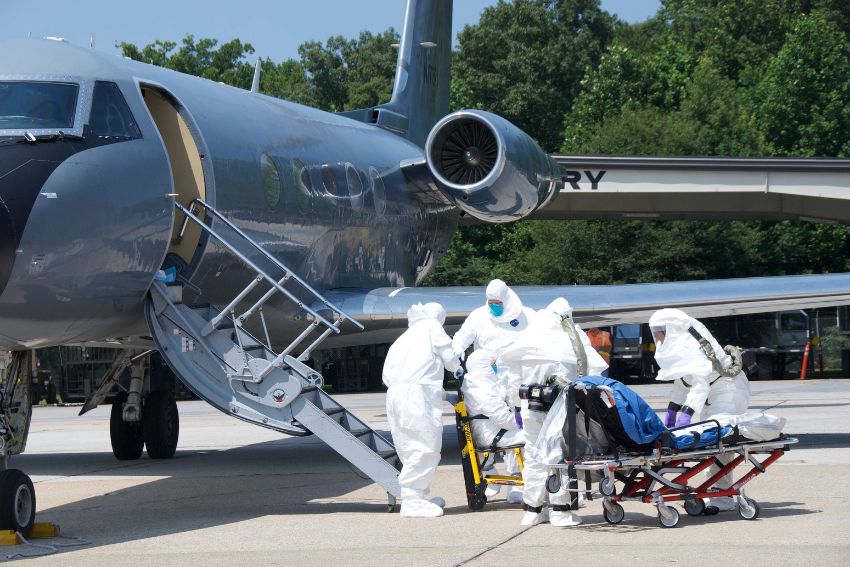
When a patient with a high-consequence infectious disease (HCID) needs advanced care, distance and logistics cannot be barriers. Behind the scenes, a highly coordinated system of air and ground transport teams works to safely move patients from some of the most challenging environments in the world to specialized treatment centers in the United States.
In the latest episode of Transmission Interrupted, leaders in air medical transport, EMS, and healthcare preparedness—many of whom were directly involved in the 2014 Ebola response—share what it takes to move patients safely from runway to ICU.
Built on Experience: Lessons from the 2014 Ebola Response
The 2014–2016 Ebola outbreak in West Africa marked a turning point in global health preparedness. For the first time, patients with Ebola virus disease were transported internationally to specialized treatment centers in the United States and Europe.
These missions required unprecedented coordination between federal agencies, private air transport teams, healthcare systems, and EMS providers. Organizations like Phoenix Air Group developed and deployed innovative containment systems, while institutions such as Emory University Hospital and Nebraska Medicine activated specialized biocontainment units to receive and treat patients.
Many of the professionals involved in those early transports helped shape the protocols, training programs, and systems that are still in use today. What began as an urgent, rapidly evolving response has since become the foundation for a more coordinated national approach to special pathogen care.
Bringing the ICU to the Aircraft
One of the most remarkable advancements to come out of these efforts is the ability to deliver ICU-level care during flight.
Using specialized systems like the Airborne Biological Containment System (ABCS), transport teams can:
- Maintain negative pressure environments
- Filter air through HEPA systems
- Operate ventilators, IV pumps, and monitors
- Provide full patient access for assessment and intervention
All of this takes place in a confined, high-risk environment, with clinicians working in full personal protective equipment under physically demanding conditions.
This is not simply transportation—it is mobile critical care under some of the most extreme circumstances in healthcare.
The Power of Coordination
Air transport is only one piece of a much larger system. Safe and effective patient movement depends on seamless coordination between air crews, EMS teams, hospitals, and public health partners.
Ground teams must be prepared to:
- Receive patients safely from aircraft
- Adapt to unexpected challenges during transfer
- Transport patients securely to specialized treatment units
In many cases, these operations unfold under intense public and media attention, adding another layer of complexity. Success depends on clear communication, defined roles, and strong pre-existing relationships between partners.
Preparing for the Unpredictable
Even with detailed protocols in place, no plan can account for every possible scenario. Real-world operations require teams to think critically, adapt quickly, and rely on their training in the moment.
Preparedness depends on:
- Repeated training and exercises
- Strong situational awareness and risk assessment
- The ability to make informed decisions under pressure
Rather than relying solely on written procedures, successful teams build the skills and confidence needed to respond when conditions change.
Why This Matters Now
As global travel increases and large-scale international events bring people from around the world together, the need for a coordinated national system of care is more important than ever.
The National Special Pathogen System (NSPS) builds on lessons learned from past outbreaks to ensure that:
- Patients can access high-quality care regardless of location
- Healthcare workers are protected
- Systems are ready to scale during emergencies
Transport—whether by air or ground—is a critical link in that system.
Moving Forward
The ability to safely transport patients with high-consequence infectious diseases represents a major advancement in healthcare preparedness. But it requires sustained effort.
Ongoing success depends on:
- Continued investment in training and education
- Strong partnerships across healthcare, EMS, and public health
- Maintaining readiness even between events
At its core, the mission remains clear: deliver high-quality, compassionate care while ensuring the safety of the healthcare workforce.
Listen to the full episode of Transmission Interrupted: “From Runway to ICU: The Role of Air Transport in HCID Patient Care” to hear these stories firsthand.
About the Experts
Vance Ferebee, RN, has 44 years of nursing experience as well as 25 years as a NREMT-P, including 34 years as a rotor wing and fixed wing flight nurse. He is the former Medical Division Director and Chief Flight Nurse for Phoenix Air Group. He served as the Director from 2007-2025 and was co-lead on the team that developed the Airborne Biological Containment System (ABCS) utilized for patient transport during the West Africa Ebola outbreak of 2014-2015. He led the team that developed and implemented the follow-on infectious disease transport unit, the Containerized Biological Containment System (CBCS) utilized during the initial COVID outbreak, transporting over 100 patients from Japan, California, and Africa back home to Europe and the U.S.
Alex P. Isakov, MD, MPH, is the founding executive director of the Office of Critical Event Preparedness and Response (CEPAR) and a professor of emergency medicine at Emory University. He directs CEPAR’s initiatives to enhance disaster resilience at Emory and in the broader community. Dr. Isakov’s experience includes service in the U.S. Navy, consulting for the CDC, and leadership roles in EMS and disaster preparedness. He is also the director of Emory’s Section of Prehospital and Disaster Medicine and leads Emory EMS. Certified in emergency medicine and EMS, he practices clinically at Emory University Hospital. Dr. Isakov serves as a co-lead for NETEC’s EMS Workgroup.
Wade O. Miles, NRP, is the Operations and Training Manager for the Office of Critical Event Preparedness and Response. Miles is responsible for the development, management and delivery of educational programs. In addition, he works with the CEPAR team to help develop and coordinate drills and exercises for the University. Miles also serves as the Training Manager for the Section of Prehospital and Disaster Medicine. Furthermore, Miles also serves as the Deputy Director for Emory EMS (EEMS). Prior to joining CEPAR, Miles served for nearly 20 years with Grady EMS. During his time with Grady EMS, he performed in various roles including Paramedic, Special Operations Paramedic, Supervisor, Manager and Director of EMS Operations. He has an extensive background in emergency pre-hospital care. Miles is a founding member and former team leader of the Grady EMS Biosafety Transport Team. He was instrumental in the planning and operational oversight of transport for the first two confirmed patients with Ebola Virus Disease in the United States. Miles serves as a subject matter expert in the area of moving patients who have high-consequence diseases. He delivers training and educational programs across the United States with NETEC.
Jill Morgan, RN, has over thirty-five years of emergency and critical care nursing experience. She is on Emory’s Serious Communicable Disease Unit team and cared for all five of Emory’s viral hemorrhagic fever patients. She now serves as the site manager for the Emory biocontainment unit, has validated the unit’s processes and protocols on the autoclave inactivation of special pathogen waste and the safe doffing of complex PPE ensembles, and created the Emory Healthcare Test Kitchen to advance the science of healthcare worker safety. Morgan is a PPE subject matter expert and co-lead of the PPE Working Group for NETEC, the National Emerging Special Pathogens Training and Education Center, where she helps create and deliver education to healthcare workers, evaluates ensembles, protocols, and plans, and assesses the readiness of healthcare facilities. She is a member of ASTM, AAMI, ANSI, and APIC. In 2023, Morgan was appointed to the National Academies Committee on Personal Protective Equipment.
Ben Tysor, NRP, has over 20 years of experience in fire and emergency medical services. He is a member of the Omaha Fire & Rescue high-consequence infectious disease transport team and was instrumental in the transport of patients with confirmed Ebola Virus Disease who were cared for at the Nebraska Biocontainment Unit. Tysor enjoys working with other EMS agencies in developing their infectious disease transport programs. Outside of work, he enjoys traveling with his family and keeping up with his two young sons’ numerous activities.