Inside the National Quarantine Unit: Preparedness, Partnership, and People
Share this article
.
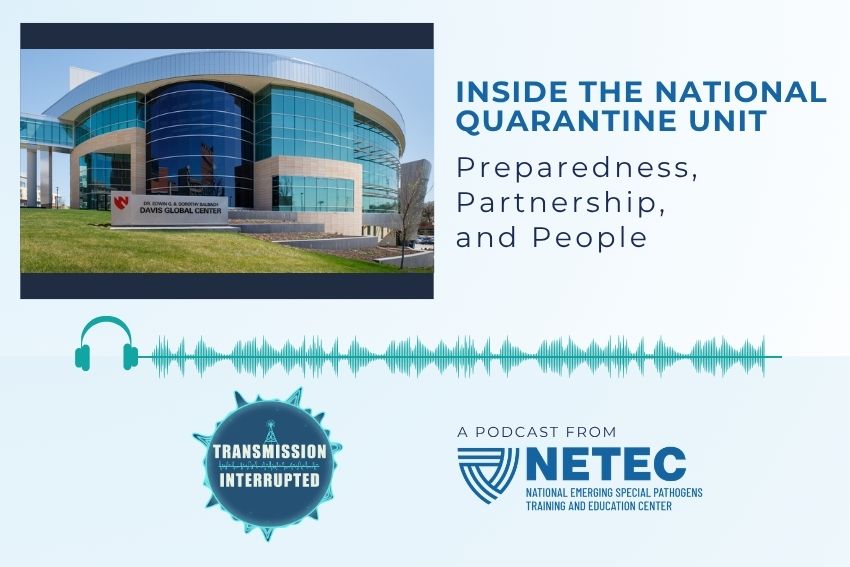
Step inside one of the most unique corners of American healthcare as Transmission Interrupted takes you behind the scenes of the National Quarantine Unit at the University of Nebraska Medical Center and Nebraska Medicine. In this episode, host Jill Morgan is joined by key members of the Nebraska team—Dr. Katie Willet, Morgan Shradar, and Angie Vasa—to explore how preparedness, partnership, and people form the backbone of the nation’s only dedicated quarantine unit. Listeners will discover the origin story of this 20-bed unit, why it’s different from both home quarantine and traditional hospital isolation, and how its creation was driven by real-world lessons from recent public health emergencies like the Ebola outbreak and COVID-19 pandemic.
From the practical logistics of care (think twice-daily health checks, concierge-level support, and even laundry service) to the psychological challenges of isolation and the intricacies of national and global collaboration, this episode sheds light on the critical thinking and teamwork required to protect both individuals and the community during high-stakes contagious threats. Hear firsthand how the UNMC and Nebraska Medicine team adapts with each new pathogen, leans on the strength of their Omaha community, and continuously trains to stay a step ahead of the next big infectious risk—demonstrating “Nebraska nice” even in the toughest circumstances.
Questions or comments for NETEC? Contact us at info@netec.org.
Visit Transmission Interrupted on the web at netec.org/podcast.
Guests
Morgan Shradar, RN, BSN, MPH
Nursing Professional Development Specialist- Nebraska Biocontainment Unit
Co-Director- National Disaster Medical Disaster Infectious Disease Training Program
Subject Matter Expert NETEC & Task 2 Lead – NICS
Morgan Shradar has more than 20 years of experience in the operating room and more than 14 years of experience with the Nebraska Biocontainment Unit. She has previous experience as a lead surgical nurse where she managed procedural areas (endoscopy, surgery, cardiac cath lab/interventional radiology, preop/pacu, and sterile processing). She has also managed process improvement initiatives for supply chain improvements and patient experience within procedural areas at Nebraska Medicine Bellevue. Morgan is a nurse coordinator with the Regional Emerging Special Pathogens Treatment Center (RESPTC). She develops and leads the education and training for the RESPTC team, including education meetings, quarterly trainings, exercises, and drill development. Morgan collaborates on the education and training and policy development for the National Quarantine Unit. She actively participated in the repatriation efforts of guests from Wuhan, China, and the Diamond Princess, who required care for COVID-19. Further, she is a subject matter expert with NETEC and partners with others to evaluate readiness for RESPTCs and works with long-term care focus groups to develop education and just-in-time resources to enhance LTC setting readiness. In 2020/2021, she partnered with LTC and skilled nursing facilities on evaluating the current COVID-19 infection control practices within facilities across Nebraska. She has also partnered with Nebraska Medicine to educate and train medical teams on donning/doffing PAPRs and worked with procedural areas on developing their PAPR protocols. Morgan is a task lead with NICS, which is focused on developing XR/AR education for the small and rural hospital on infection control practices within the sterile processing department. She is also the co-director of the National Disaster Medical Response Infectious Disease Training program, which has focused on educating and training the NDMS teams on infection control practices to ready them for deployment to both austere and hospital missions. Morgan collaborates in program development and partnerships with various organizations focused on infectious disease education and training. Morgan began her career in 2000 as an operating room nurse for Nebraska Medicine, where she joined the Nebraska Biocontainment Unit team in 2009 to play an integral role in treating patients with Ebola Virus Disease during the 2014-2015 activation.
Dr. Katie Willet, MD, FACEP
Associate Professor, UNMC Department of Emergency Medicine
Associate Program Director, UNMC Department of Emergency Medicine
Health Security Fellowship Director, UNMC Department of Emergency Medicine
Katie Willet, MD (she/her/hers), is an assistant professor in the Department of Emergency Medicine. She is one of the residency assistant program directors and takes part in the development of disaster preparedness and biopreparedness training for residents and other multidisciplinary trainees, both within UNMC and our external partners. She has interests in austere/wilderness medicine, disaster medicine, and biopreparedness. She also serves as the health security fellowship program director and co-creator with several partners within the Global Center for Health Security. With this, she takes part in preparedness planning, training development, and response. Similarly, she is involved with several different research and training projects with the Global Center for Health Security as well as teaching regionally about disaster preparedness. She is an assistant medical director for the National Quarantine Unit and a health security scholar with the Global Center for Health Security.
Angie Vasa, MSN, RN
Director, Readiness Consultations and Metrics Development, NETEC
Director, Emergency Preparedness and Special Pathogen Programs, Nebraska Medicine
Program Director, Region VII Regional Emerging Special Pathogen Treatment Center
Angela Vasa, MSN, RN, is the Director of Emergency Preparedness and Special Pathogen Programs at Nebraska Medicine. She serves as the Director of Consulting Services and Metrics Development at NETEC and is the Program Director for the Region VII Regional Emerging Special Pathogen Treatment Center. Angela is also a scholar in the Global Center for Health Security at the University of Nebraska Medical Center. Her nursing background includes over a decade of clinical experience with specialized expertise in the areas of trauma, critical care, solid organ transplant, and high-consequence infectious diseases. She joined the Nebraska Biocontainment Unit team in 2009, where she has cared for patients with Ebola virus disease and Lassa Fever and continues to be an active clinical member while serving as the program director.
Host
Jill Morgan, RN
Emory Healthcare, Atlanta, GA
Jill Morgan is a registered nurse and a subject matter expert in personal protective equipment (PPE) for NETEC. For 35 years, Jill has been an emergency department and critical care nurse, and now splits her time between education for NETEC and clinical research, most of it centering around infection prevention and personal protective equipment. She is a member of the Association for Professionals in Infection Control and Epidemiology (APIC), ASTM International, and the Association for the Advancement of Medical Instrumentation (AAMI)
Resources
- National Quarantine Unit
- Global Center for Health Security
- Nebraska Medicine/UNMC asked to monitor U.S. citizens from cruise ship hantavirus outbreak
- What to know about Nebraska’s National Quarantine Unit as it prepares to bring in hantavirus cruise ship passengers
- Transmission Interrupted Podcast
- NETEC Resource Library
- NETEC
About NETEC
A Partnership for Preparedness
The National Emerging Special Pathogens Training and Education Center’s mission is to set the gold standard for special pathogen preparedness and response across health systems in the U.S. with the goals of driving best practices, closing knowledge gaps, and developing innovative resources.
Our vision is a sustainable infrastructure and culture of readiness for managing suspected and confirmed special pathogen incidents across the United States public health and health care delivery systems.
For more information, visit NETEC on the web.
NETEC Consultation Services
Assess and Advance Your Readiness for Special Pathogens with Free, Expert Consulting.
NETEC offers free virtual and onsite readiness consulting to help health care facilities and EMS agencies prepare for special pathogen events. Our targeted support services are delivered by experts selected and assigned to each inquiry based on the unique needs of your organization. Have a question? Ask a NETEC expert.
For more information, visit NETEC Consultation Services.
Transcript
Hello, and welcome to Transmission Interrupted.
Speaker:My name is Jill Morgan.
Speaker:I'm a nurse here at Emory University Hospital Atlanta.
Speaker:For those of you not yet familiar with NETEC, our mission is to set the gold
Speaker:standard for special pathogen preparedness and response across health systems in
Speaker:the U.S. with the goals of driving best practices and closing knowledge gaps
Speaker:and developing innovative resources.
Speaker:NETEC works alongside and in cooperation with the CDC and is
Speaker:funded by ASPR, the Administration for Strategic Preparedness and Response.
Speaker:And speaking of preparedness and response, that's exactly what we're going to talk
Speaker:to you today because we're going to take just a peek into the National Quarantine
Speaker:Unit, which many people probably had no idea existed until if you watch the
Speaker:news or listen to things or on social media, you might have heard about it
Speaker:during the recent hantavirus episode.
Speaker:We won't talk a whole lot about hantavirus today, but we do want to explore this
Speaker:quarantine unit and talk more about what that was created for and why.
Speaker:So I am very pleased to have three folks from Nebraska here with me today that
Speaker:I've worked with for quite a while now.
Speaker:We have Katie Willet.
Speaker:She's an emergency physician and health security fellowship director
Speaker:and the associate medical director of the National Quarantine Unit.
Speaker:Morgan Schroeder, who's the nurse manager of the National Quarantine Unit
Speaker:and Nebraska's Biocontainment Unit, and Angie Vasa, who's the director
Speaker:of emergency preparedness and special pathogens programs at Nebraska Medicine.
Speaker:So ladies, you are the brilliant backbone of all of this preparedness,
Speaker:and I am thrilled that you're here.
Speaker:So let's start with when was the quarantine unit… I guess I want to
Speaker:first find out like was it a proposal or an idea that folks had for a long
Speaker:time, and then it took some, some salesmanship to get it activated
Speaker:or put into place, or what was the impetus for a national quarantine unit?
Speaker:And I'm gonna let y'all decide who's the best person to answer that, 'cause I think
Speaker:some of y'all have a very long history with this and maybe know the backstory.
Speaker:I'm happy to start, Jill, and then I welcome Dr. Willet and Morgan to add in.
Speaker:al Quarantine Unit started in:Speaker:and it was really born out of the experiences that many of our now regional
Speaker:treatment centers had when we were asked to provide quarantine care for
Speaker:individuals who had deployed to respond to the West Africa Ebola outbreak.
Speaker:And when they came back, there was not a lot of structure or facilities in place to
Speaker:provide that quarantine care for that 21 days following those high-risk exposures.
Speaker:So people were provided observation and monitoring in a variety of settings.
Speaker:they were put in homes in neighborhoods that were either owned by hospitals
Speaker:or public health departments.
Speaker:There were hospital-based hotel rooms used.
Speaker:There were biocontainment units that were used.
Speaker:And none of those were really purpose-built or designed to provide
Speaker:monitoring and observation care while still providing some level of
Speaker:independence and dignity and respect and not being forced to stay in a
Speaker:hospital for 21 days post-Ebola exposure.
Speaker:And there was a lot of conversation around what would be a better approach to have
Speaker:a centralized place to provide that care.
Speaker:And so in:Speaker:It was a dual review by ASPR and the CDC, but really funded through ASPR.
Speaker:And it took four years of planning and design and identifying, do
Speaker:we have the space to build this?
Speaker:How many rooms is appropriate?
Speaker:And I think what people might not realize is that at the time, UNMC was building
Speaker:the Davis Global Center for Experiential Learning, and there was a floor that
Speaker:was meant to be a parking garage.
Speaker:And as we started having these conversations and looked around to
Speaker:see where might we be able to provide this care in a space on campus.
Speaker:A parking garage.
Speaker:Yay.
Speaker:Yeah.
Speaker:And so we had those conversations with the planning team for that building and
Speaker:really came to the conclusion that we could repurpose the existing shell and
Speaker:infrastructure to create a ground floor that was previously not in the plans.
Speaker:And so that ground floor became the National Quarantine Unit, and
Speaker:it ended up being built out as a 20-bed unit with two distinct wings.
Speaker:And it was really built in a way that was meant to be in close proximity
Speaker:to a biocontainment unit, recognizing that if folks with exposures became
Speaker:ill, they wanted to be able to be transitioned into care quickly.
Speaker:For those of you who are familiar with the Regional Treatment Center
Speaker:system, you know that most of us have two beds that we have dedicated
Speaker:for viral hemorrhagic fever care.
Speaker:And so you do the math, the 20 beds for quarantine and the two beds
Speaker:for isolation are not the same.
Speaker:And so that disproportionate number of individuals really then means we need
Speaker:to lean on the National Special Pathogen System, the Regional Treatment Centers,
Speaker:and our federal partners to move people into care should they become ill.
Speaker:Yeah.
Speaker:So I think it's important to maybe even step back, not from a
Speaker:historical standpoint, but just from a definitional standpoint.
Speaker:You pointed out that these folks didn't need to be in a biocontainment
Speaker:unit, but really we're talking about people, if you need to be in
Speaker:quarantine, you don't need to be in a hospital, you're not sick, right?
Speaker:So I think that's just an important thing to clarify here, and maybe Dr.
Speaker:Willet, you want to go into a little bit about the difference there.
Speaker:And I know that there is some difference in how we might define it here in
Speaker:the United States versus some of the terminology that might be used elsewhere.
Speaker:But here, what kind of people need quarantine versus what kind
Speaker:of people need something else?
Speaker:Yeah.
Speaker:I think that's a, a, great call-out that a lot of times quarantine and isolation
Speaker:can get used interchangeably, even amongst medical professionals that aren't
Speaker:familiar with the space in general.
Speaker:When we're talking about quarantine, we are talking about an individual
Speaker:that had an exposure to a high-consequence infection of some kind.
Speaker:In this instance, hantavirus is the one that we were worried
Speaker:about during this activation.
Speaker:But it could be a range of things.
Speaker:We also had the quarantine unit activated for COVID exposures
Speaker:early on in the pandemic.
Speaker:Isolation means that you now are having symptoms or are testing positive.
Speaker:So that means that we now have signs that you have an infection.
Speaker:That does not necessarily mean that you are critically ill, or even necessarily
Speaker:requiring inpatient care, but it does mean that instead of watching you to
Speaker:see if you are developing symptoms, we are now monitoring you for ongoing
Speaker:symptoms or a known infection.
Speaker:And then when we talk about the biocontainment unit space, Angie
Speaker:was mentioning the two beds that we have for viral hemorrhagic fever.
Speaker:In some instances we're looking
Speaker:at people who are having active symptoms, who are having potentially
Speaker:increasing needs in their medical care.
Speaker:But I think it's just worth discussing
Speaker:that not everyone who is in quarantine will get sick.
Speaker:They are just being monitored.
Speaker:Not everyone who is in isolation for all in diseases necessarily
Speaker:needs to be in a hospital.
Speaker:And then when we're talking about the biocontainment unit, we're
Speaker:ideally using that for people who have a known infection.
Speaker:So I think that just like separates out what those three
Speaker:words that we're using mean.
Speaker:Isolation and biocontainment care can sometimes be used interchangeably
Speaker:a bit when we're talking about it.
Speaker:But while we might have admitted anyone with hantavirus to the biocontainment
Speaker:unit if they had any symptoms, whether sick or not, there are certain infections
Speaker:that people could be isolated at home.
Speaker:COVID is a great example of that.
Speaker:Plenty of people when they had a known infection were isolating at home, not
Speaker:in a hospital space, because that's intended primarily to protect the
Speaker:public, that isolation, terminology, as opposed to meaning that you're
Speaker:actively getting medical care.
Speaker:Yeah.
Speaker:No, I think it's a great explanation of, the differences between those.
Speaker:And I think we do think about, I think historically home quarantine when
Speaker:somebody in the family might have been sick, and so they'd quarantine everybody
Speaker:at home, even if they weren't sick, because again, they were monitoring them.
Speaker:They wanted to do it as a public health measure.
Speaker:And then many of us, of course, had the "I'm going to home isolate.
Speaker:I'm gonna be in the spare bedroom so I don't make everybody else
Speaker:in my family sick" kind of thing.
Speaker:So absolutely, unfortunately COVID is at least a, a recent
Speaker:enough memory that people can associate with that pretty easily.
Speaker:So I'd like to find out sort of what you guys actually do.
Speaker:So I would like to start with Morgan Shradar, who-- tell me a little bit about
Speaker:what it means to manage these units.
Speaker:They're not really, the quarantine unit at least, is not housing people
Speaker:who need nursing care, but you need to be able to evaluate them and
Speaker:know when they might need care.
Speaker:So it seems like that's one skill set.
Speaker:And then you have the biocontainment unit where people are sick and
Speaker:definitely need care and probably have something that would scare many, people.
Speaker:And so that seems like just two ends of a spectrum that now you're managing both.
Speaker:Yeah, which is really a, an exciting role and responsibility for both Angie and
Speaker:I. She doesn't get out of it completely.
Speaker:We're a dual team on this since we've been around for a long time.
Speaker:And then Katie helps us make sure that we have all of the tools and resources
Speaker:that we need in order to activate that.
Speaker:So it's really a team sport.
Speaker:And the great thing is about the Biocontainment and the National Quarantine
Speaker:Unit is the teams are interchangeable.
Speaker:And I think that's something that is a unique skill set here that we have,
Speaker:that our team members quarterly train for biocontainment unit activation
Speaker:and biocontainment unit level capabilities, so the complex care.
Speaker:But those education and training sessions actually translate very nicely to the
Speaker:quarantine unit when we think about how do we evaluate somebody who has
Speaker:a high-risk exposure, and they may or may not have a complex medical history
Speaker:in order so we can differentiate are they sick because of their exposure,
Speaker:or are they sick due to their medical history and things of those nature.
Speaker:So we rely heavily on our diverse team.
Speaker:We have clinic nurses that are amazing and fantastic at coordinating outpatient
Speaker:level resources and outpatient level care, but we also have ICU nurses that really
Speaker:hone in on symptomatology that may be a little bit obscure and what do we need to
Speaker:do to evaluate somebody who has complex history and those change in symptoms.
Speaker:And we have a unique skill set of, just recently added phlebotomists that
Speaker:help us with outpatient laboratory draws and certified nurse assistants
Speaker:that are fantastic at delivering that individualized care to their patients
Speaker:and forming relationships really because they spend so much time with them.
Speaker:So in the quarantine unit specifically, it takes a whole robust skill set
Speaker:of everybody to get that done.
Speaker:One thing that translates is the infection prevention and control practices
Speaker:because we are working with individuals that may not be showing signs and
Speaker:symptoms of their illness quite yet.
Speaker:There may be asymptomatic shedding that we're aware of.
Speaker:And so really
Speaker:forming relationships with our individuals in order to manage those
Speaker:symptom checks, those daily assessments
Speaker:that we want to do, the making sure that we're building that
Speaker:psychosocial relationship of the collaborative, holistic care for
Speaker:these individuals is really essential.
Speaker:And so we don't view it as one or the other.
Speaker:We view it as we'll take our skill sets from the hospital-based care,
Speaker:and modify it in order to deliver almost concierge level individualized,
Speaker:assessments on a daily routine.
Speaker:that's great, and it gives us a little insight into what it is like there.
Speaker:I, wonder, Angie, if you can kind of, like, is this sort
Speaker:of like a medical hotel wing?
Speaker:so, so people are basically stuck in their hotel room, but somebody's coming
Speaker:by, maybe morning and night and doing an assessment and delivering their food and
Speaker:making sure they're not having symptoms.
Speaker:what is it actually like in there?
Speaker:Yeah.
Speaker:I think it's an interesting mix, right?
Speaker:Because we wanna make sure that people have access to all of the things that
Speaker:they would need on a regular basis, and yet they cannot leave the room
Speaker:that they have been assigned to.
Speaker:And so trying to, be able to provide some semblance of a daily structure supporting,
Speaker:as Morgan noted, the psychosocial needs.
Speaker:And so it is very much concierge-based because if they have a hobby or an
Speaker:activity that they want to be able to partake in… And you have to
Speaker:remember, when we initially planned for quarantine, we thought 21 to 30 days.
Speaker:In this particular case, the incubation period was six weeks, so
Speaker:42 days, which is a very long time, to maintain someone in a space.
Speaker:And so our team really had to think creatively around how do we be
Speaker:that bridge that they have to human interaction while not increasing the
Speaker:number of visits to become intrusive.
Speaker:and so really recognizing that we do need to do the twice daily public health
Speaker:monitoring, meals three times a day.
Speaker:And then in addition to those things, we still need to provide laundry and
Speaker:activities and mental stimulation and behavioral health support.
Speaker:And so it really is this complex set of problems where some individuals
Speaker:may want a lot of one-on-one care support, and other individuals really
Speaker:want to limit their interaction with you to as little as necessary.
Speaker:And so it's, it is a, a very different type of service.
Speaker:And I think we heard that from, particularly I think our critical
Speaker:care nurses, which we tried not to use them frequently because like
Speaker:all hospitals in the United States, we have high census, high acuity.
Speaker:but we also-- Morgan does a really nice job of saying our team members
Speaker:have trained for this, and we wanna give them the opportunity to
Speaker:experience it and use their skills.
Speaker:So balancing the needs of the hospital, the desires of our staff, the needs
Speaker:of the people in the quarantine unit, is also an interesting problem set, to
Speaker:really work through on a day-to-day basis.
Speaker:Right.
Speaker:I hadn't even thought about laundry.
Speaker:So it seems so weird to me, like I obviously I do my own laundry at home.
Speaker:I can't imagine, I can't imagine staying at a medical hotel, a quarantine, being
Speaker:in a quarantine unit and saying, "Here are my dirty clothes." am I, am I handing my
Speaker:dirty laundry over to somebody else to do?
Speaker:That feels creepy to me as well.
Speaker:I, hadn't even thought about laundry.
Speaker:if you frame it around like a residential living center, it fits
Speaker:into that paradigm as well as, And yeah, so there's, everybody has
Speaker:their own individual laundry basket.
Speaker:They decide what they wanna set out, what they don't, and then our team would
Speaker:pick it up overnight, and then they would deliver it back, so when they
Speaker:woke up in the morning, their clean laundry was waiting for them to receive.
Speaker:My husband would love that.
Speaker:So would we.
Speaker:We just haven't done it yet.
Speaker:Right, right.
Speaker:All right, so Angie, before I get to Dr. Willet about what she
Speaker:actually does for this unit, I want to ask, so Morgan is there.
Speaker:She's sor- making sure that she has the right staff doing the right
Speaker:things, and it sounds like also doing a lot of the training for
Speaker:people to get them to this level.
Speaker:And, tell me what your role is, 'cause I know you have a lot of other roles that
Speaker:you also do, but what is your role on the day-to-day for the quarantine unit?
Speaker:Yeah.
Speaker:So my role during activation is to support Morgan, and so making sure that
Speaker:any barriers that she has in place to ac-accessing resources, I can remove.
Speaker:And so it's really acting as that kind of executive liaison
Speaker:back to hospital leadership.
Speaker:So trying to identify, do we need supplies?
Speaker:Do we need people?
Speaker:Do we need additional resources?
Speaker:Do we need access to community partners?
Speaker:What does she need to make sure that our staff feel safe and supported,
Speaker:and that we can provide that full complement of services to the guests
Speaker:and individuals who are in quarantine?
Speaker:And then I'm also working with our regional treatment center
Speaker:network, and so making sure that, in coordination with our Global Center
Speaker:for Health Security director, Dr.
Speaker:John Lowe, that we're providing updates to our regional treatment
Speaker:center partners, recognizing if we have 20 individuals, or in this case
Speaker:we had 18 individuals, should they all become symptomatic, we do not have the
Speaker:capacity to admit them all to our unit.
Speaker:And so keeping in close contact with our Douglas County health officials, our
Speaker:Nebraska Department of Health and Human Services, and then our regional treatment
Speaker:center representatives so that they knew and there were no surprises, right?
Speaker:Like, "Here's-- everybody is stable, no symptoms are presenting," or,
Speaker:"Here's what we have concerns about." And so it's a really, it's more of a
Speaker:coordination and removal of barrier role than it for the direct, hands-on care.
Speaker:With the caveat that Morgan and I both believe that we should not
Speaker:ask our team to do anything that we're not willing to do ourselves.
Speaker:And so when people arrive, we're there to greet them and provide
Speaker:orientation, attending the town halls every day at 2:00 p.m. to make sure
Speaker:that anything that needs to be elevated to leadership is addressed promptly.
Speaker:And I think that really, making sure that our frontline staff know that
Speaker:they're not alone in the response is really what, we strive to do.
Speaker:So if there was something that was needed, I'm running out to Walmart to get it, or
Speaker:if there's somebody that needs to talk, I'm, happy to sit in the debriefing room.
Speaker:So yeah.
Speaker:No, I think that's like that sort of role of coordinating all those
Speaker:things, especially when you're trying to deliver this concierge service.
Speaker:I can't imagine people got there, they weren't anticipating this,
Speaker:what became a six-week ordeal.
Speaker:So, do you have your iPad?
Speaker:Do you have your knitting?
Speaker:Is there something you could do to help people get through that time?
Speaker:And, I think there's nothing more dangerous than people being
Speaker:bored in a space, to make them want to, first of all, misbehave.
Speaker:I think any school teacher knows that.
Speaker:But also just, time wears on you.
Speaker:So yeah, I think having all those layers of support have to be really, helpful.
Speaker:Dr. Willet, tell me, hopefully physician care isn't needed in this
Speaker:unit, but obviously understanding what exposures are and what the risk is
Speaker:and what symptoms to watch for, and I assume with some of these pathogens,
Speaker:we don't always know a whole lot.
Speaker:You have to do some digging to figure out, well, what were they seeing with
Speaker:this X pathogen In Patagonia or whatever.
Speaker:So, tell me a little bit more about your role.
Speaker:Yeah.
Speaker:So I, think there's kind of two separate roles that were going on.
Speaker:We actually ended up, I think, requiring a lot more physician support
Speaker:on this particular activation than we normally would have, and some of
Speaker:that had to do with the duration.
Speaker:So again, like Angie said, ended up being six weeks, which is a long time
Speaker:for, for anyone to be managing in that space, let alone, we have a whole team
Speaker:of people on the whole spectrum that are still doing their regular job oftentimes.
Speaker:And so, we had kind of the, individual focused, which is going to be things
Speaker:like we do a physician, intake with them, so when they arrive, that is
Speaker:the assessment determining, obviously symptoms, but any medical conditions,
Speaker:medications that they need to be on.
Speaker:Other considerations from like a psychosocial aspect, if they are already
Speaker:noting that they have mental health issues, that may make us a, a little bit
Speaker:more goal-oriented to get them connected.
Speaker:We have a, therapist that's on our team and is willing to meet with these
Speaker:folks both as a group and individually.
Speaker:And for six weeks, most people were very close to out of their medicines
Speaker:by the time that they arrived here.
Speaker:So in the first couple of days, we probably had somewhere around
Speaker:40 medications that we needed to obtain for the individuals
Speaker:when they were in their space.
Speaker:And a lot of them were things that people would think of day two or day
Speaker:three, some even like not prescription.
Speaker:A lot of folks that take melatonin, these are international travelers.
Speaker:And so every single day, that was one of the things that I was checking on.
Speaker:"Are, are there any medications that you are out of, near running out
Speaker:of, that we need to get for you?"
Speaker:And then other medical things that are ongoing.
Speaker:At least a third of our individuals required some form of non
Speaker:hantavirus-related medical care over the course of their six weeks
Speaker:there, to varying levels of degree.
Speaker:And so this was something that we were able to assess that situation, determine,
Speaker:one, is this something we're worried is related to potential infection?
Speaker:Two, is there a thing that we can accomplish, whether that is some
Speaker:kind of assistive device, some kind of over-the-counter medications,
Speaker:or do they need further testing and/or some kind of specialist
Speaker:consultation, for what's going on?
Speaker:Yeah.
Speaker:'Cause it, seems like, you do have not only whatever somebody's baseline medical
Speaker:conditions are, but then they may have, of course, we hope that hospitals all
Speaker:across the country are following this identify, isolate, inform model, and that
Speaker:first piece is, of course, saying, "Do you have a travel and a, a symptom, history?"
Speaker:So here we have people that they had to have gotten to Nebraska somehow, right?
Speaker:So if you've been in a plane for four or six or eight or 10 hours, you could
Speaker:have a whole host of things, as anybody who's flown knows, whether that's a,
Speaker:a pulmonary embolism, a blood clot, just feeling like crud from being in
Speaker:the air that long, and here you are now receiving them, not knowing what
Speaker:they look like at baseline, right?
Speaker:This is not your, your GP visit, , somebody who knows you well, and now
Speaker:you've got to explain, "Well, yes, I've got baseline hypertension," or,
Speaker:"I'm diabetic," or, "I'm this" or, "I'm that," and, "I've now been in the air
Speaker:and I'm cranky and tired and I'm not sure what, what symptom's coming from what."
Speaker:So it does sound like a lot.
Speaker:Yeah, and we had about a 60-year age spread amongst the, the
Speaker:individuals that were there.
Speaker:So as you can imagine, 20s to 80s is a pretty broad range of age.
Speaker:And, these individuals had already been, one, on a very planned long
Speaker:trip that then they were stuck on the ship longer than planned.
Speaker:So even for people who had anticipated all of their medical needs for the
Speaker:duration of their planned trip, this ended up surpassing what a
Speaker:lot of them had accounted for with medication and, logistics planning.
Speaker:So that was one of the things that was an early on
Speaker:consideration for the individuals.
Speaker:We also have a lot of things that are going on less forward-facing to
Speaker:the, the individuals that are there.
Speaker:So, I know you were mentioning at the beginning, a bit more
Speaker:towards the disease itself.
Speaker:So each pathogen that comes in, we are taking a, a approach with our
Speaker:whole leadership team and talking through how we're going to approach
Speaker:our PPE posturing from a infection prevention and control standpoint.
Speaker:We talked about the logistics of potential testing for asymptomatic, individuals.
Speaker:we're talking through are there post-exposure prophylaxis or
Speaker:medical countermeasures that we should be considering.
Speaker:And this is a very unique situation because obviously we had our 18
Speaker:individuals in the US that were at the quarantine unit, but there were also
Speaker:other individuals in the US with a similar exposure, further into their quarantine
Speaker:period, and people across the globe.
Speaker:So we were, engaging with international partners that may
Speaker:have different options, different models, different testing strategies.
Speaker:So I think especially the first several weeks, the first two to
Speaker:three weeks, there was discussions, I would say near daily on all of the
Speaker:topics about, testing strategies.
Speaker:Should we be looking into, post-exposure prophylaxis, medical countermeasures,
Speaker:and, having a lot of team members involved in those discussions and decisions
Speaker:Wow.
Speaker:Yeah, that's, that is, as I said, a lot.
Speaker:So
Speaker:I have
Speaker:Sorry, I want to add one thing
Speaker:to
Speaker:yeah, ahead
Speaker:just
Speaker:With the global connection.
Speaker:I think another thing that Dr. Willet, Dr. Wadman, Morgan, and myself got
Speaker:pulled into is that these folks were very well connected to other
Speaker:individuals who were either traveling with them or, that they had met on
Speaker:the ship who are now in other places.
Speaker:And so we also had to answer questions about why is it happening this way
Speaker:here and happening that way there.
Speaker:And so a lot of that, you know, overview, rationale, what do we know, what do
Speaker:we not know, because everyone is very well connected, on a day-to-day basis,
Speaker:but particularly in this response.
Speaker:So as soon as the decision was made on the other side of the world, we had to have an
Speaker:answer for why that was not was happening.
Speaker:So
Speaker:I know back when we first got our first Ebola patients, they were
Speaker:very cognizant of the care they were receiving in contrast to the care
Speaker:they were able to give or that their coworkers would receive in country.
Speaker:And anytime you have that tension, I think there are a lot of questions
Speaker:about, what's the right thing to do?
Speaker:If there is that much disparity, is there a middle ground and, what can we do?
Speaker:So I imagine that for you guys it was like, well, all right, does
Speaker:Germany have a better model or do we think we have the better model?
Speaker:And, so, that's a lot to navigate.
Speaker:I wanna ask you, setting aside hanta, I-- and I hope you all can sometime soon,
Speaker:put it in the past as much as possible.
Speaker:But what did you anticipate you would be seeing in the quarantine unit.
Speaker:Like when you-- when it was in its creation, way back, Angie and, Morgan,
Speaker:having these conversations in:Speaker:and waiting for building, tell me what you thought you'd be taking care of and
Speaker:what you think you might be taking care of in the future, in a quarantine unit
Speaker:That's a really great question, Jill.
Speaker:So what we thought we would be responding to was based on what we had responded
Speaker:to, which was humanitarian healthcare workers or government personnel who had
Speaker:volunteered to respond to an outbreak who were, of an age range of, 25 to
Speaker:50, who were generally healthy, who had healthcare experience and knowledge.
Speaker:And so when we first initially thought about protocols and plans
Speaker:and procedures, it was really with those planning assumptions in mind.
Speaker:Both of our experiences activating the quarantine unit were not that
Speaker:population, and, there were the, both of the cohorts who came from
Speaker:two different cruise experiences.
Speaker:We did have one group of healthcare workers who had come to us.
Speaker:We had three different cohorts, over the span of the life of the unit.
Speaker:But we've seen ranging, as Dr. Willet noted, from 20s to 80s and
Speaker:a variety of underlying health conditions that we didn't necessarily
Speaker:anticipate would be part of the work that we would be responding to.
Speaker:And so what we thought we would be managing versus what we have
Speaker:managed was very different.
Speaker:And when we think about what we're managing in the future, one of the things
Speaker:ssa fever response in Iowa in:Speaker:was that we need to plan for families.
Speaker:We need to plan for people with potentially severe underlying
Speaker:psychological challenges or mental health issues.
Speaker:And so we're really rethinking what would it look like to plan care for
Speaker:young children or geriatric individuals who have significant risks related
Speaker:to falls or, other mobility needs.
Speaker:And so as we're thinking about the future of providing that type of care, whether
Speaker:it's in response to a deployment or any other type of high-risk exposure, I think
Speaker:we're taking all planning assumptions off of the table and really looking at
Speaker:what could any possible scenario bring us, and how do we plan for pediatric
Speaker:to geriatric and everything in between?
Speaker:Yeah.
Speaker:That's a very complex bingo card you have there, right?
Speaker:So I think we all think of, like, "Oh, I didn't have hanta on a cruise ship on
Speaker:my bingo card." yes, when they announce an outbreak of Crimean-Congo hemorrhagic
Speaker:fever or Lassa, we're like, "Okay.
Speaker:Yes, that's not that unusual there.
Speaker:Here, this is typical there.
Speaker:Some things have seasonality we look for." And then here we go,
Speaker:"Oh, we hadn't considered that one.
Speaker:Here, we're just gonna toss it at you and, trust that you'll
Speaker:respond." It's a lot to think about.
Speaker:and then you think, "Well, what will the next possibility be
Speaker:that we haven't thought about?"
Speaker:g this, in, in the summer of,:Speaker:the World Cup is nearing its finale.
Speaker:But, a lot of people thought , "Well, what if we have something that,
Speaker:causes an outbreak in a, an event space where thousands and thousands
Speaker:of people are?" good grief.
Speaker:I think all our plans sort of fly out The window very quickly when,
Speaker:things like that, are brought up.
Speaker:So, what other pathogens that somebody might be exposed to would
Speaker:warrant being moved or placed or held in a quarantine center versus
Speaker:what I can quarantine for at home?
Speaker:And is that something that is a public health decision?
Speaker:Dr. Willet, maybe you have, some insight into like who makes these
Speaker:decisions, or is it a group effort?
Speaker:I'm not sure how that works.
Speaker:I can kick off the answer, although I think Angie and Morgan both are, gonna
Speaker:be great resources for answering that.
Speaker:So at the end of the day, the decision to activate the NQU, the, the quarantine
Speaker:unit, is not purely our decision.
Speaker:So it is an ASPR resource, and so if someone is to, if the federal government
Speaker:is wanting to utilize that space, they're going to confirm obviously that
Speaker:we are open and, capable of receiving individuals to provide that care.
Speaker:And they can determine that.
Speaker:We have had people ask, whether that's state or, other public health officials
Speaker:ask about the possibility of utilizing our space, in which case, once again,
Speaker:it's stemming from are we ready and able to, and then they have to get approval
Speaker:from our federal sponsor essentially.
Speaker:ASPR has to approve that space being used.
Speaker:And usually part of it is coming from is this something that the
Speaker:federal government is supporting?
Speaker:Is this supported by the, state public health department?
Speaker:Because obviously this is a resource that does take a lot of time and energy,
Speaker:and so we need to make sure that we're actually able to provide our workers
Speaker:with getting paid for the work that they're doing and things like that.
Speaker:So those are all things that are part of that consideration
Speaker:when we look at activation.
Speaker:But I think it's worth noting that, we need to be ready to receive
Speaker:them, but it is not entirely our decision, as far as, full activation.
Speaker:Angie or Morgan, I think you both may have some, additional points to add there
Speaker:I think you've covered it really well as far as, the authority for activation.
Speaker:I think what I would add, Jill, to your question around can it be accommodated
Speaker:with home quarantine or does it need to be in a located facility, in
Speaker:proximity to a biocontainment unit?
Speaker:I think some of the factors that we consider around that are, is this a
Speaker:pathogen which we would admit into our biocontainment unit, or can it be
Speaker:safely managed in a standard isolation capacity elsewhere in the hospital?
Speaker:And is this a pathogen for which the person has the
Speaker:ability to quarantine at home?
Speaker:Do they have other family members?
Speaker:Do they have the ability to be alone?
Speaker:Do they have access to EMS transport or an appropriate medical facility if needed?
Speaker:What we've always formed all of our concepts around is for pathogens
Speaker:for which would need to be in a biocontainment unit, those would warrant
Speaker:potential use of the quarantine unit.
Speaker:With the caveat that, as Dr. Willet noted, if the federal government
Speaker:has concerns around the, pathogen, the transmission, the exposure, they
Speaker:could ask for us to use the quarantine unit, even if we wouldn't necessarily
Speaker:admit those individuals into the biocontainment unit for definitive care.
Speaker:I think the other piece that has come up, quite a bit is, as we've talked
Speaker:through what are the national strategies for support for biosafety Level 4
Speaker:laboratories, that's also part of the consideration around what types of
Speaker:pathogens are being used in those labs.
Speaker:Are they transmissible human to human, or is it just, something that you can
Speaker:get from the laboratory work which you wouldn't necessarily transmit to
Speaker:another individual, but perhaps our standard ICUs aren't equipped or ready
Speaker:to care for somebody with that specific pathogen because it's never really
Speaker:been seen, in our standard hospital.
Speaker:So that would also situation where we would consider using the
Speaker:quarantine unit for some of those high-risk laboratory exposures.
Speaker:Yeah.
Speaker:I think it's a great point that we've said before and I'll reiterate it
Speaker:now and, welcome your, input, but that there's not a definitive list of
Speaker:high-consequence infectious diseases.
Speaker:There's a list of things most of us agree on, but even within the national
Speaker:system, we probably have a fair amount of variety with, would you admit someone
Speaker:with Middle Eastern Respiratory Syndrome?
Speaker:Well, if you feel like your ICU could handle that , you have airborne isolation,
Speaker:you have whatever else you feel like you need, then maybe it wouldn't
Speaker:necessarily warrant a biocontainment unit.
Speaker:I think some people draw the line at, is it a Category A infectious agent?
Speaker:Would it require special handling of their waste and all that stuff?
Speaker:And those are, of course, typically the things that people think of when they
Speaker:think of high-consequence infectious diseases like Ebola and Marburg and Lassa.
Speaker:So then when we have something like hanta and we-- hanta it was decided
Speaker:would not be a Category A infectious agent from a waste standpoint in this
Speaker:case, then it seems like, well, maybe it could be in a biocontainment unit,
Speaker:maybe not, depending on how sick people were and what the risk is.
Speaker:So it does seem like, we've always categorized high-consequence infectious
Speaker:diseases with the added element of not just infectious and not just
Speaker:potentially making people quite ill or, causing death, but also that there's
Speaker:a significant public health concern.
Speaker:And it sounds like the quarantine unit is really there to help bridge that
Speaker:public health concern between somebody's exposed to something, and then we
Speaker:have the people who are really sick.
Speaker:And in the middle of that, we have people that need to be watched and
Speaker:need to be cared for and monitored, but we are hoping that they're gonna
Speaker:slide back down into "I can go home," versus sliding up into some sort of
Speaker:isolation space and needing, medical care
Speaker:Yeah, I think you summarized that really well, Jill.
Speaker:I think the other consideration that we give some thought to is for some of these
Speaker:pathogens, they're really well defined.
Speaker:We know a lot about their transmission, their characteristics, but there are
Speaker:some where we're not really sure.
Speaker:Do you shed virus that could be infectious prior to symptom onset?
Speaker:Do we actually know when there's increased risk to the people that are around you?
Speaker:What level of personal protective equipment should we
Speaker:wear prior to symptom onset?
Speaker:And so I think for those pathogens where we are unsure or we're still
Speaker:trying to sort out the definitive science, that's also a space where the
Speaker:quarantine unit can fill while we work to characterize some of those pathogens
Speaker:And I just want to give an amen to that as we would in the South, because
Speaker:I think one of the lessons to me that came out of COVID is that we need to
Speaker:protect first and then back off when we realize maybe we didn't need all of that.
Speaker:Versus what many people in healthcare experienced, which was, "You're
Speaker:probably all right in a mask.
Speaker:You probably don't need this.
Speaker:You probably don't need that." And then find out that, oh, yes,
Speaker:people are actually just every time they open their mouths, virus is
Speaker:spewing out of them during COVID.
Speaker:You don't need to cough, it's just every time you speak.
Speaker:And that was, I think, really, in many ways damaging to the trust of infection
Speaker:prevention and, bedside clinicians.
Speaker:And I want to believe that every healthcare system in the United States
Speaker:, their first priorities are great patient care and great staff safety, and making
Speaker:sure that we can do both of those.
Speaker:So thank you, Angie, for really highlighting the importance of sometimes
Speaker:we just don't have all the information yet, and we want to err on the side of
Speaker:caution, which I think is phenomenal.
Speaker:Well, I really appreciate hearing a little bit about what the National Quarantine
Speaker:Unit is like and why it was started, and I want to give you just an opportunity if
Speaker:you want to say something else about like your team or what it takes, or, anything
Speaker:you feel would be important for folks to know about the National Quarantine
Speaker:Unit at UNMC and Nebraska Medicine?
Speaker:I Think one thing that doesn't recognize is that how do we get
Speaker:ready and what defines the National Quarantine Unit, and who, would
Speaker:we take and who would we wouldn't.
Speaker:I'm gonna put my preparedness hat on and say we've been training for this since
Speaker:we opened the doors in,:Speaker:And so the fun thing about having the Biocontainment Unit and the
Speaker:National Quarantine Unit is, that our team gets to be involved in those
Speaker:conversations that define best practice.
Speaker:And so they talk about what PPE posture are we gonna wear?
Speaker:How are we going to interact with the guests?
Speaker:What's our family cohort plan?
Speaker:Do we have a family cohort plan?
Speaker:If not, let's work and collaborate together.
Speaker:How do we provide all those wellness activities?
Speaker:And so when you put on your preparedness hat, over the last six
Speaker:vated, our first time in, in:Speaker:We've been continuously testing what pathogens we put in the unit.
Speaker:What does a dual activation look like?
Speaker:Can we provide, individualized care with two different pathogens on
Speaker:two different wings in the unit?
Speaker:And so continuously elevating our standards and capabilities is something
Speaker:that we really are excited about and proud of, even though we don't always
Speaker:have all the answers right away.
Speaker:And so it takes a group of, team members willing to step
Speaker:up and go, "Well, let's try it.
Speaker:we may learn a lot." And then Angie going, "Well, let's not
Speaker:write that exercise to that level.
Speaker:Let's bring it down a little bit." But always pushing the envelope on,
Speaker:support and innovation and creativity and excellence on such unique scenarios
Speaker:that we can't always clearly define when we're working in those spaces, so.
Speaker:I think that's really nicely said, Morgan.
Speaker:I think, emphasizing this jewel that's there in Nebraska that many, people didn't
Speaker:have any idea about, and that takes a lot of dedicated people, a lot of planning
Speaker:and exercising and time and training, and it doesn't happen accidentally.
Speaker:Like y'all have put in the work to make it, work.
Speaker:And we're continuously evolving.
Speaker:We've added new professions to our team just this last activation,
Speaker:which we're super excited about.
Speaker:we've realized the value of having radiologists and radiologic technologists
Speaker:on our team and all of the things.
Speaker:It's just been amazing.
Speaker:That's great
Speaker:Dr. Willet, any last thoughts?
Speaker:One big call-out is that, Morgan was definitely alluding to this, is we have
Speaker:just a wonderful team of, members that they put a lot of their time into training
Speaker:and being ready for these scenarios, so that way they can step in and step
Speaker:up when these situations are occurring.
Speaker:And we'd be remiss if we didn't call out and, give just the massive
Speaker:kudos to everyone who was, taking part in that response, because,
Speaker:really it is such a team effort.
Speaker:And, when it comes to something like this with infection prevention and control,
Speaker:you really only need one, one crack in that to make a response go very poorly.
Speaker:And I think we have just a robust training done by, led by Morgan there, with members
Speaker:that are highly invested and, volunteering their time and, taking part in the
Speaker:situation and, doing the best that they can for the, individuals who are with us.
Speaker:And, yeah, I think you can't ever replace what a team is.
Speaker:Even with the, best training, if you don't have a good team, everything falls apart.
Speaker:Yeah
Speaker:Yep.
Speaker:Excellent.
Speaker:Excellent
Speaker:Jill, may I add one additional component?
Speaker:I think that in addition to our internal preparedness, I do want to note that
Speaker:there was a lot of conversation around the individuals who were brought
Speaker:to Nebraska, and there was a lot of conversation around, willingly
Speaker:volunteering to come to Nebraska or being asked to come to Nebraska to quarantine
Speaker:because of the public health concern.
Speaker:And I want to call out that the community in Omaha in particular, we've worked
Speaker:really hard to build those relationships.
Speaker:The sentiment that we got from our local community partners is that
Speaker:they wanted people to feel welcome in Nebraska, even if they had not
Speaker:had Nebraska on their bingo card for this year, as you said earlier.
Speaker:And so what we saw from our community partners was this willingness to really
Speaker:exude hospitality, and we had reach-outs from people that wanted to provide
Speaker:a behind-the-scenes tour at the zoo.
Speaker:We had local community members provide gift baskets with artisan
Speaker:soaps and other local oddities.
Speaker:And then we had a lot of our local restaurants that really
Speaker:wanted to give people a taste of what's unique to the Midwest.
Speaker:And I think that we have that ability to provide something that is outside of what
Speaker:you would typically see in a, a hospital or quarantine unit because our community
Speaker:is proud of what we have built here, and they want to be seen as welcoming,
Speaker:and they want people to feel like they are supported while they're here.
Speaker:So in addition to what Dr. Willet and Morgan called out for the team and
Speaker:the hospital support, the university support, I just want to note that, we
Speaker:feel very grateful to have a community that surrounds us and really steps
Speaker:in to make it a, a really, I think, excellent experience for people that
Speaker:are having a really difficult time.
Speaker:I think that's such a lovely way to wrap this up because I got to experience
Speaker:firsthand the Nebraska nice, right?
Speaker:So I think, I'm from Atlanta, I grew up in the South, and I think
Speaker:we think about Southern hospitality.
Speaker:But I can absolutely imagine that Nebraska, and Omaha specifically, want
Speaker:to demonstrate their neighborliness and their welcoming, nature and certainly,
Speaker:offering people barbecue or some sort of corn product or, the, this is the
Speaker:birthplace of the Reuben sandwich.
Speaker:You need to get all those things and make sure people have that experience, even
Speaker:if what they thought they were starting out their trip as was like Antarctica,
Speaker:and here I ended up in Omaha, Nebraska.
Speaker:So, I think that's great.
Speaker:that's something that I don't think would happen in, every place.
Speaker:So I'm really glad that we got to talk about the Nebraska Quarantine
Speaker:Unit and that, really, I know it's the National Quarantine Unit, but I think
Speaker:you guys give it the flair of Nebraska nice, which is just a wonderful thing.
Speaker:So thank you guys so much.
Speaker:I really appreciate you joining me today on "Transmission Interrupted."
Speaker:Thank you for those listening at home for tuning in on this episode centered
Speaker:around the National Quarantine Unit.
Speaker:We hope you'll join us for future episodes on a wide range of topics
Speaker:from healthcare worker safety, personal protective equipment, and more about
Speaker:infectious diseases of all kinds.
Speaker:If you have any questions for NETEC or ideas for future shows, please feel
Speaker:free to contact us at info@netec.org.
Speaker:That's info@N-E-T-E-C.O-R-G, and you can find us on the web at
Speaker:where you can of course subscribe to future episodes.
Speaker:So thank you for joining us.
Speaker:, And we'll see you next time on "Transmission Interrupted."