Ebola Town Hall: What Frontline Healthcare Facilities Need to Know About Bundibugyo Virus Disease Preparedness
Share this article
This post highlights practical preparedness considerations from NETEC’s July 28, 2026 Ebola Town Hall: Current Outbreak Updates and Healthcare Preparedness Considerations. Because outbreak conditions and public health guidance continue to change, healthcare teams should use the NETEC Ebola exhibit for the latest outbreak information, guidance, tools, and resources.
Situation Update
The Bundibugyo virus disease outbreak underscores the need for continued special pathogen readiness. For current case counts, geographic updates, and evolving public health guidance, visit the NETEC Ebola exhibit.
Early diagnostic challenges also reinforce an important preparedness lesson: when clinical and epidemiologic concern remains high despite an initial negative test, maintain a broad special pathogen differential and coordinate early with public health and reference laboratories.
The town hall brought together experts in adult care, PPE, laboratory biosafety, emergency management, and special pathogen preparedness:
- Anna Yaffee, MD, MPH, Emory University and NETEC Adult Care Workgroup Co-Chair
- Brooke Henriksen, BSN, RN, CCRN, Providence Sacred Heart Medical Center and Children’s Hospital and NETEC PPE Workgroup Co-Chair
- Vicki Herrera, MS, University of Nebraska Medical Center and NETEC Laboratory Workgroup Co-Chair
- Syra Madad, DHSc, MSc, MCP, CHEP, NYC Health + Hospitals
- Jackson Gruber, BS, Nebraska Medicine and NETEC Emergency Management Workgroup Co-Chair
PPE and Infection Prevention Recommendations
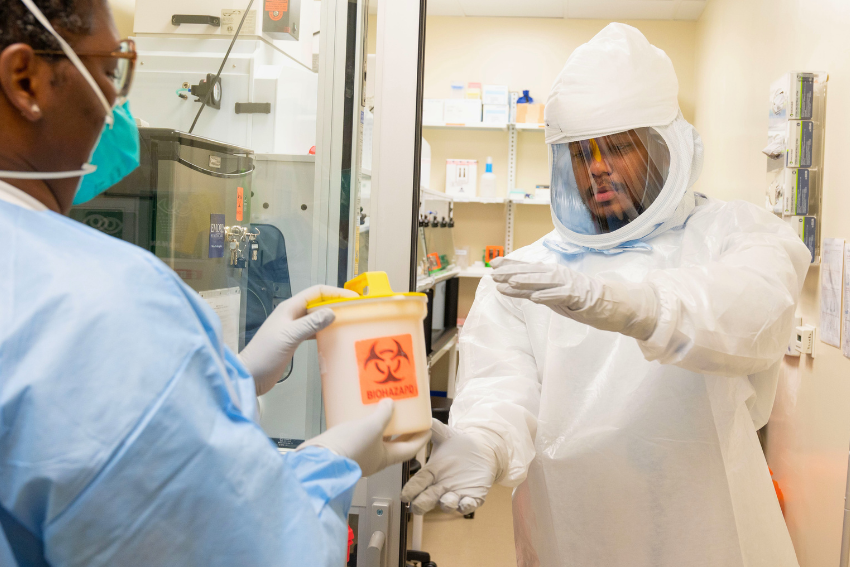
Choosing an appropriate PPE ensemble for the care of a patient suspected of or confirmed with a high-consequence infectious disease (HCID) such as Ebola is an important step in keeping caregivers safe, in addition to the other aspects of the hierarchy of controls for infection prevention. Consider appropriate pieces of PPE readily available through your facilities supply chain. Limit the number of healthcare workers caring for the patient.
For dry (stable) patients under investigation, use eye protection, droplet mask or respiratory protection appropriate to the facility’s protocol, a fluid-resistant gown or coverall (appropriate to State regulations or facility protocols), and double gloves (with the outer pair being extended cuffed if 2 pair of extended cuffed gloves are not available); shoe or boot covers are optional.
For wet (unstable), or confirmed cases, use a total-body-coverage ensemble with head and neck protection, face shield, respiratory protection, level 4 fluid-impervious gown or coverall (appropriate to State regulations or facility protocols), apron, double gloves (with the outer pair being extended cuffed if 2 pair of extended cuffed gloves are not available), and shoe or boot covers.
* Always follow State regulations and/or facility protocols when creating a PPE ensemble for HCID’s.
Facilities should have established donning and doffing checklists appropriate to their PPE ensemble(s) and their space. Use of a trained observer for both donning and doffing are recommended. Doffing requires particular attention because of the risk of self-contamination.
PPE resources: Personal Protective Equipment Featured Resources | Know Your PPE | PPE Matrix for High-Consequence Infectious Diseases | Disaster Available Supplies in Hospitals (DASH) Tool
Laboratory Safety Considerations
Laboratory plans should define what testing can be performed safely, where presumptive and confirmatory testing will occur, and how specimens will move within and outside the facility. Confirm regional testing access, specimen requirements, and referral pathways with public health and regional partners before an activation.
Presumptive testing may be available through Laboratory Response Network public health laboratories and Regional Emerging Special Pathogen Treatment Centers (RESPTCs), with confirmatory PCR testing through CDC. Access and routing vary by region.
Build a clinically useful test menu that supports stabilization and evaluation of common and life-threatening alternative diagnoses while protecting laboratory personnel.
Use a step-by-step biological risk assessment to identify higher-risk activities, such as opening tubes, centrifugation, vortexing, sharps use, and aerosol-generating tasks, and apply appropriate engineering, workflow, PPE, and staffing controls.
Maintain Category A specimen-management and shipping capability, including trained personnel, appropriate packaging and documentation, secure specimen tracking, and advance communication with receiving laboratories.
Listen: Inside Lab Safety: Navigating Special Pathogen Testing from NETEC’s Transmission Interrupted podcast provides additional discussion of biological risk assessment, testing decisions, and laboratory coordination.
The Importance of “Identify, Isolate, Inform, and Initiate”
Use NETEC’s Identify, Isolate, Inform, and Initiate care framework as a repeatable frontline response: practice core actions during steady state, then add disease-specific education and just-in-time training during an activation.
Identify
Screen consistently for symptoms, travel, and relevant exposures, and update staff on triggers for additional evaluation.
Isolate
Provide source control and move patients of concern to appropriate isolation promptly; ensure PPE and trained support are immediately available.
Inform
Notify infection prevention, clinical and laboratory leadership, occupational health, public health, and regional special pathogen partners early.
Initiate care
Begin with the differential diagnosis and provide stabilizing, supportive critical care within facility capabilities while engaging public health and the Level 1 RESPTC early for transfer coordination.
Preparedness Matters
Preparedness improves when teams test plans under realistic conditions, identify gaps, assign corrective actions, and retest.
Use mystery patient drills to measure recognition, isolation, PPE use, communication, and other operational steps, then convert findings into an improvement plan and retest schedule.
Use notice walkthroughs and special pathogen cart audits to verify screening tools, signage, isolation routes, call trees, PPE availability, waste supplies, and current protocols when a full drill is not feasible.
Healthcare coalitions can strengthen regional readiness by convening partners, sharing current information, coordinating exercises, and incorporating lessons learned into infectious disease annexes and training.
Keep situational awareness current through NETEC’s Ebola exhibit and tools such as BEACON and GenomicEpi.
Use Ebola preparedness to strengthen broader high-consequence infectious disease readiness: reliable screening and isolation, trained staff, defined laboratory capabilities, early communication, safe stabilization, practiced transfer pathways, and recurring exercises.
Assess. Exercise. Measure. Correct. Exercise again. That cycle turns preparedness from a plan on paper into an operational capability for Ebola—and for the next emerging special pathogen event.
Additional Resources
- Webinar recording and slides
- NETEC Ebola exhibit
- Personal Protective Equipment Featured Resources
- Know Your PPE
- PPE Matrix for High-Consequence Infectious Diseases
- Disaster Available Supplies in Hospitals (DASH) Tool
- Inside Lab Safety: Navigating Special Pathogen Testing
- NETEC Exercise Templates
- BEACON
- GenomicEpi
Frequently Asked Questions
The following answers address common questions from the live discussion and written Q&A. Apply them using facility-specific risk assessment and in consultation with infection prevention, occupational health, public health, and regional special pathogen partners.
Transmission & Infectious Risk
Does caring for a patient in recommended PPE count as an exposure?
Not by itself. Caring for a patient while wearing the correct PPE, following the facility’s procedures, and completing donning and doffing without a breach does not automatically constitute an exposure. Staff may still participate in symptom monitoring. Any PPE breach, direct contact with blood or body fluids, or other concern should trigger an individualized risk assessment with infection prevention, infectious diseases, caregiver or occupational health, and public health.
Do healthcare workers need to quarantine after caring for a patient with a viral hemorrhagic fever?
Quarantine is generally not required when recommended PPE and processes were followed without a breach or unprotected contact. Because exposure circumstances vary, facilities should use established exposure definitions and coordinate with public health when a potential exposure occurs.
How should organizations make travel or return-to-work decisions related to an affected region?
Use current government and public health guidance and consult the public health authority responsible for the location where the employee will work or return. Outbreak milestones such as the last reported case, discharge of the last patient, and a 42-day countdown require local interpretation. Organizations should also ensure that monitored individuals have access to testing, definitive care, medical countermeasures when available, and basic needs.
Should malaria remain in the differential diagnosis?
Yes. Malaria and other common travel-related illnesses should remain part of the differential diagnosis. Malaria coinfection has occurred in prior Ebola outbreaks, reinforcing the need to plan how malaria testing can be performed or referred safely.
PPE & Infection Control Practices
What PPE should a trained observer wear during doffing?
The answer depends on the observer’s role. A doffing assistant who will touch the healthcare worker or contaminated PPE should wear the same ensemble used for patient care. An observer who remains at least six feet away, provides verbal cues, and has no physical contact may wear a lower-level ensemble selected through the facility’s risk assessment, such as a mask, gown, gloves, and face shield.
How should a facility handle a glucometer used for a patient under investigation?
Point-of-care testing may be performed near the patient when it is the safest and most practical option. Follow the manufacturer’s written disinfection instructions and service-contract requirements. Depending on inventory and facility policy, the device may be removed from general service, retained for future use with patients under investigation, or returned to service after approved decontamination. Plan this process with the point-of-care testing program and the manufacturer before an activation.
What should environmental services plan for terminal cleaning?
Environmental services staff should be included in preparedness activities and trained to use the required PPE and cleaning procedures. Facilities should identify compatible disinfectants, review EPA List L or List Q as appropriate, define roles, and rehearse the terminal-cleaning workflow. The plan should also address waste, reusable equipment, room downtime, and who authorizes re-entry.
What PPE is appropriate when specimens move out of the patient room?
Use the patient-care ensemble in the patient or contaminated zone. As a properly contained specimen is disinfected, double- or triple-packaged, and moved through progressively cleaner zones, PPE can be stepped down according to the facility’s protocol. The final Category A outer package should be assembled in the clean zone.
Laboratory Testing & Specimen Handling
Can a malaria smear be performed without a BSL-3 laboratory?
Perform the work in a biosafety cabinet with additional PPE whenever possible. If a biosafety cabinet is unavailable, the laboratory should conduct a detailed workflow and risk assessment and add controls. Thick smears are not recommended before Ebola is ruled out; thin smears may be fixed in methanol for about 30 minutes before further handling or referral.
Can blood tubes be labeled only on the transport box?
No. Normal identification requirements still apply. Labels with the required patient identifiers should be attached directly to the specimen tubes. Outer packaging and documentation do not replace specimen labeling.
What laboratory controls are most important for routine testing?
Review every step of the planned test. Higher-risk activities include opening tubes, centrifugation, vortexing, sharps, and tasks that may generate aerosols. Controls may include using a biosafety cabinet, changing the testing location or workflow, limiting personnel, using point-of-care equipment, and increasing PPE. The safest approach depends on the instrument, laboratory layout, procedure, and the ability to decontaminate or remove equipment from service.
How should specimens and equipment used before Ebola was suspected be managed?
Identify and secure all specimens, document where they went and who handled them, and prevent further movement until a plan is established. For analyzers or other equipment, follow the manufacturer’s written decontamination and service guidance. Contact the manufacturer when the instructions do not address the scenario.
Treatment & Care
What does stabilizing treatment mean for a frontline facility?
Stabilizing treatment is based on the patient’s condition and the facility’s capabilities. It may include evaluating for malaria, sepsis, and other causes of illness; fluid resuscitation and electrolyte management; antibiotics when indicated; airway and respiratory support; renal support; and other critical care interventions. Facilities should engage public health and their Level 1 RESPTC early, provide care within trained capabilities, and arrange transfer to a Level 1 or Level 2 facility for further treatment.
How should facilities approach decedent management?
Stop nonessential activity, secure the room, and contact public health and facility leadership before proceeding, especially when test results are pending. State requirements vary. The plan should define body preparation, packaging or heat-sealing capability, transport, documentation, PPE, waste, and coordination with the medical examiner or funeral services. NETEC has a decedent-management template for viral hemorrhagic fever patients.
How can a patient be moved within the hospital for essential testing or procedures?
Avoid movement that is not essential. When movement is required, coordinate the route and receiving area, control access, use source control and the required PPE, prepare for spills and waste, and consider a containment wrap or portable isolation unit if appropriate. Contact your Level 1 RESPTC for facility-specific guidance.
Are medical countermeasures available for Bundibugyo virus disease?
No approved vaccine was available for Bundibugyo virus disease as of July 28, 2026. Vaccine and medical countermeasure information may change; consult current public health guidance and the NETEC Ebola exhibit for updates. Preparedness continues to rely on rapid recognition, infection prevention, supportive critical care, public health coordination, and access to definitive treatment.
Preparedness & Response
How can facilities maintain competency between activations?
Treat special pathogen readiness as an institutional safety priority. Use short, focused training that fits operational constraints, and repeat screening exercises, PPE practice, mystery patient drills, and walkthroughs at a sustainable cadence. Start with the highest-risk gaps, measure performance, implement corrective actions, and retest rather than waiting to build a perfect program.
What belongs in a special pathogen cart?
Contents may vary by facility, but a special pathogen cart may include:
- Special Pathogens Response Binder, which may include PPE instructions, room-entry logs, call trees, zone diagrams, waste routes, and transfer procedures.
- Level 1 PPE:
- N95 respirator
- Face shield
- Isolation gown
- Non-sterile gloves (1 pair)
- Level 2/VHF PPE:
- N95 respirator
- Face shield
- Coverall or surgical gown
- Extended-cuff gloves (2 pair)
- Hood
- Mid-calf shoe covers
- Inner shoe covers, if a coverall is used
- Apron
- Disinfection and clinical supplies:
- Germicidal disinfecting wipes
- Bleach disinfecting wipes
- Alcohol-based hand rub
- Single-use disposable thermometer
- Single-use disposable stethoscope
- Selected laboratory supplies
- Absorbent pads and solidifier
- Waste-management supplies
- Containment wrap supplies for patient transfer:
- Flat sheets (2)
- XL surgical sheet
- Small hand sanitizer
- Surgical masks (loop, 2)
- Small red biohazard bag
- Signage:
- Airborne + Contact + Eye Protection isolation signage
- Special Pathogens Level 2 signage
What should facilities check during a notice walkthrough?
Review multilingual signage, screening questions, masking and respiratory stations, the route to the isolation room, staff knowledge of notification procedures, the room and zone configuration, cart contents and expiration dates, access to PPE in appropriate sizes, call trees, waste pathways, and the availability of current protocols.
How can healthcare coalitions support Ebola and special pathogen readiness?
Coalitions can convene hospitals, EMS, public health, laboratories, emergency management, and regional treatment partners; distribute reliable information; coordinate regional exercises; and help organizations use lessons learned to update infectious disease annexes and mutual-aid arrangements.
For additional questions or preparedness support, contact NETEC.