Practical PPE Training Strategies for Special Pathogens Preparedness
Share this article
Preparing healthcare workers to safely use personal protective equipment (PPE) for special pathogens presents a particular training challenge: The events are rare, the stakes are high, and the PPE and workflows may be unfamiliar to frontline staff.
During the NETEC webinar “Practical PPE Training Strategies for Special Pathogens Preparedness,” experts from across the National Special Pathogen System (NSPS) shared approaches for building practical, sustainable PPE training programs—from selecting PPE ensembles and establishing competency expectations to incorporating hands-on practice, exercises, and just-in-time resources.
The discussion was moderated by Jill Morgan, RN, of Emory University Hospital, one of the Region 4 Regional Emerging Special Pathogen Treatment Centers (RESPTCs), and included Brooke Henriksen, BSN, RN, CCRN, Training and Education Coordinator for the Region 10 RESPTC at Providence Sacred Heart Medical Center and Children’s Hospital; Morgan Shradar, MPH, BSN, RN, Nurse Manager and Special Pathogens Program Lead Educator Coordinator for the Region 7 RESPTC and National Quarantine Unit at Nebraska Medicine; Ryan Thatcher, MSN, RN, CMSRN, Clinical Educator for the Corewell Health Special Pathogens Unit, one of the RESPTCs in Region 5; and Bethany Little, BSN, RN, Nursing Operations Director and Training and Education Coordinator at MedStar Washington Hospital Center, one of the RESPTCs in Region 3.
Start With the Front Line
Special pathogen preparedness is not limited to facilities with dedicated biocontainment units or specialized teams. A patient with a suspected high-consequence infectious disease could initially present to an emergency department, urgent care, clinic, labor and delivery unit, or another point of entry.
That makes the fundamentals of identify, isolate, inform, and initiate care essential across healthcare settings.
Hospitals also need appropriate PPE; staff trained in donning and doffing; infection prevention and control procedures; plans for environmental cleaning and waste management; and documentation of education, hands-on training, and competency assessment.
Importantly, competency does not have to look the same at every facility. Organizations should determine how they will assess and document competency based on their own staff, workflows, risks, and existing approaches to other critical clinical skills.
Match the PPE to the Patient—and the People Wearing It
PPE selection should begin with a risk assessment.
For a patient suspected of having a viral hemorrhagic fever (VHF) who is clinically stable and does not have vomiting, diarrhea, or bleeding, PPE recommendations differ from those for a patient who is unstable, has significant body fluids, or has confirmed VHF.
NETEC’s PPE Matrix for High-Consequence Infectious Diseases provides a quick-reference guide to PPE selection for VHFs and other high-consequence infectious diseases.
For a wet, unstable, or confirmed VHF patient, complete body coverage is needed, including respiratory protection, head and neck coverage, face protection, fluid-impermeable body protection, double gloves, and foot protection.
Facilities should also account for applicable state occupational safety requirements, which may exceed baseline recommendations.
But more PPE is not necessarily better PPE.
Complex ensembles such as coveralls can require considerably more training to remove without self-contamination. For frontline teams that may train only annually, an ensemble incorporating PPE they already use regularly may be easier to learn, remember, and safely remove.
As Shradar emphasized at the conclusion of the webinar, training programs need the “staff, the stuff, the space, and the systems” to support what they are asking healthcare workers to do.
For facilities still evaluating PPE options, NETEC’s Know Your PPE guide reviews PPE components and ensembles used when caring for patients with or suspected of having a high-consequence infectious disease.
Consider an All-Hazards Approach
One way to reduce complexity is to standardize PPE where appropriate.
Henriksen described how the Region 10 RESPTC worked with frontline emergency department staff to develop an all-hazards ensemble that could be used for several scenarios rather than asking staff to memorize multiple PPE configurations. The ensemble intentionally incorporates PPE familiar to frontline caregivers, while the specialized biocontainment team trains with a different ensemble and at a much higher frequency.
The strategy reflects an important principle: Design training around the people who will actually need to use it.
A specialized team that practices quarterly can reasonably maintain more complex skills than a frontline employee who may encounter the training once a year.
Build From Skills to Scenarios
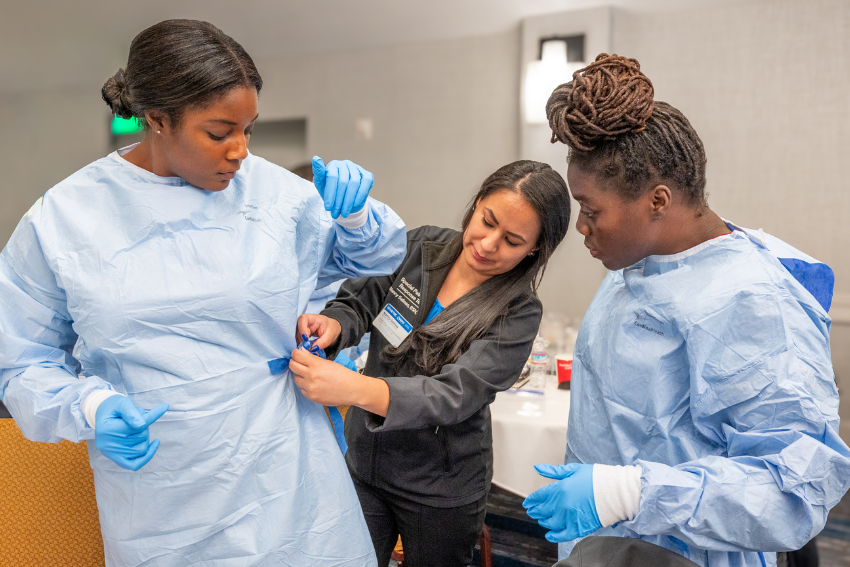
Hands-on practice is critical to PPE competency, but training does not have to begin with a complicated exercise.
At Nebraska Medicine, Shradar described a progression from skill-based learning to scenario-based learning. Facilitators first teach individual skills and explain the rationale behind each step. Staff later apply those skills during realistic patient scenarios, requiring them to work with colleagues from different disciplines and make decisions in PPE.
That progression also allows training to build on competencies staff already use in their regular clinical roles rather than teaching every skill from scratch.
Scenarios can then introduce the additional complexity associated with high-consequence infectious disease care: How do you obtain a portable X-ray without contaminating equipment? How do you collect and process laboratory specimens? How do you manage waste? What happens when a patient needs intubation, proning, obstetric care, or another high-risk intervention?
The goal is not simply to prove that someone can put PPE on and take it off. It is to determine whether teams can safely perform their actual jobs while wearing it.
Make Training Fit Into Existing Workflows
Reaching large numbers of frontline staff can be one of the greatest challenges, particularly across large healthcare systems.
Panelists described several strategies for bringing PPE education to staff rather than relying on a single training format:
- Incorporate PPE into existing annual competency or skills fairs.
- Provide special pathogen education during new employee or department orientation.
- Use staff meetings for focused training.
- Develop online modules and videos that can reinforce knowledge and serve as just-in-time resources.
- Train infection preventionists, educators, charge nurses, or other “super users” who can support staff at individual facilities.
- Integrate special pathogen content into existing required education whenever possible.
At MedStar Washington Hospital Center, one of the Region 3 RESPTCs, Little described how annual special pathogen training for emergency department nurses has been incorporated into an existing required course, reducing the need to create an entirely separate training requirement.
Corewell Health, one of the RESPTCs in Region 5, uses its infection preventionists as important special pathogen preparedness champions across a health system with more than 20 emergency departments. Thatcher explained that infection preventionists receive regular training and can then support teams at their individual sites.
Train Where Care Will Happen
Whenever possible, practice in the actual environment where staff would care for a patient.
Little noted that her team has found training in its biocontainment unit particularly valuable because staff can practice real workflows within the physical constraints of the space. Skills learned in a classroom or mock environment do not always translate perfectly once equipment, room dimensions, clean and contaminated zones, and other operational considerations are introduced.
The same principle applies outside a biocontainment unit. Frontline teams should understand where a suspected patient would go, where PPE would be stored, where donning would occur, how contaminated and clean areas would be established, and where staff could safely doff.
NETEC’s Guidance for Anteroom or Designated Anteareas Within the Facility – Managing the Special Pathogen Patient Care Area provides practical recommendations for establishing these transitional spaces, including zone-based workflows, PPE donning and doffing, personnel roles, waste management, and movement of supplies. Facilities may also find NETEC’s Space Recommendations for Donning and Doffing PPE in Biocontainment Areas useful when planning the physical layout of these areas.
Don’t Skip the Debrief
Training does not end when the PPE comes off.
Little explained that MedStar Washington Hospital Center now reserves the final 20 minutes of its training sessions for a group debrief rather than allowing participants to leave as they finish doffing.
That change has created an opportunity for staff to compare experiences, identify problems, suggest improvements, and learn from one another while the exercise is still fresh.
Debriefs can also help educators identify whether a problem reflects an individual training need or a larger issue with equipment, procedures, space, or workflow.
Plan Ahead—and Make Training Sustainable
Successful training programs require substantial advance planning.
Panelists recommended developing training schedules well before clinical schedules are finalized, communicating dates through channels staff actually use, creating facilitator guides so training remains consistent across sessions, and using continuing education or other professional development opportunities when possible to encourage participation.
Cost is another important consideration.
Several panelists described using expired PPE for training when appropriate and reusing designated training PPE that does not need to be discarded after every session. Some programs assign reusable training components to individual staff members and continue using them until they are damaged or no longer suitable for training.
Facilities should also consider who needs advanced competency and how those individuals can support the broader clinical team. Rather than attempting to provide the same level of intensive training to every emergency department staff member, facilities may identify and train a smaller group of superusers who develop greater proficiency with complex PPE ensembles and can help guide and support colleagues during an activation. This approach can be supplemented with baseline training for broader staff and just-in-time training when an event occurs.
Facilities planning PPE inventories can also use the ASPR TRACIE Disaster Available Supplies in Hospitals (DASH) Tool, which helps healthcare facilities estimate PPE needs based on factors such as patient volume, staffing, and PPE ensembles. NETEC also offers additional DASH training through its PPE resources.
Build Special Pathogen Readiness on Everyday PPE Skills
Perhaps the most immediately actionable recommendation from the webinar was also one of the simplest: Start with the PPE skills healthcare workers already use.
Correctly removing a gown, gloves, face shield, and mask without contaminating yourself is the foundation for more advanced PPE practices. Strengthening those everyday competencies gives organizations a stronger base on which to build special pathogen preparedness.
Early identification remains equally important. The sooner a potentially infectious patient is recognized and isolated, the sooner source control can be implemented and staff can use appropriate PPE.
For teams training on a dry or suspect VHF ensemble, NETEC’s PPE Donning and Doffing: Non-PAPR Dry and Suspect Viral Hemorrhagic Fever resource provides step-by-step guidance that can be incorporated into staff education and hands-on training.
Special pathogen PPE training does not need to begin with the most complicated ensemble or the largest exercise. It can begin with strong everyday infection prevention practices, a realistic assessment of what frontline staff need to know, and repeated opportunities to practice the skills that matter most.
Questions and Answers
The webinar generated dozens of questions from participants. Below are answers to several of the practical questions raised during the session.
How often should frontline staff train on special pathogen PPE?
There is no single cadence appropriate for every facility or role. Henriksen described annual training for frontline emergency department staff, supplemented by online and just-in-time resources and additional exposure during orientation. Specialized biocontainment teams generally train more frequently. Facilities should determine the frequency needed to establish and maintain competency for the PPE and responsibilities assigned to each group.
Does every staff member need to put on VHF-level PPE during orientation?
Not necessarily. One approach is to provide broad awareness education while targeting nurse leaders, educators, infection preventionists, or other designated staff for additional hands-on training. Just-in-time training can supplement preparedness for staff who are unlikely to need advanced PPE skills routinely.
How can facilities address staff anxiety about caring for patients with VHF?
Hands-on training can help staff understand both what protection is needed and why more PPE is not always safer. Thatcher described demonstrating the difference between simpler and more complex ensembles—including the difficulty of safely doffing a coverall-based ensemble—to help staff understand why PPE should be matched to the patient’s condition and the worker’s training.
Should facilities use gowns or coveralls?
Either may be appropriate depending on the situation, regulatory requirements, and facility protocols. From a training perspective, gowns are more familiar to many healthcare workers and can be easier to remove safely. Coveralls may require substantially more practice to reach and maintain competency. Facilities should consider not only protection but also the complexity of donning and doffing and how frequently staff can realistically train.
NETEC’s Know Your PPE guide and PPE Matrix for High-Consequence Infectious Diseases can help facilities evaluate PPE options.
Can a CAPR be used instead of a PAPR?
A CAPR is a type of powered air-purifying respirator (PAPR). Facilities should ensure that the equipment and any associated components are appropriate for infectious disease use and consistent with their selected ensemble and protocols.
Can expired PPE be used for training?
Expired PPE can be a useful training resource when it remains suitable for practice and is clearly separated from clinical stock. Expiration dates are determined by manufacturers and may not always be readily visible on packaging, so facilities should consult the manufacturer when necessary.
How can facilities reduce the cost of PPE training?
In addition to using expired PPE when appropriate, Shradar and Little described designating reusable training PPE for individual staff members. Items such as training gowns, suits, hoods, boots, or boot covers may be reused until they become damaged or unsuitable. Programs can also reduce costs by incorporating training into existing competencies and using trained staff members to help facilitate future education.
Should a disinfectant tray be used when leaving a doffing area?
The panel noted that evidence supporting disinfectant trays or chemical mats is limited. Other strategies for reducing the risk of tracking contamination include removing shoe or boot covers early in the doffing process, using additional shoe covers over integrated coverall socks, or using a seated “sit-and-swivel” approach that separates contaminated and cleaner areas.
What PPE should be available in an ED triage area?
One panelist’s facility keeps dry VHF PPE available in triage and the emergency department so staff can quickly access an appropriate ensemble when a suspect patient is identified. Facilities should develop protocols based on their own risk assessment, PPE selection, workflows, and applicable requirements.
The PPE Matrix for High-Consequence Infectious Diseases can support those planning discussions.
Are additional precautions needed when moving a suspect patient from triage to an AIIR?
For a patient with vomiting, diarrhea, or another risk of fluid contamination, a containment wrap or fluid-resistant sheet may be considered. A clinically stable “dry” patient may not require a wrap; the panel recommended placing a mask on the patient and minimizing contact with surfaces during transport.
How should smaller or critical access hospitals approach PPE training?
Focus on the functions staff are most likely to perform, particularly identify, isolate, inform and appropriate PPE use at the point of entry. Collaboration can make training more manageable: infection preventionists can work with professional development staff or nurse educators, and facilities can develop ED “super users” who receive additional training and help support their colleagues.
Who should serve as PPE “super users”?
Facilities can train nurse managers, assistant nurse managers, charge nurses, educators, infection preventionists, or other willing staff members. Super users should understand the facility’s selected PPE ensemble, donning and doffing checklists, and how to establish the designated donning and doffing space.
Does The Joint Commission require a particular training format?
Jill Morgan explained that organizations are expected to demonstrate competency, but the specific approach is determined by the organization. Facilities should establish what competency means for their program and document education, hands-on training, and competency assessment.
Do environmental services staff need to perform the initial cleaning after care of a VHF patient?
Panelists noted that at many RESPTCs, trained clinical staff in appropriate PPE perform initial cleaning and waste handling. Environmental services personnel may enter after primary—and sometimes secondary—cleaning and removal of waste and linens to complete more routine cleaning tasks. Some facilities may also use specialized terminal decontamination services.
NETEC’s Cleaning and Disinfecting Patient Rooms resource provides additional guidance on systematic cleaning and disinfection of patient rooms and frequently touched surfaces.
Should laboratory staff wear full PPE when handling specimens from a patient with suspected Ebola?
The panel recommended that laboratory staff processing specimens from a patient with suspected Ebola use appropriate full PPE and work under a hood. Individual facilities should establish laboratory PPE and specimen-handling protocols based on their risk assessment and procedures.
How large should the zones around a doffing area be?
There is not one prescribed dimension. One panelist recommended making the yellow zone large enough for both the trained observer and the person doffing to occupy the space and move through the entire doffing process without touching one another.
For additional planning guidance, see NETEC’s Guidance for Anteroom or Designated Anteareas Within the Facility – Managing the Special Pathogen Patient Care Area, which addresses zone-based workflows and considerations for facilities that need to establish designated anteareas for special pathogen care.
How long should staff remain in PPE?
The answer depends on the PPE ensemble, working conditions, staff tolerance, and facility protocols. Morgan emphasized that staff should remain in PPE only as long as they can do so safely. Programs should test their selected ensembles during training to understand how heat, respiratory protection, workload, and other factors affect safe wear time.
Where should infection preventionists or educators at smaller facilities begin if they are responsible for PPE training?
Start by partnering with emergency department staff to select an ensemble that works for the facility’s environment and workforce. Then map the donning and doffing process, including exactly where each step will occur. Facilities without an anteroom may need to establish temporary zones in an adjacent hallway or other space.
NETEC’s Guidance for Anteroom or Designated Anteareas Within the Facility can help facilities think through these space and workflow considerations. From there, training can build progressively from routine PPE competency to special pathogen-specific procedures.
NETEC PPE Resources
NETEC’s Personal Protective Equipment (PPE) Featured Resources page brings together guidance, tools, videos, webinars, and printable resources to support PPE selection, training, donning and doffing, and preparedness.
Featured resources include:
- Know Your PPE
- PPE Matrix for High-Consequence Infectious Diseases
- PPE Donning and Doffing: Non-PAPR Dry and Suspect Viral Hemorrhagic Fever
- Guidance for Anteroom or Designated Anteareas Within the Facility – Managing the Special Pathogen Patient Care Area
- Space Recommendations for Donning and Doffing PPE in Biocontainment Areas
- Cleaning and Disinfecting Patient Rooms
- ASPR TRACIE Disaster Available Supplies in Hospitals (DASH) Tool
Questions about special pathogen preparedness or PPE training? Contact NETEC for technical assistance and support.