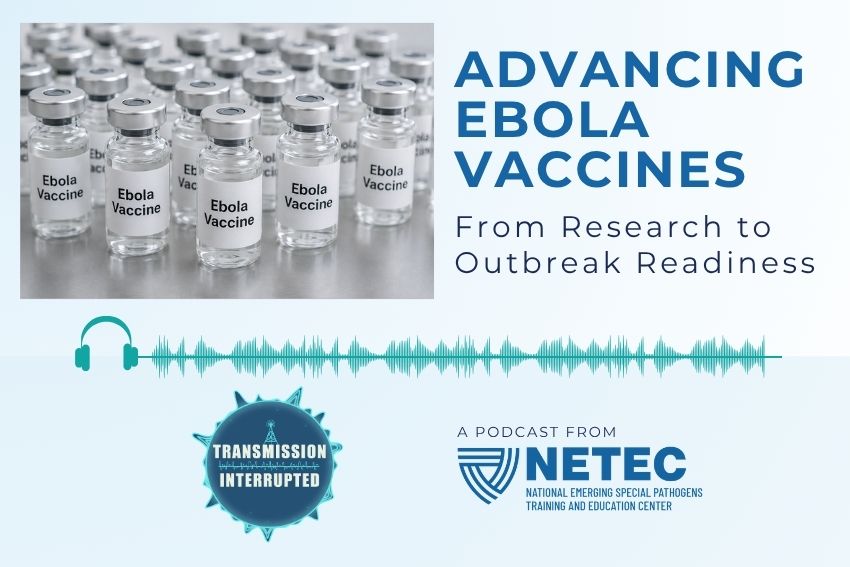
Advancing Ebola Vaccines: From Research to Outbreak Readiness
Share this article
As the current Ebola outbreak in the Democratic Republic of the Congo and Uganda continues to spread — with over 2,000 cases and more than 600 deaths — host Jill Morgan sits down with Dr. Tom Geisbert, a leading virologist and professor at the University of Texas Medical Branch (UTMB) in Galveston.
Dr. Geisbert has spent decades developing vaccines for some of the world’s deadliest pathogens, including the vaccine that became Ervebo, the first licensed Ebola vaccine. In this episode, he explains why a vaccine that works against one Ebola species — like the current outbreak’s Bundibugyo strain — doesn’t necessarily protect against another, and why a promising Bundibugyo vaccine developed over a decade ago has been sitting on the shelf for lack of funding and market interest.
Jill and Dr. Geisbert break down the science behind mRNA and viral-vector (VSV-based) vaccine platforms, weighing their tradeoffs in speed, durability, and manufacturing complexity — and discuss why fast-acting, single-dose protection matters so much in outbreak response and ring vaccination strategies.
The conversation also turns to other high-consequence pathogens on Dr. Geisbert’s radar, including Nipah virus, and to the bigger picture: what true pandemic preparedness would look like, from broad-spectrum antivirals to multivalent vaccines, and why investing in the next generation of scientists is critical to staying ahead of the next outbreak
Questions or comments for NETEC? Contact us.
Visit Transmission Interrupted on the web.
Guest
Thomas Geisbert, PhD
Professor, Department of Microbiology & Immunology
University of Texas Medical Branch – Galveston, Texas, USA
Dr. Geisbert is currently a Professor in the Department of Microbiology & Immunology at the University of Texas Medical Branch in Galveston. He has considerable experience conducting experiments utilizing NHPs in high biocontainment, with over 29 years’ BSL-4 experience at USAMRIID and at the GNL. He has experience managing large research programs, including a current U19 Center of Excellence for Translational Research grant. His research interests have focused on the study of hemorrhagic fever viruses and he has published extensively in this area. His research group was the first to demonstrate complete protection of NHPs against both Ebola and Marburg viruses and Lassa virus using a novel vaccine based on recombinant VSV. More recently, they demonstrated that this vaccine is capable of providing postexposure protection against filoviruses in NHPs. His group also performed the first studies to show complete postexposure protection of NHPs against the Zaire species of Ebola virus using a novel siRNA-based strategy. In addition, he has extensive experience in developing and refining appropriate animal models that mimic human disease, including the NHP model used in this project.
Host
Jill Morgan, RN
Emory Healthcare, Atlanta, GA
Jill Morgan is a registered nurse and a subject matter expert in personal protective equipment (PPE) for NETEC. For 35 years, Jill has been an emergency department and critical care nurse, and now splits her time between education for NETEC and clinical research, most of it centering around infection prevention and personal protective equipment. She is a member of the Association for Professionals in Infection Control and Epidemiology (APIC), ASTM International, and the Association for the Advancement of Medical Instrumentation (AAMI)
Resources
- NETEC – Ebola Resources Exhibit
- NETEC – SBAR: Ebola Bundibugyo Virus Disease
- NETEC – FAQ: Ebola Disease (EVD)
- NETEC – Resource Library
- Transmission Interrupted Podcast
About NETEC
A Partnership for Preparedness
The National Emerging Special Pathogens Training and Education Center’s mission is to set the gold standard for special pathogen preparedness and response across health systems in the U.S. with the goals of driving best practices, closing knowledge gaps, and developing innovative resources.
Our vision is a sustainable infrastructure and culture of readiness for managing suspected and confirmed special pathogen incidents across the United States public health and health care delivery systems.
For more information, visit NETEC on the web.
NETEC Consultation Services
Assess and Advance Your Readiness for Special Pathogens with Free, Expert Consulting.
NETEC offers free virtual and onsite readiness consulting to help health care facilities and EMS agencies prepare for special pathogen events. Our targeted support services are delivered by experts selected and assigned to each inquiry based on the unique needs of your organization. Have a question? Ask a NETEC expert.
For more information, visit NETEC Consulting Services.
Transcript
Jill Morgan (2): Hello, and welcome to Transmission Interrupted.
Speaker:My name is Jill Morgan.
Speaker:I'm a nurse here at Emory University Hospital in Atlanta.
Speaker:For those of you not yet familiar with NETEC, our mission is to set the gold
Speaker:standard for special pathogen preparedness and response across health systems in
Speaker:the U.S., with the goals of driving best practices and closing knowledge gaps
Speaker:and developing innovative resources.
Speaker:NETEC works alongside and in cooperation with the CDC, and is
Speaker:funded by ASPR, the Administration for Strategic Preparedness and Response.
Speaker:And along the lines of response, we are thinking about this terrible
Speaker:outbreak, of Ebola, one of the strains of Ebola in the Democratic Republic
Speaker:of the Congo and, Uganda right now, where we have over two thousand cases
Speaker:and , just over six hundred deaths.
Speaker:I am thrilled to be able to talk today with Dr. Tom Geisbert, who's a professor
Speaker:in the Department of Microbiology and Immunology at University of Texas Medical
Speaker:Branch in Galveston, otherwise known as UTMB, where he is a researcher about
Speaker:vaccines for exactly this kind of thing.
Speaker:So really excited to hear what the latest progress is on this and maybe give us
Speaker:a little bit of insight into just how difficult it is for us to create vaccines
Speaker:for some of these special pathogens.
Speaker:So welcome.
Speaker:Thank you, Dr. Geisbert, for joining us today.
Tom Geisbert:Good to be here.
Tom Geisbert:Jill Morgan (2): So as we mentioned, it's a terrible outbreak right now that's still
Tom Geisbert:simmering, has not really been contained.
Tom Geisbert:Things like contact tracing, some of the things, the tools we would normally like
Tom Geisbert:to have, are really difficult in this environment and, both physically on the
Tom Geisbert:ground and in remote areas, but also with, the loss of some of the expertise over
Tom Geisbert:the years and, the resources to really put a lot of people on the ground, which
Tom Geisbert:is what it takes to trace every contact.
Tom Geisbert:And that leaves us in a situation of having very few tools at our
Tom Geisbert:disposal for an outbreak like this.
Tom Geisbert:But we do have an Ebola vaccine for one of the strains of Ebola.
Tom Geisbert:So can you back up a little bit for people and, tell us a little bit
Tom Geisbert:about why one vaccine doesn't work for another strain and where you are on
Tom Geisbert:developing a vaccine for this new strain,
Tom Geisbert:or new strain, but different strain?
Tom Geisbert:Yeah.
Tom Geisbert:As you may know, there are six different species or strains of,
Tom Geisbert:Ebola virus, and four of those cause disease in humans, and three of them
Tom Geisbert:have caused lethal disease in humans.
Tom Geisbert:And they're genetically different.
Tom Geisbert:And so there's, 30-something percent difference at the, protein
Tom Geisbert:or nucleotide amino acid level, between these different strains.
Tom Geisbert:So it's if, you're familiar with COVID vaccines, and I think
Tom Geisbert:a lot of people are, right?
Tom Geisbert:And you have a new variant pops up, and all of a sudden, the vaccine
Tom Geisbert:that protected against this one doesn't protect against that one.
Tom Geisbert:So in layman's terms, it's a s- a similar story with Ebola.
Tom Geisbert:Ebola that were identified in:Tom Geisbert:we know as zaire and Sudan, and most people refer to Zaire's as ebola.
Tom Geisbert:A lot of work, was done on those, particularly Ebola, because these
Tom Geisbert:outbreaks were sporadic, and they would pop up sporadically
Tom Geisbert:in different parts of Africa.
Tom Geisbert:And they were, as you noted, they were really controlled well by
Tom Geisbert:contract tracing in the beginning.
Tom Geisbert:And up until:Tom Geisbert:ll of a sudden in December of:Tom Geisbert:really hit hard, where we had this big epidemic with 28,000 cases.
Tom Geisbert:We had, a case that was imported in, Dallas, Texas, and so that
Tom Geisbert:really caused a lot of attention.
Tom Geisbert:But up until that time, a lot of work had been done on this one particular
Tom Geisbert:species, or I guess a, lot of people would call strain, of, Ebola.
Tom Geisbert:And we actually had a lot of success.
Tom Geisbert:I worked for the Army for 23 years, and, we had a lot of failures in the beginning,
Tom Geisbert:and we learned from those failures.
Tom Geisbert:You get something that would protect a small animal, and then all of a sudden,
Tom Geisbert:you test it in a non-human primate, which is really the, gold standard animal
Tom Geisbert:model for, looking at, at human disease.
Tom Geisbert:And then, and, so there was a lot of failures early on, and then around
Tom Geisbert:2000, a colleague and I, Heinz Feldmann and I, more he than me,
Tom Geisbert:came up with this, the vaccine that we now know is licensed as Ervebo.
Tom Geisbert:But that vaccine was developed to protect against the most common
Tom Geisbert:Zaire species that caused the:Tom Geisbert:ed that vaccine, in the early:Tom Geisbert:that it worked very well in animals.
Tom Geisbert:And then it just sat there on the shelf because there was
Tom Geisbert:really a small global market.
Tom Geisbert:It's not a moneymaker for a big company, right?
Tom Geisbert:and because that epidemic in:Tom Geisbert:was so large, Merck did the right thing, and they, basically made a
Tom Geisbert:human-grade version of that, that became a licensed vaccine, Ervebo.
Tom Geisbert:But the challenge with that particular vaccine is just because it protects
Tom Geisbert:against this one particular type of Ebola It doesn't mean it's
Tom Geisbert:gonna protect against others.
Tom Geisbert:So the current outbreak in,:Tom Geisbert:that was first identified in:Tom Geisbert:We actually developed a vaccine for that particular species of Ebola.
Tom Geisbert:I came to UTMB in:Tom Geisbert:in:Tom Geisbert:Bundibugyo works against Bundibugyo.
Tom Geisbert:But you don't get, often get cross-protection among the
Tom Geisbert:different species, so that, that's the challenge here.
Tom Geisbert:Jill Morgan (2): So fascinating.
Tom Geisbert:So you have what you think is an effective vaccine, at least to
Tom Geisbert:the extent you can test it in this setting and it sits on a shelf because
Tom Geisbert:there's not an outbreak, there's not an interest, there's not a market.
Tom Geisbert:And here's this potential magic potion, And I get it that it's not magic, right?
Tom Geisbert:It-- there's a lot of work in that, and it's not 100% guaranteed, but
Tom Geisbert:there's this really good nugget there.
Tom Geisbert:How frustrating must it be to know you've got that in your back pocket
Tom Geisbert:when something like this happens?
Tom Geisbert:I mean, 600 people have died, and we might have something that could
Tom Geisbert:keep more people from dying.
Tom Geisbert:How do we… I, I can't imagine your position of, dedicating your life to this
Tom Geisbert:work and then, like I know you don't wish for outbreaks, but there's gotta
Tom Geisbert:be almost like a positive side to an outbreak that it actually makes people
Tom Geisbert:pay attention to some of these things.
Tom Geisbert:Yeah, it's, very frustrating.
Tom Geisbert:Thinking back to when Heinz Feldmann and I first did all this early work
Tom Geisbert:in the early:Tom Geisbert:vaccine, Ervebo, used in:Tom Geisbert:during the Ebola epidemic in West Africa.
Tom Geisbert:And I would like to think that it, made a difference, in helping
Tom Geisbert:to end or curtail that outbreak.
Tom Geisbert:And it's extremely frustrating.
Tom Geisbert:And for the current, the Bundibugyo species of Ebola, we had a vaccine
Tom Geisbert:made back in:Tom Geisbert:good as what we had done for Ervebo.
Tom Geisbert:And so yeah, it was really frustrating.
Tom Geisbert:Very frustrating.
Tom Geisbert:Jill Morgan (2): Yeah.
Tom Geisbert:it's amazing, that the good that people dedicate their lives to.
Tom Geisbert:And, we just, I think through our own ignorance sometimes don't,
Tom Geisbert:pay enough attention to that.
Tom Geisbert:And of course, everybody who listens to this podcast that is in emergency
Tom Geisbert:management and preparedness is aware of that kind of, we, tend
Tom Geisbert:to just react to things instead of being proactive about them.
Tom Geisbert:But, you mentioned having this vaccine.
Tom Geisbert:Where are we now with this being made for this outbreak?
Tom Geisbert:Or what would be the timeline if, that in fact could be done now?
Tom Geisbert:Yeah.
Tom Geisbert:at history taught us from the:Tom Geisbert:'16 epidemic in West Africa, where, Merck jumped in and, being a large company,
Tom Geisbert:and again, I think did the right thing.
Tom Geisbert:And, we had a research grade material vaccine that we made for lab experiments,
Tom Geisbert:but it wasn't suitable to put into humans.
Tom Geisbert:So, they jumped in and did that, It took about eight or nine months from
Tom Geisbert:the time that they started to prepare a vaccine that would be suitable
Tom Geisbert:for use in humans till the time it went into humans at that outbreak.
Tom Geisbert:And so I think that's where the starting point now.
Tom Geisbert:Hopefully, there's been a lot of lessons learned from that and hopefully
Tom Geisbert:that time period can be shortened.
Tom Geisbert:And there's different types of vaccines.
Tom Geisbert:Right now, there's four vaccines that I'm aware of that are being advanced,
Tom Geisbert:for the Bundibugyo species of Ebola to hopefully help with this outbreak.
Tom Geisbert:We don't have no idea how long this outbreak is gonna last.
Tom Geisbert:Two of those are, developed or are based on the same technology as Ervebo.
Tom Geisbert:It's a recombinant vesicular stomatitis virus backbone, vaccine.
Tom Geisbert:And then there's two others.
Tom Geisbert:There's an mRNA vaccine, and then there's a, chimpanzee adenovirus-based vaccine.
Tom Geisbert:So they're viral vector vaccines except for the mRNA.
Tom Geisbert:And, the vaccine that we developed, here with a lot of help from Heinz
Tom Geisbert:Feldmann and Andrea Marzi at Rocky Mountain Labs, there's a organization
Tom Geisbert:called IAVI, that is moving that vaccine forward and making a clinical grade.
Tom Geisbert:They got some funding from CEPI, to move that forward and hopefully, I, don't know
Tom Geisbert:what the exact timeline is, but I would expect it to be, somewhere in that seven,
Tom Geisbert:eight-month timeline, hopefully sooner.
Tom Geisbert:mRNA vaccines, and I think CEPI is funding one of the,
Tom Geisbert:M-mRNA vaccine for Bundibugyo.
Tom Geisbert:mRNA vaccines can be made a lot faster.
Tom Geisbert:but there's, I'm guessing in months or several months or so, but then, you
Tom Geisbert:get into advantages and disadvantages with every different vaccine platform.
Tom Geisbert:Some perform better than others, some work quicker than others.
Tom Geisbert:There's a lot of things there to think about.
Tom Geisbert:But yeah, it's take a little time.
Tom Geisbert:Jill Morgan (2): Yeah, and can we go into that for just a minute?
Tom Geisbert:Just 'cause I think we have a fair number of people who, remember
Tom Geisbert:or were introduced to the idea of mRNA vaccines really during COVID.
Tom Geisbert:That's when the term became, something that we saw on a daily
Tom Geisbert:basis during the COVID pandemic.
Tom Geisbert:And so these are messenger RNA vaccines, and I think of them as a little like
Tom Geisbert:going back to the old, Mission Impossible where, there was something that you
Tom Geisbert:got one little piece of information, and then it said "this message will
Tom Geisbert:self-destruct in 30 seconds," or whatever.
Tom Geisbert:I think my, husband, who's a big movie fan, would say, almost like, probably
Tom Geisbert:something like Game of Thrones, where they don't want anybody on the cast
Tom Geisbert:to know the whole story, so they only give everybody their own little piece.
Tom Geisbert:So an mRNA vaccine basically is one little piece that tells your
Tom Geisbert:cells to make this sort of protein, and then it self-destructs.
Tom Geisbert:So it's maybe fast to work and then goes away.
Tom Geisbert:And a VSV vaccine, which you mentioned earlier, which is the vesicular stomatitis
Tom Geisbert:virus, we're taking something that's a, maybe a weaker or less pathogenic
Tom Geisbert:virus, and we're modifying it.
Tom Geisbert:We're, like inserting a little direction to tell it what to respond
Tom Geisbert:to so that your immune system is primed for that particular thing.
Tom Geisbert:And like we've talked about, little protein spikes or
Tom Geisbert:whatever, but to recognize an invader when it hits your system.
Tom Geisbert:You did a great job of explaining that.
Tom Geisbert:Yeah, a VSV vaccine that, we use for, say, Ebola, VSV is in the same
Tom Geisbert:family of viruses as rabies virus.
Tom Geisbert:It looks like a bullet.
Tom Geisbert:It's kind of bullet-shaped.
Tom Geisbert:And then basically we just insert a gene so that, we take out a gene
Tom Geisbert:for the surface protein of, the VSV, and we insert the gene that makes
Tom Geisbert:the surface glycoprotein of Ebola.
Tom Geisbert:So you have this thing that looks like a bullet, but it's got Ebola
Tom Geisbert:spikes coated all around the surface.
Tom Geisbert:So it tricks your body.
Tom Geisbert:Your body thinks when, this is used as a vaccine, your body thinks it's
Tom Geisbert:seeing real Ebola, but it's not.
Tom Geisbert:And, so then you develop a strong immune response, and because, you did a great job
Tom Geisbert:with the mRNA kind of self-destructing, this doesn't quite do that.
Tom Geisbert:This, basically replicates or it grows through a few cycles, and so you
Tom Geisbert:get a much stronger immune response.
Tom Geisbert:So, again, looking at the advantages of mRNA, one of the advantages of mRNA
Tom Geisbert:vaccines is, it's a production issue.
Tom Geisbert:You can make large quantities in a really quick period of time versus
Tom Geisbert:some of these viral vectored vaccines where, I'm not a manufacturer.
Tom Geisbert:I've known more, I've learned more over the last several decades as a virologist
Tom Geisbert:in manufacturing than I ever want to know.
Tom Geisbert:But, it's a little more tricky, to make a viral vectored vaccine that's
Tom Geisbert:suitable for use in humans and to scale up and that kind of thing.
Tom Geisbert:So that's a disadvantage.
Tom Geisbert:But then the huge advantage of the viral vectored vaccines is they give just much
Tom Geisbert:better immunity in my personal opinion.
Tom Geisbert:and you saw that with Ervebo.
Tom Geisbert:So in other words, you can give like a VSV-based vaccine.
Tom Geisbert:We can actually give that vaccine to a non-human primate shortly
Tom Geisbert:after exposure and still protect a large number of, animals.
Tom Geisbert:You know how the rabies vaccine is used as if you're exposed to an
Tom Geisbert:animal with rabies, they give you the vaccine even after you're exposed.
Tom Geisbert:And so it works really quickly.
Tom Geisbert:And, we and, others have done studies in non-human primates with these VSV
Tom Geisbert:vaccines where it's saying the window between when you give the vaccine and
Tom Geisbert:when it works is several days versus an mRNA vaccine where y- a lot of times
Tom Geisbert:people remember this from COVID, right?
Tom Geisbert:You have to go back and get a booster shot and maybe another booster shot.
Tom Geisbert:That's not the case with the VSV-based vaccines.
Tom Geisbert:They work, single injection, less than a week later, you're probably gonna be,
Tom Geisbert:completely protected to most realistic exposure routes and doses of virus.
Tom Geisbert:So maybe if you stick yourself with a needle or something really high risk,
Tom Geisbert:that would be a little different, but they're gonna work really well,
Tom Geisbert:and I think we saw that again, when you look in an outbreak situation.
Tom Geisbert:The best way to control these outbreaks is to intervene quickly and have
Tom Geisbert:something that works quickly because you have a situation where maybe
Tom Geisbert:you've got a cluster of people over here that where have an Ebola case.
Tom Geisbert:Somebody died with Ebola, and they were, had five or six people that
Tom Geisbert:were, they were exposed to, and you don't know if those people were really
Tom Geisbert:exposed or not, or whether they're gonna be infected and live or die.
Tom Geisbert:But you can get in quickly and then you vaccinate those people in a ring
Tom Geisbert:vaccination strategy, which I think a lot of people are familiar with, and
Tom Geisbert:you vaccinate the contacts of contacts, contact tracing's really important.
Tom Geisbert:That's how you can really control these outbreaks and end them.
Tom Geisbert:And so I think, some of these vaccines, like maybe the mRNA vaccines could be
Tom Geisbert:okay for medical workers where you have time and you vaccinate people here or
Tom Geisbert:wherever people are responding from in Europe, and you vaccinate them, you wait
Tom Geisbert:a month, then you boost them, and then you send them into the hot zone, so to speak.
Tom Geisbert:So for those kinds of situations where medical staff maybe vaccines that,
Tom Geisbert:take a little bit longer to mount a protective immune response are okay.
Tom Geisbert:But what, in my opinion, what you really need to really best contain these
Tom Geisbert:outbreaks is something that works quickly.
Tom Geisbert:Jill Morgan (2): Yeah.
Tom Geisbert:Yeah.
Tom Geisbert:And I think for those people thinking about like, what's the more-- what mimics
Tom Geisbert:our own natural, immune response more?
Tom Geisbert:When I think back to, of course, the sort of the, almost fabled story
Tom Geisbert:of vaccines with, the milkmaids not having smallpox and the idea that
Tom Geisbert:it was basically saying if there's a weaker version of this pathogen,
Tom Geisbert:which in that case was cowpox, right?
Tom Geisbert:That it could give you protection against smallpox, which was
Tom Geisbert:ravaging the world at the time.
Tom Geisbert:That's a bit of what these VSV vaccines are doing.
Tom Geisbert:We're just helping them along by inserting the bits of the viruses
Tom Geisbert:that are a problem at the time
Tom Geisbert:Absolutely.
Tom Geisbert:Absolutely.
Tom Geisbert:And if, you're familiar, I think a lot of people that travel are familiar
Tom Geisbert:with yellow fever vaccine, right?
Tom Geisbert:A lot of us have had that.
Tom Geisbert:If you travel internationally, a lot of countries require it.
Tom Geisbert:That's a crippled, weakened virus.
Tom Geisbert:It's just a crippled form of yellow fever that doesn't cause disease, And
Tom Geisbert:think about how great that vaccine is.
Tom Geisbert:That vaccine's one of the better vaccines that's, to, to me, polio.
Tom Geisbert:There's a lot of these vaccines where, yellow fever is good for what?
Tom Geisbert:10 years or something.
Tom Geisbert:So you're not constantly getting boosted because it's a crippled form, so it does
Tom Geisbert:a much better job of tricking your body.
Tom Geisbert:Jill Morgan (2): Yeah.
Tom Geisbert:That's just amazing.
Tom Geisbert:So I want to pivot just for a second because I'm sure this is not the only
Tom Geisbert:thing that you're working on, and I know there are other pathogens out there
Tom Geisbert:that I think about things like, there was a case recently of Nipah in Kerala.
Tom Geisbert:We haven't heard anything about Hendra for a very long time,
Tom Geisbert:and let's hope we never do.
Tom Geisbert:But that family of viruses are out there as well.
Tom Geisbert:What other things are simmering somewhere in your lab or in your mind that we
Tom Geisbert:might be tapping into when there's another outbreak a year from now?
Tom Geisbert:Yeah, you nailed it.
Tom Geisbert:We're doing a lot of work on Nipah right now, and I think there's a lot of concern.
Tom Geisbert:That was actually chosen to be the virus that was used for the movie "Contagion."
Tom Geisbert:And I think because there's evidence that it's transmitted through the air, so there
Tom Geisbert:can be per-person-to-person transmission.
Tom Geisbert:Unfortunately, because you have huge mortality rates with Nipah, you're looking
Tom Geisbert:at 70% up to certain small outbreaks have, been nearly 100%, So that's
Tom Geisbert:one that we're very concerned about.
Tom Geisbert:It's a tier one pathogen.
Tom Geisbert:And again, I think that's, that's something that I worry about the most.
Tom Geisbert:I worry about that more than Ebola, honestly, because Ebola,
Tom Geisbert:you and I could be sitting next to each other, and I'm probably not
Tom Geisbert:gonna give you Ebola if I have it.
Tom Geisbert:It's not-- It's transmitted by close contact.
Tom Geisbert:It's mostly mucosal, like secretions, blood, things like that.
Tom Geisbert:So you have to have really close contact.
Tom Geisbert:But Nipah worries me a lot more because of just the potential,
Tom Geisbert:because it's respiratory.
Tom Geisbert:It starts out, people get infected with, Nipah.
Tom Geisbert:We see the same thing in laboratory animals.
Tom Geisbert:It starts in the respiratory tract, and you get a really,
Tom Geisbert:like a ARDS-like syndrome.
Tom Geisbert:And, it can get into the central nervous system, which is, you get neuropathology,
Tom Geisbert:and we've seen that particularly with Hendra, the sister virus.
Tom Geisbert:I'm much more worried that Nipah could have the potential to cause
Tom Geisbert:problems because of potential for airborne transmission.
Tom Geisbert:Again, fortunately, it hasn't happened yet, but it's a concern.
Tom Geisbert:Jill Morgan (2): Yeah.
Tom Geisbert:And certainly Nipah is an interesting one because we have both the date
Tom Geisbert:palm, the juice and fruit from the date palms that can contaminate with
Tom Geisbert:virus, and then also like the-- where it was initially discovered, I think
Tom Geisbert:in Malaysia, when the swine were eating the contaminated dates or fruit that had
Tom Geisbert:fallen, and then the people who worked with the pigs were getting, infected.
Tom Geisbert:And so, we think about contact with bats, and of course I don't think we've-- we
Tom Geisbert:haven't actually narrowed down exactly who the reservoir for Ebola is specifically.
Tom Geisbert:But, we think about it being in bats.
Tom Geisbert:But here we have multiple ways that this could infect people.
Tom Geisbert:And so even the things I think about with preparedness of what questions to ask
Tom Geisbert:somebody, Well, if I'm screening them and they haven't had any exposure to date palm
Tom Geisbert:sap, but maybe they have pigs at home or they have, like it, just gets so much more
Tom Geisbert:complicated to try to screen that out.
Tom Geisbert:And then I think as every ER nurse or, ICU nurse knows that dealing with people
Tom Geisbert:who have some sort of encephalopathy, that's really difficult, right?
Tom Geisbert:They may not know what they're doing.
Tom Geisbert:They may be confused.
Tom Geisbert:Getting a good history is difficult.
Tom Geisbert:And even just evaluating like what their exposure history might
Tom Geisbert:have been is such a challenge.
Tom Geisbert:So I think Nipah, for me, is also a really scary one.
Tom Geisbert:So where are we with Nipah from a vaccination or vaccine standpoint?
Tom Geisbert:Yeah, we have several vaccines.
Tom Geisbert:Very promising candidates.
Tom Geisbert:There is a vesicular stomatitis virus-based Nipah
Tom Geisbert:vaccine that we've developed.
Tom Geisbert:One that Rocky Mountain Labs has developed.
Tom Geisbert:It's a little bit different than the one we developed.
Tom Geisbert:And, Chris Broder and a team at Uniformed Services University have developed a
Tom Geisbert:soluble G-based vaccine against Nipah, that has advanced into phase one trials.
Tom Geisbert:So I think we're probably a little bit further along with Nipah and
Tom Geisbert:hopefully from lessons learned.
Tom Geisbert:CEPI is, a international organization that funds some of this work for
Tom Geisbert:understudied or underfunded pathogens, that have pandemic potential.
Tom Geisbert:And I think we're probably a bit further along there with Nipah
Tom Geisbert:than maybe we were with Ebola.
Tom Geisbert:And if you think back to Ebola again, we just guessed wrong, right?
Tom Geisbert:So there was just a heck of a lot of effort put into coming up with
Tom Geisbert:vaccines and treatments for the Zaire species, because most of the
Tom Geisbert:outbreaks were caused by Zaire.
Tom Geisbert:there was another big one in:Tom Geisbert:And then if you think past Zaire, it was Sudan.
Tom Geisbert:So there were actually some clinical grade vaccines produced against the Sudan
Tom Geisbert:species of Ebola, but not Bundibugyo.
Tom Geisbert:And we just weren't quite as prepared for that one.
Tom Geisbert:But yeah, getting back to Nipah, I think definitely there's probably
Tom Geisbert:a, little bit further along for Nipah when it comes to vaccines.
Tom Geisbert:Jill Morgan (2): That's great.
Tom Geisbert:Good to hear.
Tom Geisbert:So I want to ask you, without getting into any of the politics of the day, but if you
Tom Geisbert:could wave a magic wand, like what, to you as a researcher, somebody who's dedicated
Tom Geisbert:your life to this work, what would real preparedness, what would it take to move
Tom Geisbert:this forward and have at our disposal…
Tom Geisbert:I think the, United States has such a great history of exploration and
Tom Geisbert:scientific discovery and being at really the cutting edge of things.
Tom Geisbert:But to make this something that we're not always, like, stopping, coming
Tom Geisbert:from our, I guess, what's the phrase?
Tom Geisbert:Off our back foot, right?
Tom Geisbert:Like, we're not always reacting to something.
Tom Geisbert:But to you, if you could just wave a magic wand , what would make
Tom Geisbert:this a better system of response?
Tom Geisbert:It's, a difficult question.
Tom Geisbert:I'll be candid about it.
Tom Geisbert:It's a multi-pronged approach, I guess.
Tom Geisbert:But I think one thing, that I think is really important, and we're starting
Tom Geisbert:to see that being developed more, is coming up with antiviral drugs that
Tom Geisbert:are broad spectrum, that protect against not just one particular
Tom Geisbert:type of virus, but multiple viruses.
Tom Geisbert:And we've seen that with the drug remdesivir lately, and, that's
Tom Geisbert:being used in phase one trials actually, or sorry, not phase one.
Tom Geisbert:Phase two, three trials, during the current bundibugyo outbreak.
Tom Geisbert:And so I think monoclonal antibodies are great, but they tend to be very specific.
Tom Geisbert:They work just like a vaccine.
Tom Geisbert:It works against-- A lot of times it works against one particular
Tom Geisbert:species or strain and not others.
Tom Geisbert:And so I think some of the more broad-spectrum antivirals, like,
Tom Geisbert:obeldesivir or molnupiravir, some of these types of antivirals that
Tom Geisbert:we see that with bacteria, right?
Tom Geisbert:And it hasn't really translated as well to viruses are a little
Tom Geisbert:bit tougher to deal with.
Tom Geisbert:And if I could wave my wand, I would love to see some more
Tom Geisbert:broad-spectrum antivirals.
Tom Geisbert:And I think we're starting to get the structural virology
Tom Geisbert:technology is so much advanced, AI and things like that, compared
Tom Geisbert:to where we were 10, 15 years ago.
Tom Geisbert:And maybe it is possible.
Tom Geisbert:There probably needs to be some more effort put into developing vaccines
Tom Geisbert:that are what we'd call multivalent, where, you know, you have one vaccine,
Tom Geisbert:but it protects against multiple species or an entire family of viruses.
Tom Geisbert:And I think that's where some of our research has gone.
Tom Geisbert:That's what we've been funded for.
Tom Geisbert:That's what some of the funding agencies are funding for, is, trying to look at it
Tom Geisbert:as a, an approach towards an entire family of viruses or closely related families of
Tom Geisbert:viruses, where you're, trying to develop a strategy that you can implement quickly.
Tom Geisbert:So, if you have to turn on a dime, how quick can you turn?
Tom Geisbert:And so I think having an antiviral, broad-spectrum antiviral that you can
Tom Geisbert:pull off the shelf and send wherever the problem is, and it doesn't matter
Tom Geisbert:if it's Ebola or Marburg or Nipah or something else, it's gonna work.
Tom Geisbert:And some of these viruses, there are similarities, and it's trying
Tom Geisbert:to find areas that they're similar that you can target and intervene.
Tom Geisbert:Jill Morgan (2): Yeah.
Tom Geisbert:No, it's fantastic.
Tom Geisbert:And not the answer I was expecting, so I'm, grateful to hear that idea.
Tom Geisbert:I think we still have people who, you have a cold or you have some sort of
Tom Geisbert:upper respiratory thing or some GI thing going on, and you say, "Well,
Tom Geisbert:just give me an antibiotic." And I, think we still have a problem even with
Tom Geisbert:people understanding that antibiotics are not good for viruses to start with.
Tom Geisbert:You have to have an antiviral, and we don't have many.
Tom Geisbert:We have very few, and we have very few that would work for any of the
Tom Geisbert:just garden variety things people have, let alone some of the big
Tom Geisbert:high-consequence infectious pathogens.
Tom Geisbert:So, more, research and more work in that area, I think, is, there's still so
Tom Geisbert:much potential there and, I certainly hope that I want smart people to still
Tom Geisbert:want to do science . I want more people, no matter where they are, to understand
Tom Geisbert:more about science, and I am so grateful that people like you are out there
Tom Geisbert:basically dedicating your life to, making a vaccine, working on a vaccine
Tom Geisbert:that may not see the light of day.
Tom Geisbert:But you've done so much work ahead of time that it makes, at least
Tom Geisbert:we're not starting from zero.
Tom Geisbert:You said seven, eight, nine months to get a vaccine, hopefully shorter.
Tom Geisbert:That's still better than, I think, any of the rest of us could think
Tom Geisbert:about starting from scratch and working towards something like that.
Tom Geisbert:It is important to have these things in process sort of all
Tom Geisbert:the time, in that ready state.
Tom Geisbert:We have people working on these things just to keep us all safe.
Tom Geisbert:Yeah, I think so.
Tom Geisbert:I, agree with you.
Tom Geisbert:I think it's like an insurance policy, right?
Tom Geisbert:You may never need it, but it's great to have it there.
Tom Geisbert:And you know, I kind of look at it like if we do something, if we develop
Tom Geisbert:one vaccine or one treatment and we save one person, it's worth it.
Tom Geisbert:And, that's just the way I feel.
Tom Geisbert:And it, because I think we all have family, and what if it's your family
Tom Geisbert:member or something, and you all, i, look at it from that perspective.
Tom Geisbert:And, if, anything good comes from, some of this work, at least maybe we'll
Tom Geisbert:have a vaccine for Ebola Bundibugyo that could be used to put out this
Tom Geisbert:outbreak, or maybe it's at least we have a, material there that's ready if
Tom Geisbert:there's gonna be another outbreak, and there probably will, at some point.
Tom Geisbert:So at least we're not scrambling around the next time.
Tom Geisbert:Jill Morgan (2): Absolutely.
Tom Geisbert:I don't even know which early Ebola vaccine I got, but, several of us who were
Tom Geisbert:of the Ebola response back in:Tom Geisbert:because we felt like it was important.
Tom Geisbert:We took care of patients who were given the first human
Tom Geisbert:dose of some of these things.
Tom Geisbert:And that's both a privilege and a risk, right?
Tom Geisbert:Because you don't know what, your reaction's gonna be or
Tom Geisbert:whether it's gonna work or not.
Tom Geisbert:But we have to get out there and, do the hard work, which is making sure
Tom Geisbert:these things are safe and effective, and that we have the ability to
Tom Geisbert:manufacture them correctly and roll them out and, that's no small task.
Tom Geisbert:So I would like to give you the opportunity, if there's anything else
Tom Geisbert:you really want to get out there, I wanna give you the chance to do it.
Tom Geisbert:No, I, think it's been great.
Tom Geisbert:When I worked at USAMRIID, I was involved with the hot zone, and, Peter Darling
Tom Geisbert:and I discovered that virus, and of course, I think a lot of people know
Tom Geisbert:the story of the hot zone and Richard Preston made millions off of that.
Tom Geisbert:We got autographed copies of the book and Christmas cards.
Tom Geisbert:But I think one thing is it's the next generation, and you mentioned that,
Tom Geisbert:the next generation of scientists, and I get concerned about that.
Tom Geisbert:I wanna see, I still e-even now, every now and then, I get an email
Tom Geisbert:from a high school student or college student who has that book as an assigned
Tom Geisbert:reading for a project or something.
Tom Geisbert:And of course, not like it was a decade ago, but they're so enthusiastic, right?
Tom Geisbert:And even though we know everything gets sensationalized, but it was still
Tom Geisbert:just seeing the excitement and, If I had PhD students in my lab or postdocs
Tom Geisbert:in my lab that had, gone through and saw these books and movies, and
Tom Geisbert:yeah, we all understand, again, the sensationalism, but it's just getting
Tom Geisbert:them into science is, really important.
Tom Geisbert:And, as I've grown up in my career, it's just so much paperwork and red tape.
Tom Geisbert:And, I'm not against safety or, anything at all.
Tom Geisbert:We-- None of us want to do anything that's not safe or put things
Tom Geisbert:into humans that are not safe.
Tom Geisbert:But it's just, it's frustrating sometimes when you see a lot of the…
Tom Geisbert:Just as a, virologist, we get tasked with a lot of administrative
Tom Geisbert:things, and we just want to do cool science and, and, make a difference.
Tom Geisbert:Jill Morgan (2): Yeah.
Tom Geisbert:And I think that's, to me, that's one of the most important
Tom Geisbert:things for people to understand.
Tom Geisbert:If you are somebody who likes science, has a propensity for
Tom Geisbert:science, you're a curious person, there is still so much we don't know.
Tom Geisbert:We didn't even really get into immunology today, but the entire field of immunology
Tom Geisbert:has been exploding exponentially since my career started, when we knew
Tom Geisbert:almost nothing, 30 or 40 years ago.
Tom Geisbert:And now it's just every day it feels like there's some
Tom Geisbert:fascinating thing that's revealed.
Tom Geisbert:And, there is still plenty of horizon out there for people.
Tom Geisbert:So I would encourage folks, I just think whether it's special
Tom Geisbert:pathogens, whether it's-- there's just no end to the areas that still
Tom Geisbert:need good, smart, dedicated people.
Tom Geisbert:And I hope that they're inspired by you and your story and the potential to save
Tom Geisbert:lives and have cool discoveries and maybe be part of some famous book one day or,
Tom Geisbert:be the inspiration from, for some movie.
Tom Geisbert:But, more importantly, it's just valuable, important, and at least
Tom Geisbert:intermittently really rewarding work
Tom Geisbert:Yeah.
Tom Geisbert:I, love my job and it's, not for everybody.
Tom Geisbert:Everybody that doesn't want to put on a spacesuit and, I don't go in the lab very
Tom Geisbert:much anymore like I did up until COVID.
Tom Geisbert:I was in the, a spacesuit almost every day for 30 years and it's not for
Tom Geisbert:everybody, especially people who are claustrophobic, 'cause when you come out
Tom Geisbert:you're like going through a car wash.
Tom Geisbert:but I, think it's really rewarding and, even if we don't have books or
Tom Geisbert:movies or anything, I still think it's a really cool job to have.
Tom Geisbert:Jill Morgan (2): Yeah, I agree.
Tom Geisbert:I agree completely.
Tom Geisbert:Well, thank you so much.
Tom Geisbert:Dr. Tom Geisbert from UTMB, I could not thank you enough for joining me today.
Tom Geisbert:I really appreciate you sharing your expertise, and I think people will
Tom Geisbert:be fascinated to hear more about the potential for some help at least
Tom Geisbert:for this terrible Ebola outbreak.
Tom Geisbert:For those of you listening at home, thank you for joining us, We hope you'll join
Tom Geisbert:us for future episodes on a wide range of topics from healthcare worker safety to
Tom Geisbert:personal protective equipment, and more about infectious diseases of all kinds.
Tom Geisbert:If you have any questions for NETEC or ideas for future shows, please feel
Tom Geisbert:free to contact us at info@netec.org.
Tom Geisbert:You can find us on the web at netec.org/podcast netecorgpodcast where
Tom Geisbert:you can also, of course, subscribe to future shows and find out more
Tom Geisbert:information about today's topic.
Tom Geisbert:So thank you again, Tom Geisbert, and thank you for joining us
Tom Geisbert:on Transmission Interrupted