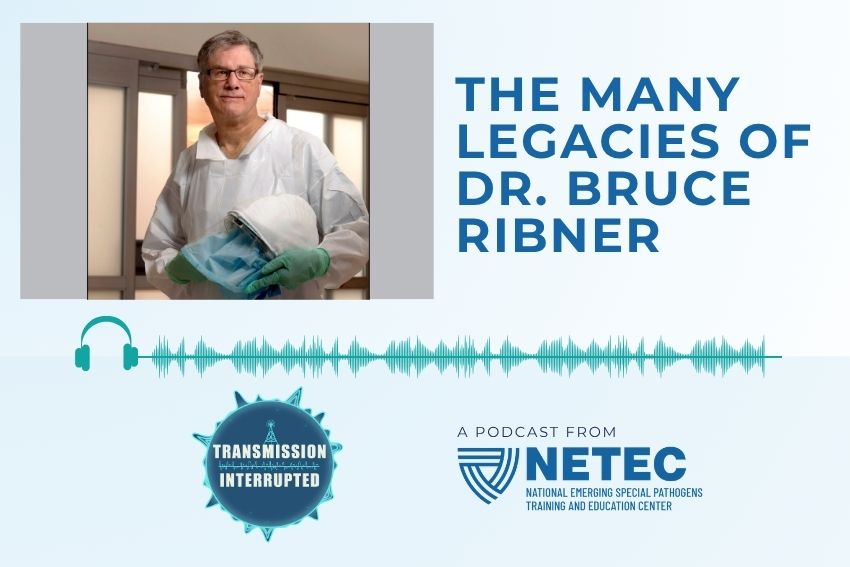
The Many Legacies Of Dr. Bruce Ribner
Share this article
In this episode of Transmission Interrupted, Jill Morgan joins Dr. Aneesh Mehta, Dr. Jay Varkey, and Dr. Colleen Kraft to remember Dr. Bruce Ribner, a physician, educator, hospital epidemiologist, and mentor whose work shaped biocontainment care at Emory and beyond.
The conversation moves from sharp humor and encyclopedic clinical knowledge to the quieter parts of Dr. Ribner’s life: his devotion to family, his willingness to protect and guide colleagues, and his commitment to preparedness long before it was tested. His legacy lives in the programs he built, the teams he strengthened, and the principle that doing the right work matters even when no one knows whether it will ever be needed.
Questions or comments for NETEC? Contact us at info@netec.org.
Visit Transmission Interrupted on the web at netec.org/podcast.
Guests
Colleen S. Kraft, MD, MSc
Colleen S. Kraft, MD, MSc, is a Professor in the Department of Pathology and Laboratory Medicine and the Department of Medicine, Division of Infectious Diseases, at Emory University School of Medicine. She previously served as Associate Chief Medical Officer of Emory Hospital from 2020–2023 and currently serves as Associate Chief Research Informatics Officer for the Woodruff Health Sciences Center
Dr. Kraft was one of the infectious disease physicians at Emory Hospital in 2014 who cared for patients with Ebola virus disease and Lassa fever. Her work since then has focused in part on high reliability in health care, including human factors, infection prevention, and preparedness for highly contagious infectious diseases. She is a clinical consultant for the Emory Healthcare Human Factors Lab and a director in the Healthcare Test Kitchen Lab. She served as President of the American Society for Microbiology from 2022–2023.
Dr. Aneesh Mehta, MD, FIDSA, FAST
Aneesh Mehta is a Professor of Medicine and of Surgery at Emory University School of Medicine, and also serves as the Chief of Infectious Diseases Services and Assistant Director of Transplant Infectious Diseases at Emory University Hospital. He is a board-certified infectious diseases physician, who received an MD from the University of Oklahoma and completed Internal Medicine and Infectious Diseases training at Emory University.
Aneesh has been one of the core physicians of the Emory Serious Communicable Diseases Unit (SCDU) since 2009. He was admitted physician for Emory’s first patient with Ebola Virus Disease and was highly involved in care of the four patients with EVD, one patient with Lassa Fever, and several PUIs cared for by the Emory SCDU. During the Ebola activation, Aneesh was involved in all aspects of unit management, patient care, laboratory handling, and research.
Aneesh is a co-Principal Investigator at NETEC. He has also been involved in the development of the Special Pathogens Research Network Biorepository and evaluation of Medical Countermeasures.
Jay Varkey, MD
Jay Varkey, MD received his BA from Marquette University and an AOA graduate of the Medical College of Wisconsin. He completed his residency in Internal Medicine and Fellowship in Infectious Diseases at Duke University Medical Center, where he was a member of the Antimicrobial Evaluation Team and the Infection Control and Epidemiology Committee.
He was recruited to Emory University in 2009 to become the Director of the Antimicrobial Management Program and Associate Hospital Epidemiologist at Emory University Hospital (EUH). He also serves as the Co-Director of the Outpatient Parenteral Antimicrobial Treatment Clinic at Emory and as the Hospital Epidemiologist at the Wesley Woods Geriatric Hospital of Emory University.
Dr. Varkey currently serves on numerous institutional committees including the Department of Medicine Quality Council, the Department of Surgery Wound Infection Group, the Clinical Effectiveness Septicemia Design Team, and the Infectious Diseases Fellowship Program Admissions Committee.
Dr. Varkey was the recipient of the Department of Medicine Quality Achievement Award in 2012. He is a member of the Infectious Diseases Society of America, the Society for Healthcare Epidemiology of America and the American Society of Transplantation, Infectious Diseases Community of Practice.
Host
Jill Morgan, RN
Jill Morgan is a registered nurse and a subject matter expert in personal protective equipment (PPE) for NETEC. For 35 years, Jill has been an emergency department and critical care nurse, and now splits her time between education for NETEC and clinical research, most of it centering around infection prevention and personal protective equipment. She is a member of the Association for Professionals in Infection Control and Epidemiology (APIC), ASTM International, and the Association for the Advancement of Medical Instrumentation (AAMI)
Resources
- Remembering Dr. Bruce Ribner: A Legacy of Leadership, Preparedness, and Compassion
- Bruce Ribner leaves legacy of redefining infectious disease care
- Transmission Interrupted Podcast
- NETEC Resource Library
About NETEC
A Partnership for Preparedness
The National Emerging Special Pathogens Training and Education Center’s mission is to set the gold standard for special pathogen preparedness and response across health systems in the U.S. with the goals of driving best practices, closing knowledge gaps, and developing innovative resources.
Our vision is a sustainable infrastructure and culture of readiness for managing suspected and confirmed special pathogen incidents across the United States public health and health care delivery systems.
For more information, visit NETEC on the web at www.netec.org.
NETEC Consultation Services
Assess and Advance Your Readiness for Special Pathogens with Free, Expert Consulting.
NETEC offers free virtual and onsite readiness consulting to help health care facilities and EMS agencies prepare for special pathogen events. Our targeted support services are delivered by experts selected and assigned to each inquiry based on the unique needs of your organization. Have a question? Ask a NETEC expert.
For more information, visit: netec.org/consulting-services.
Transcript
Hello, and welcome to "Transmission Interrupted."
Jill Morgan:My name is Jill Morgan.
Jill Morgan:I'm a nurse here at Emory University Hospital Atlanta, and I am very pleased
Jill Morgan:today to join a group of physicians that I know very well, a team of
Jill Morgan:infectious disease physicians here at Emory to really honor Dr. Bruce Ribner.
Jill Morgan:We are very grateful for his legacy here in Atlanta.
Jill Morgan:So I'll get to those introductions in just a second.
Jill Morgan:For those of you not yet familiar with NETEC, our mission is to set the gold
Jill Morgan:standard for special pathogen preparedness and response across health systems in
Jill Morgan:the U.S. with the goals of driving best practices and closing knowledge gaps
Jill Morgan:and developing innovative resources.
Jill Morgan:NETEC works alongside and in cooperation with the CDC and is
Jill Morgan:funded by ASPR, the Administration for Strategic Preparedness and Response.
Jill Morgan:So I want to introduce friends of mine, near and dear.
Jill Morgan:So first I want to start with Dr. Colleen Kraft.
Jill Morgan:She is an infectious disease physician and a clinical microbiologist
Jill Morgan:here at Emory University Hospital.
Jill Morgan:Dr. Jay Varkey, who is a former hospital epidemiologist here at Emory.
Jill Morgan:He's also the chief quality officer for Emory University Hospital and Emory
Jill Morgan:University Orthopedic and Spine Hospital.
Jill Morgan:And Dr. Aneesh Mehta, who is also an infectious disease physician
Jill Morgan:here at Emory and is now the chief of infectious diseases here
Jill Morgan:at Emory University Hospital.
Jill Morgan:And the reason these three are here is that they were a team of incredible
Jill Morgan:physicians who cared for our Ebola patient and Lassa fever patients
Jill Morgan:back in:Jill Morgan:in this arena for a long time.
Jill Morgan:It was quite a group back then, and we'll we're gonna share a few of those stories.
Jill Morgan:But I really wanna welcome you guys to "Transmission Interrupted" with me, to
Jill Morgan:talk about one more member of the team who now has passed away, Dr. Bruce Ribner.
Jill Morgan:So welcome to "Transmission Interrupted."
Jill Morgan:I'd like to start with how you guys met Dr. Ribner, when you first met him,
Jill Morgan:Because, of course, I met him as a nurse, and he was somebody who was running this
Jill Morgan:team already when I came on board.
Jill Morgan:But I know you have a longer history with him than I did.
Jill Morgan:So, Aneesh, why don't we start with you and then Jay. I'll
Jill Morgan:go to you, and then Colleen.
Aneesh Mehta:Thanks, Jill, and it's really a happy and sad occasion being
Aneesh Mehta:here to talk about Bruce Ribner.
Aneesh Mehta:So I met Dr. Ribner when I was a senior medical student.
Aneesh Mehta:I was visiting from Oklahoma, and did an away rotation at Emory because this was
Aneesh Mehta:one of the places that I really wanted to come, and I knew I was interested
Aneesh Mehta:in infectious disease, so I signed up to do that elective here at Emory.
Aneesh Mehta:And just by happenstance got assigned to a month where Dr. Ribner was rotating,
Aneesh Mehta:and just had him as my attending.
Aneesh Mehta:I still remember some really great moments where he was teaching us about
Aneesh Mehta:the time course of HIV, and that was, you know, I still have, like, notes
Aneesh Mehta:from that little lecture, and he had this train going off the cliff to
Aneesh Mehta:demonstrate how the CD4 count dropped off once the viral load hit a certain
Aneesh Mehta:amount of time for a certain duration.
Aneesh Mehta:And so, I also remember being intimidated by Dr. Ribner, because he's very
Aneesh Mehta:senior, very astute and erudite.
Aneesh Mehta:And also had a very sharp sense of humor, which definitely caught me a couple of times
Aneesh Mehta:as a medical student, as a resident, as a fellow, and also as a colleague of his.
Aneesh Mehta:And then I got to match here at Emory as an internal medicine resident and also had
Aneesh Mehta:Dr. Ribner as my attending when I did a infectious disease rotation as a resident.
Aneesh Mehta:And then, of course, as a fellow in infectious diseases here, I got
Aneesh Mehta:to spend a lot of time with Bruce as an attending, as an advisor.
Aneesh Mehta:And, yeah, just enjoyed all of those moments.
Aneesh Mehta:To be honest, I knew much about Bruce as an infectious disease physician
Aneesh Mehta:and educator, and as the hospital epidemiologist here at Emory.
Aneesh Mehta:I did not really know about the Serious Communicable Diseases program that he
Aneesh Mehta:built until I became faculty, or I was becoming faculty, and he's like, "Oh,
Aneesh Mehta:you seem to have a strong interest in viral immunology and viruses."
Aneesh Mehta:And I said, "Yeah, that's what I love." And he's like, "Well, we could use
Aneesh Mehta:some of that talent on this team." I was like, "What are you talking
Aneesh Mehta:about?" And so that I think, right, just as I was finalizing what I was
Aneesh Mehta:gonna be doing as a faculty member, he offered for me to join the team.
Aneesh Mehta:And I learned a lot about it.
Aneesh Mehta:And I'll give one final introduction to Bruce.
Aneesh Mehta:So one of my first experiences as a faculty member with Bruce is
Aneesh Mehta:he called a surprise drill in the SCDU, my first week as being an
Aneesh Mehta:attending physician on service.
Aneesh Mehta:Totally caught me by surprise.
Aneesh Mehta:I didn't really know all the protocols as well as I should have.
Aneesh Mehta:And I still remember Bruce sitting behind me with a piece of paper,
Aneesh Mehta:writing down all the things that I had opportunities to improve upon.
Aneesh Mehta:And so, but yeah, he continued to be an educator, a trainer, a mentor, and
Aneesh Mehta:and colleague, right up until the time that he was not with us anymore.
Jill Morgan:I'm glad you mentioned that he was a little intimidating
Jill Morgan:to you because certainly, as a nurse, he just had the aura of sort
Jill Morgan:of old-school medicine, right?
Jill Morgan:Always with the tie, usually with some sort of pathogen on his tie, right?
Jill Morgan:I mean, not a spill, but actually, the pattern on his tie, suit, lab coat.
Jill Morgan:And he was an intimidating presence.
Jill Morgan:So, I'm glad it wasn't just me.
Jill Morgan:Jay Varkey, how did you get to know Bruce?
Jay Varkey:Jill, first thanks for inviting us.
Jay Varkey:Pleasure to be here with you, and certainly with my friends and
Jay Varkey:colleagues, Dr. Craft and Dr. Mehta.
Jay Varkey:meeting Bruce in February of:Jay Varkey:So I was finishing up my fellowship at Duke.
Jay Varkey:I was applying for faculty jobs, and I'd gotten some interest in terms of…
Jay Varkey:you how dated this is, but in:Jay Varkey:stewardship, and there was a position to be the medical director of antibiotic
Jay Varkey:stewardship at Emory University Hospital.
Jay Varkey:So I came here to interview, and Bruce might have been maybe my third or fourth
Jay Varkey:person I was interviewing with that day.
Jay Varkey:Which meant that I got to go to his office, which I realized turned into
Jay Varkey:a whole side quest to my interview day because I, I got introduced for the first
Jay Varkey:time to floor 7B, which is actually in the attic of the old university hospital.
Jay Varkey:There's actually no public elevator that goes up there, and I ended up
Jay Varkey:actually taking the elevator to the sixth floor, and I found a random stairwell.
Jay Varkey:It looked like I was about to get lost.
Jay Varkey:I walked into an area with a bunch of contractors.
Jay Varkey:It looked like it was, in fact, an attic.
Jay Varkey:And then I actually found that Bruce's office was right there,
Jay Varkey:and he was genuinely shocked that I actually found his spot.
Jay Varkey:And for the next hour or so, I interviewed with him through a small window of two
Jay Varkey:giant stacks of journals and papers.
Jay Varkey:So I sort of sat like this and talked with him.
Jay Varkey:And little did I know that not only would I end up seeing Bruce almost
Jay Varkey:every day for the next several years after I joined faculty, but that I would
Jay Varkey:actually become his office neighbor, because my first spot was actually
Jay Varkey:right across the hall from him.
Jay Varkey:And I bring this up because, similar to what Aneesh said, Bruce
Jay Varkey:definitely had a wry sense of humor.
Jay Varkey:I had been advised, and I had been asked on my interview day
Jay Varkey:whether I had any interest in hospital epidemiology, and I did.
Jay Varkey:And to that end, I had actually, when I was… When I joined, I
Jay Varkey:said if there was an opportunity to join as an assistant hospital
Jay Varkey:epidemiologist, I'd really be honored.
Jay Varkey:I had heard after the fact, and I teased Bruce about it when he was retiring,
Jay Varkey:that, I think, when Bruce found that out, I remember him saying something
Jay Varkey:to the effect of, "I don't remember asking for an assistant." which is
Jay Varkey:totally legit because he actually made the job look really, really easy.
Jay Varkey:He could answer in a cool, calm, and almost detached way, stuff that
Jay Varkey:would immediately make me sweat.
Jay Varkey:There's an outbreak of tuberculosis," and he would just very simply just
Jay Varkey:ask like three very straightforward questions to ground everyone.
Jay Varkey:And to that end, I learned a ton from him, all the way until he retired.
Jay Varkey:In fact, I learned so much that, that even though he didn't ask for an assistant,
Jay Varkey:it was an honor to take over his role as hospital epidemiologist when he
Jay Varkey:gravitated to his leadership role in NETEC
Jill Morgan:Yeah.
Jill Morgan:I think that's absolutely right.
Jill Morgan:I remember during a press conference when somebody had asked a question
Jill Morgan:that he considered just, like, not very well stated or not very well
Jill Morgan:presented, and he said, "Well,
Jill Morgan:I think what you meant to ask was…" And I was like, " Oh, no.
Jill Morgan:He went there.
Jill Morgan:"I mean, and it was just so perfect.
Jill Morgan:Yeah.
Jill Morgan:He, he definitely was, if you were on the right side of his humor,
Jill Morgan:was great, and if you weren't, you definitely squirmed a little bit.
Jill Morgan:Yeah.
Jay Varkey:You squirm, but sometimes it was even funnier.
Jill Morgan:Oh, yeah.
Jill Morgan:Yeah.
Jill Morgan:No, it's true.
Jill Morgan:He was never, it was never of evil intent or mean in any way.
Jill Morgan:It was just that he was so smart and so, yeah.
Jill Morgan:Colleen, tell me about your relationship with Dr. Ribner.
Colleen Kraft:Yeah.
Colleen Kraft:I mean, he is a very interesting guy.
Colleen Kraft:ime I met him was February of:Colleen Kraft:an infectious disease fellow.
Colleen Kraft:And I had been rounding, you know, it was the winter month, so I had,
Colleen Kraft:like, a kid at home from daycare.
Colleen Kraft:My husband was also sick from the kid.
Colleen Kraft:The kid had yet another thing.
Colleen Kraft:I was pregnant.
Colleen Kraft:I had pneumonia.
Colleen Kraft:Was trying to round with him, and he finally looked at me and was like,
Colleen Kraft:"Colleen, just go home and come back when everybody's feeling better." And
Colleen Kraft:I was sort of ashamed because I felt like, you know, "Don't you need me?
Colleen Kraft:Don't… You know, do I have to be here!
Colleen Kraft:I'm an ID fellow." And he just showed me that, you know, he
Colleen Kraft:could still do all the work.
Colleen Kraft:And honestly, that has made me wanna be I mean, since that moment, I
Colleen Kraft:have wanted to be that way as well.
Colleen Kraft:So yes, I'm rounding in the hospital.
Colleen Kraft:Yes, I have a team, but I've always really aspired to be able to handle
Colleen Kraft:everything myself, just because I think that was something that he showed me.
Colleen Kraft:But now, I think, the other cool thing for me is that around that time
Colleen Kraft:as well, his wife Barb also worked at the Glen Memorial preschool, and so
Colleen Kraft:my kids were also cared for by her at different times in their growing up.
Colleen Kraft:So that was also very special.
Colleen Kraft:They had three boys.
Colleen Kraft:We have, we have three boys.
Colleen Kraft:I mean, they still have three boys.
Colleen Kraft:So, but just as, you know, his self-reliance, and I like what both
Colleen Kraft:Jay and Aneesh said, his mastery of the situation is something that I still aspire
Colleen Kraft:to because I still don't always have that.
Colleen Kraft:But your memory of him during that press conference, just like managing those
Colleen Kraft:questions, I will never forget that.
Colleen Kraft:That is one of my top highlights of Bruce Ribner, especially when they
Colleen Kraft:asked why we didn't tell anybody that we sent Nancy Rebel home.
Colleen Kraft:That was my favorite answer from him.
Colleen Kraft:And, you know, I'm not gonna say it perfectly, but he essentially said,
Colleen Kraft:"I don't usually tell the press when I discharge patients from the
Colleen Kraft:hospital." It was like so awesome
Jill Morgan:Yes.
Jill Morgan:Yes.
Jill Morgan:Yeah, he sort of invented the, the-- not invented, but he, he certainly perfected
Jill Morgan:that almost mic-drop kind of thing.
Jill Morgan:Like, there is no comeback to that.
Jill Morgan:You're just left hanging by that. I am of an older vintage than y'all,
Jill Morgan:and so Dr. Ribner and I were of a similar, I don't know, not age
Jill Morgan:really, but I think just upbringing in medicine that was more old-school.
Jill Morgan:So, you know, I come from a very conservative family and then grew up
Jill Morgan:in, from my nursing career, in some more rural places that I think were, there was
Jill Morgan:a time for casualness, but also in the hospital, you called people Dr. Ribner.
Jill Morgan:I, I never called him Bruce Ribner.
Jill Morgan:I, I called him Dr. Ribner always, and then he, in return
Jill Morgan:just called me Nurse Morgan.
Jill Morgan:I mean, it was Nurse Morgan all the time.
Jill Morgan:And so it was not a formality because he put himself on any high horse.
Jill Morgan:It was just sort of that was how we were both brought up in; I
Jill Morgan:think, in our healthcare careers.
Jill Morgan:But one of the things that I found most valuable. I know I've heard several of
Jill Morgan:you talk about over the years was the real equality of the team we had during
Jill Morgan:our care of Ebola patients, and I think that he was inspirational in that.
Jill Morgan:And it was something that I appreciated and have continued to value through
Jill Morgan:the rest of my career because you realize how, unfortunately, it's
Jill Morgan:still sort of a rare thing to feel like you're really treated as an
Jill Morgan:equal no matter what your ranking is.
Jill Morgan:So, you know, you each met him at a different point in your career, and yet
Jill Morgan:I think you would probably say that your acceptance into Dr. Ribner's circle, and
Jill Morgan:and how he treated you was essentially the same because it was just, you know, show
Jill Morgan:me what you're worth and do your job and we're all in this together kind of thing.
Jill Morgan:And I was really grateful to feel like no matter who you
Jill Morgan:were on our team, he listened
Jay Varkey:I think that's spot on, Jill.
Jay Varkey:I was just gonna briefly add to that, and this is gonna sound odd, but I think in
Jay Varkey:that same role modeling of equal voices on a team, the other thing, and I, I won't
Jay Varkey:speak for Colleen and Aneesh on this, but the other thing that I appreciate,
Jay Varkey:I think kind of goes hand-in-hand with that is also sort of the freedom to not
Jay Varkey:necessarily fail, but sometimes flail.
Jay Varkey:So you asked about- you made a good comment that, you know, we worked with
Jay Varkey:him at different points in our career.
Jay Varkey:I think Bruce recognized that a lot of what we do, not just
Jay Varkey:in medicine, but especially in infectious diseases, is very gray.
Jay Varkey:There's not a lot of black and white.
Jay Varkey:And to that end, sometimes you actually have to have some freedom to do
Jay Varkey:something where it might be a little bit different than what somebody else may do.
Jay Varkey:And I think Bruce was particularly skilled in allowing that in, in a
Jay Varkey:very… as long as you could rationalize why you were doing it, and as long as
Jay Varkey:he reiterated the fact that he would steer you in the right direction if it
Jay Varkey:saw you were going off on a tangent.
Jay Varkey:That was something that was actually really quite motivating
Jay Varkey:and inspiring, in a way
Colleen Kraft:And I will say I do not have the patience for that all
Colleen Kraft:the time for those who are junior And so I, I just like, as we're kind
Colleen Kraft:of reflecting on him, I'm really grateful that he showed us so much.
Colleen Kraft:I mean, he always was, to me, a little bit of a walking contradiction.
Colleen Kraft:Like he had this flat hierarchy, but he could also just raise up and be the boss,
Colleen Kraft:which is appropriate in a lot of the circumstances that we found ourselves.
Colleen Kraft:And so I think that that was always fascinating to me that, you know, Jill,
Colleen Kraft:ay from our activation during:Colleen Kraft:for patients with Ebola Virus Disease was I got to sort of spend a little bit
Colleen Kraft:of time, I know you wouldn't say much, in the shoes of nurses, like in
Colleen Kraft:their hierarchy and how they function.
Colleen Kraft:But Bruce already knew all that.
Colleen Kraft:Like, he already, he got that.
Colleen Kraft:He, he walked that, but you wouldn't necessarily… Like he knew it,
Colleen Kraft:but he didn't always, I feel like show it, if that makes sense.
Colleen Kraft:okay.
Aneesh Mehta:Yeah, I think, just to build on both of those, both Jay and
Aneesh Mehta:Colleen, what you guys just said.
Aneesh Mehta:So just going back to that first moment, in the SCDU for me, during
Aneesh Mehta:that drill, I mean, he was taking notes, and I do remember that after
Aneesh Mehta:the fact, but he ga- he did not, and I would not have been able to do this.
Aneesh Mehta:I didn't-- He never stepped in and said, "Aneesh, you should think about
Aneesh Mehta:doing it this way." And that's how he was as a teacher and a mentor.
Aneesh Mehta:He would give you that flexibility to find your way.
Aneesh Mehta:But as you mentioned, Colleen, like if it was, like, important, if this was
Aneesh Mehta:gonna hurt somebody, then he clearly knew what the right thing was to
Aneesh Mehta:do, and he would step up and say it.
Aneesh Mehta:But up until that point, he gave you the freedom to learn in your own way.
Aneesh Mehta:and it's something that I've tried to emulate in my career,
Aneesh Mehta:but I still haven't gotten there.
Aneesh Mehta:It's just that immense patience that is built on this confidence of
Aneesh Mehta:intellectual power that, that was just impressive to watch, from Bruce.
Aneesh Mehta:So yeah, just still trying to emulate that.
Jill Morgan:Yeah.
Jill Morgan:I mean, I think it is a powerful thing to be where the buck stops,
Jill Morgan:and yet give that, as you all have said, that flexibility to
Jill Morgan:other professionals to get there.
Jill Morgan:But knowing that you have that backstop, that there is this person
Jill Morgan:who has this enormous intellectual capacity, who understood things you
Jill Morgan:were probably not gonna understand, who had your back in that way.
Jill Morgan:And I think that that's, that's a very powerful thing.
Jill Morgan:I mean, I, I'm certainly grateful I didn't ever have to deal with the press, right?
Jill Morgan:I mean, I think he, he protected certainly the rest of us from ever
Jill Morgan:having to do those kinds of things.
Jill Morgan:And that can be a double-edged sword, right?
Jill Morgan:If somebody wants to have those experiences.
Jill Morgan:But I think that, I mean, to me it was, as you sort of said, a
Jill Morgan:walking contradiction in some ways.
Jill Morgan:I wanna actually kind of riff on that because, as several of us have talked
Jill Morgan:before, when we went to the services after Dr. Ribner's death, we got to
Jill Morgan:see some of the great, great images that his family had put together.
Jill Morgan:And as has been mentioned, Bruce's wife Barb was there, and his sons and
Jill Morgan:grandchildren, and seeing this person that I only knew in a suit and tie and a
Jill Morgan:starched white jacket, like holding his sons as babies, and camping and hiking
Jill Morgan:and doing all these other things that were just- he just looked so, I mean,
Jill Morgan:like comfortable and normal, if you will.
Jill Morgan:And I didn't know him that way.
Jill Morgan:I only knew him this very, sort of, I don't know, a little
Jill Morgan:bit uptight kind of persona.
Jill Morgan:So I'm, I was really grateful to get that glimpse of a very rich life.
Jill Morgan:So I'd like to hear from you guys what, what you knew that that people
Jill Morgan:would be surprised about, or that, you know, you got to see in Bruce
Jill Morgan:perhaps that other people didn't.
Aneesh Mehta:Yeah, I had a very similar experience, Jill, at the
Aneesh Mehta:Shiva, which was an honor to be at.
Aneesh Mehta:I mean, I knew Bruce for 23 years.
Aneesh Mehta:And really, you know, the past 12 or 13 years, like very, very closely.
Aneesh Mehta:And you know, he- I knew well, like his sort of medical pedigree, like
Aneesh Mehta:where he had trained and the different institutions that he had led and, you
Aneesh Mehta:know, from, coming from MUSC to Emory and how he built the program at Emory
Aneesh Mehta:for hospital epi and then built the program for our biocontainment care.
Aneesh Mehta:And I knew a lot about his family.
Aneesh Mehta:He like shared a lot about Barb and his three boys and fun things that
Aneesh Mehta:they were doing, their accomplishments.
Aneesh Mehta:But Bruce, like in all those years, like, I don't remember him
Aneesh Mehta:telling stories about the cool things that he did outside of work.
Aneesh Mehta:And that's what I think, you know, you were commenting on, and we saw in the
Aneesh Mehta:pictures, but also the stories that his boys told about him, his sons told about
Aneesh Mehta:him during that, like this rich human being that Bruce Ribner was that we
Aneesh Mehta:didn't always get to experience because, you know, we were focused on our work
Aneesh Mehta:and his contributions to our work.
Aneesh Mehta:I wish I had known more about those things, and I'd love to have those
Aneesh Mehta:conversations, but it was really nice to see, as we all talked about
Aneesh Mehta:earlier, that Bruce Ribner was far more than the man we knew at work.
Aneesh Mehta:He, just rich, had a really, really rich life beyond the confines of our hospital.
Jay Varkey:To build on that, I think… I forgot which one of us mentioned the idea
Jay Varkey:of Bruce being a bit of a contradiction, but I, I think Aneesh said it well.
Jay Varkey:I mean, on one side we knew him as Dr. Ribner, you know, EH Hospital
Jay Varkey:epidemiologist or SCDU medical director.
Jay Varkey:And then you're right, in celebration of his life with his family, I, for
Jay Varkey:the first time was looking at him on a, he, I, he seemed like the Dos Equis
Jay Varkey:most interesting man in the world.
Jay Varkey:It was just, it was fascinating.
Jay Varkey:And I wouldn't say Bruce was guarded per se.
Jay Varkey:I just think it was his general reserved personality.
Jay Varkey:He wasn't particularly effusive in terms of talking about these kinds of personal
Jay Varkey:details, even after coming off of a, yeah, a camping trip or a vacation.
Jay Varkey:He'd talk about it at a high level, but it was, I, I think, and in
Jay Varkey:some sense, this is just how he was, he clearly role-modeled the value of
Jay Varkey:family to him outside of the hospital.
Jay Varkey:And I'll give one tangible example to it.
Jay Varkey:And it was, you know, as I mentioned, he, he was my office neighbor.
Jay Varkey:So, there was a period of time where I would usually drive with
Jay Varkey:my small children at the time, from Atlanta to Austin, Texas.
Jay Varkey:And he always thought that was funny, but I, because he's
Jay Varkey:like, "Ah, it's a long ways."
Jay Varkey:But he told me for like two years in a row, and then it took
Jay Varkey:me a while to realize that this was clearly a place he had found.
Jay Varkey:He kept telling me about this restaurant, and I found out later it was in San
Jay Varkey:Antonio, that was basically pirate-themed, and the whole thing is on a pirate ship.
Jay Varkey:And he- that's the first time I had seen him kind of go in
Jay Varkey:that detail about something.
Jay Varkey:And again, I worked with Bruce for a long time.
Jay Varkey:I wasn't expecting the one restaurant recommendation he'd give me would
Jay Varkey:be a pirate ship in San Antonio.
Jay Varkey:But it clearly was something that resonated with him, and it was
Jay Varkey:because he was with his family.
Jay Varkey:And this was at the same time when he had covered the
Jay Varkey:traditional Christmas holidays for a lot of us for well over 20 years.
Jay Varkey:And even when I think a couple of us, you know, volunteered,
Jay Varkey:he- I think he shooed me off.
Jay Varkey:He's like, "No, no, you, you be with your family." And, and it, it was just,
Jay Varkey:it was a, it was kind of a… It was a role modeling a priority of family or
Jay Varkey:having a life outside of the hospital.
Jay Varkey:I think all of us saw that; that really had a significant impact on me.
Jill Morgan:Yeah.
Jill Morgan:I'm not gonna be able to picture him in a pirate ship-themed restaurant.
Jill Morgan:Not,
Jill Morgan:no way.
Jill Morgan:Yeah.
Colleen Kraft:But you should
Colleen Kraft:because he, he also did a lot of crew and rowing and sailing.
Colleen Kraft:And so that was something that I kind of only learned later 'cause I'd visited
Colleen Kraft:his townhouse, when they moved away from their Fair Oaks home to their townhouse.
Colleen Kraft:They had this huge paddle, or I, I think,
Colleen Kraft:you know, like his… Their cruises going to Antarctica, I think, like you're saying,
Colleen Kraft:Jay, all these, like, really… But a lot of them were water-based because he kind of
Colleen Kraft:had this love, and I think had been on crew or something in college or grad school.
Colleen Kraft:So, it was really interesting and I thought, you know… I, I'd looked
Colleen Kraft:through all their memory books of all these trips, and I knew Barb quite well
Colleen Kraft:and… But I was still also stumped by some of the things that he would tell me.
Colleen Kraft:When we were having our boys, he said, you know, our boys are pretty close
Colleen Kraft:together in age, but he said that he, you know, they'd had their boys five
Colleen Kraft:years apart, so one and then five years and then another one in five years.
Colleen Kraft:And he kept saying, and I loved, I, I can imagine him saying this.
Colleen Kraft:He said, "By that time they were a big helper," and it was that same kind
Colleen Kraft:of a thing; he was just a good helper by the time the next baby came along.
Colleen Kraft:And I did sort of see that, like fatherly, grandfatherly, and
Colleen Kraft:I think great-grandfatherly.
Colleen Kraft:I think they have; he has great-grandkids as well.
Colleen Kraft:And so, you, you'd get these little glimpses into that.
Colleen Kraft:And I think even the story that was told of how much he was a sympathetic,
Colleen Kraft:empathetic father figure to his boys at the shiva, also resonated
Colleen Kraft:because he was sort of like that to us, we just didn't notice.
Colleen Kraft:Like, we didn't realize.
Colleen Kraft:But especially during that time that we all worked together for a lot
Colleen Kraft:of hours, in:Colleen Kraft:I think now we see because we're having to deal with it ourselves.
Colleen Kraft:You know, the things that he kind of took care of or made decisions on for
Colleen Kraft:us or, you know, to, in order to sort of shield us from these, these kinds of
Colleen Kraft:things that would've really, I think, Jay, I like your phrase, made us sweat.
Colleen Kraft:Like, it would've really been hard for us to manage being away from our families to
Colleen Kraft:care for these patients, to then try to make sure we're doing a high reliability,
Colleen Kraft:taking care of ourselves, you know, getting pressure from all different sides.
Colleen Kraft:He was really the one that filtered all of that, and I think I didn't realize
Colleen Kraft:until much later how much he really was sort of watching out and, you know,
Colleen Kraft:he is giving us opportunities, giving us some of the positive things, but
Colleen Kraft:he was kind of taking a lot of the heavier stuff on himself, for sure.
Jill Morgan:Yeah.
Jill Morgan:And one advantage, of course, of having Dr. Ribner as a shield, if
Jill Morgan:you will, against some of those slings and arrows was that because he had
Jill Morgan:that persona and because he had the the knowledge to back it up, people
Jill Morgan:didn't question- like, when you come across as that kind of expert, people
Jill Morgan:don't poke you quite so much, right?
Jill Morgan:Because they, they, "Oh, well, well, this person clearly knows what they're talking
Jill Morgan:about." And, and that's sort of something that I think many of us struggle with,
Jill Morgan:no matter how long we've been doing our jobs or how confident we feel in it.
Jill Morgan:Somebody asks you a question, and you're like, "Huh, did I, did I say, misspeak?
Jill Morgan:Did I, d- is there something about that I don't know?" And he just,
Jill Morgan:like… It was not bluff and bluster.
Jill Morgan:It was just that he had a command of a topic that, and, and that was it.
Jay Varkey:His knowledge was encyclopedic.
Aneesh Mehta:Yeah,
Jay Varkey:I, I have-- Aneesh and Colleen have heard me say this before,
Jay Varkey:but, you know, the ID rounding room was again right next to my office, and
Jay Varkey:Bruce did a lot of clinical service.
Jay Varkey:He saw a lot of patients.
Jay Varkey:And so oftentimes I could hear him teaching next door.
Jay Varkey:And every once in a while I'd hear him say something, and just in the back of my mind
Jay Varkey:I'm like, "I don't think that's right."
Jay Varkey:And I was at my computer, so I'd, I'd actually look it up, and it always was,
Jay Varkey:you know, like to a T. It, it was-- I always wanted to kind of catch him
Jay Varkey:and be like, oh, you know, 'cause I-- he had no compunction about catching
Jay Varkey:us when we make those mistakes and giving us the exact citation in
Jay Varkey:a way that we would never forget.
Jay Varkey:So I always wanted to do that.
Jay Varkey:I can't think of one time I actually did.
Aneesh Mehta:Yeah
Colleen Kraft:I remember when he said I was there when he talked to one of
Colleen Kraft:our patient's families and said that he had Ebola encephalitis, and I thought
Colleen Kraft:I was gonna fall over because I was like, "What are you talking about?"
Colleen Kraft:But he was absolutely correct, and I- it just hadn't-- I don't know if
Colleen Kraft:we just hadn't talked about it as a group, or it hadn't dawned on me.
Colleen Kraft:Like, I kind of still feel to this day like I must have missed something.
Colleen Kraft:But he, I mean, he was so-- he knew what was going on at all
Colleen Kraft:the time, especially clinically.
Aneesh Mehta:Yeah, Corrie, I remember that specific conversation, so
Aneesh Mehta:well because it was emblematic of his, like, deep knowledge and precision
Aneesh Mehta:in application of that knowledge.
Aneesh Mehta:Because I was going around and around with the family about how this could be
Aneesh Mehta:toxic metabolic, all these other things.
Aneesh Mehta:And we had all talk…
Aneesh Mehta:And, and, and Bruce was like, "It could be all those things, but to be
Aneesh Mehta:honest, I, I believe this could be Ebola virus-induced encephalitis." And
Aneesh Mehta:we had no way to prove that until that patient needed an MRI of the brain,
Aneesh Mehta:and it was clearly demonstrated there.
Aneesh Mehta:And I remember being, like, talking to all of you guys afterwards.
Aneesh Mehta:I was like, "What is Bruce talking about?
Aneesh Mehta:Tox- you know, the encephalitis from Ebola.
Aneesh Mehta:That hasn't been described.
Aneesh Mehta:Like, do you guys know? And yeah, we- after that MRI, it was
Aneesh Mehta:like, oh yeah, he was 100% right.
Aneesh Mehta:I didn't know what I was talking about.
Aneesh Mehta:So
Colleen Kraft:Just the way he went about telling the
Colleen Kraft:family too was also very Bruce.
Colleen Kraft:He was very matter of fact and, and we were-- I mean, I, I don't guess
Colleen Kraft:I was there in the room.
Colleen Kraft:I was stunned.
Colleen Kraft:I think I probably had a hard time, you know, like softening that.
Colleen Kraft:But, you know, I was like, "Maybe we should have talked about this
Colleen Kraft:altogether and like come up with more."
Colleen Kraft:But I mean, it was the appropriate conversation.
Colleen Kraft:It was the right tone.
Colleen Kraft:He's, you know, he is, he usually has a lot of-- he's
Colleen Kraft:listening as well as speaking.
Colleen Kraft:But yeah, it was, it was amazing to be around that.
Aneesh Mehta:Yeah, and he knew exactly how those parents of our
Aneesh Mehta:patient needed to hear that information, which I clearly was struggling with,
Aneesh Mehta:and he just, like, said it, right?
Aneesh Mehta:You said matter-of-fact, with confidence, but with calm, and that's exactly
Aneesh Mehta:what they needed in that moment.
Aneesh Mehta:So yeah, it's impressive
Jill Morgan:So I want to, w- just wrap up this wonderful conversation
Jill Morgan:with you guys to ask what you think from your perspective, personally,
Jill Morgan:Dr. Ribner's legacy is to you.
Jill Morgan:And then I don't-- I, you know, obviously we know, and, and, and I probably should
Jill Morgan:have stated at the outset that Dr. Ribner, as we've mentioned, started a lot
Jill Morgan:of things, but specifically related to this podcast and this work that we do with
Jill Morgan:NETEC and, with preparedness nationally, is that Dr. Ribner put into place the
Jill Morgan:biocontainment unit at Emory University Hospital as the occupational health
Jill Morgan:first Ebola patients came, in:Jill Morgan:That was all because of this one man.
Jill Morgan:Now, obviously it took a team of people to put that together, but it was his vision.
Jill Morgan:I, my own personal legacy about him is w- honestly, his willingness to pivot
Jill Morgan:when it was needed, whether that's what was happening with the patient in
Jill Morgan:the room, whether that was happening with how we were handling something.
Jill Morgan:And then for me, as everybody knows, my favorite topic is PPE.
Jill Morgan:It happened with our personal protective equipment that we were going to
Jill Morgan:wear, and he was absolutely willing to say, "If that's what we
Jill Morgan:need to do, that's what we'll do."
Jill Morgan:And, and I, I respect that because, again, he did have the gravitas that you
Jill Morgan:didn't always question things, but it wasn't; it wasn't that he was stuck in
Jill Morgan:one answer or one way of doing something.
Jill Morgan:It was because he had just built this, this incredible
Jill Morgan:foundation of information.
Jill Morgan:So that's my personal legacy about it.
Jill Morgan:So, I don't know who wants to go first, but
Aneesh Mehta:Yeah, I'll jump in.
Aneesh Mehta:So, there are a lot of, I think, legacies that Bruce Ribner has left
Aneesh Mehta:on all of us and, and, and on me.
Aneesh Mehta:I think, specific to the realm we're talking about, Jill, in biocontainment.
Aneesh Mehta:I go back to a story, my own personal story with Bruce that was really
Aneesh Mehta:difficult for me at the moment, but now I understand so well why he did it.
Aneesh Mehta:So I took a patient that was in airborne isolation out of isolation
Aneesh Mehta:a little bit earlier than the protocol dictated, because I felt
Aneesh Mehta:like I knew what I was doing, and what was going on with the patient.
Aneesh Mehta:And so he called me into his office, and he said, "Let's review Emory Healthcare's
Aneesh Mehta:policy on airborne isolation together."
Aneesh Mehta:And I talk a lot about this part, right?
Aneesh Mehta:Because it was like him pointing out, like the details
Aneesh Mehta:and where I went astray.
Aneesh Mehta:But I don't talk about, and I should talk more, really, about why
Aneesh Mehta:he did it and how he ended it.
Aneesh Mehta:And he was talking about, you know, "Aneesh, we could all be right, and we
Aneesh Mehta:know we're right, but there's that small margin of error that we all know is human.
Aneesh Mehta:And when we make that mistake, that can affect a patient, but it
Aneesh Mehta:could also affect our colleagues.
Aneesh Mehta:And we need to make sure that we're keeping everyone safe," right?
Aneesh Mehta:And I don't talk about that as much as I should, that part of that conversation.
Aneesh Mehta:But that was emblematic of why he built the program that, that we all benefit
Aneesh Mehta:from and built NETEC, with the other NETEC leaders, back in the day, is
Aneesh Mehta:really to make sure that his message, he-we could deliver clinical excellence
Aneesh Mehta:while keeping each of us safe, right?
Aneesh Mehta:And making sure that we all went back home to our families.
Aneesh Mehta:And yeah, that's a legacy that I bring hopefully every day to the
Aneesh Mehta:work that we do in biocontainment.
Aneesh Mehta:And then the other thing that is just a legacy is being generous.
Aneesh Mehta:I think that was all the stories that we've been telling is, is really
Aneesh Mehta:a lot about his generosity in making… you know, taking on the hard task as
Aneesh Mehta:a leader and giving all the really great stuff to those around us so
Aneesh Mehta:that they can build their careers.
Aneesh Mehta:And I certainly have benefited from Bruce's generosity as well.
Aneesh Mehta:So those are sort of his lasting legacies with me.
Jay Varkey:Yeah, it's, it's a great question, and I was trying to think
Jay Varkey:in terms of how to answer it because I think Bruce's legacy is vast and kind
Jay Varkey:of, like the man, kind of understated.
Jay Varkey:But I think the point of this is for the four of us who knew him
Jay Varkey:well to kind of articulate it.
Jay Varkey:So I, I break it down into a couple of pieces.
Jay Varkey:I think it's sort of the personal impact, I think his impact on the
Jay Varkey:hospital where he practiced longest, and then really the nationwide
Jay Varkey:and international impact as well.
Jay Varkey:So at a personal level, we touched on it, but again, I think all of us to a
Jay Varkey:degree, and again, speaking for myself, I think that balance of recognizing and
Jay Varkey:prioritizing and modeling excellence in medicine, especially infectious
Jay Varkey:diseases, but still maintaining what is important outside of the hospital,
Jay Varkey:I think was a personal impact that I think all of us mentioned and have seen.
Jay Varkey:In terms of legacy of the hospital, and again, I think the longer the four
Jay Varkey:of us are here, I think there's probably a smaller number of people that remember
Jay Varkey:just the amount of things Bruce did just because he felt that it was his job.
Jay Varkey:And these were big deals.
Jay Varkey:So Aneesh was talking about that focus on public safety.
Jay Varkey:I mean, Bruce was, and many people have forgotten this, but he was the
Jay Varkey:gadfly, for lack of a better word, that led to us notifying the public
Jay Varkey:of a tiny risk, but still an important one for prion-related disease.
Jay Varkey:And we took a lot of heat for it in terms of the public, but it was
Jay Varkey:absolutely the right thing to do.
Jay Varkey:He did the exact same thing in terms of an exposure to tuberculosis because
Jay Varkey:again, it was the right thing to do.
Jay Varkey:And by role modeling that, I think that that set a precedent that certainly
Jay Varkey:impacted the way I thought about things, and I feel I left a legacy
Jay Varkey:in terms of the way Emory does things.
Jay Varkey:And then last, and this is hard, just given the fluidity of the current Ebola
Jay Varkey:outbreak and kind of where we are as a society, but if there's any legacy
Jay Varkey:that I think is important, that I hope nobody ever forgets is the fact that
Jay Varkey:we demonstrated, and Bruce demonstrated that our team could safely care for
Jay Varkey:something that many people find scary.
Jay Varkey:And I think it set an important precedent that I hope we don't forget as a society,
Jay Varkey:that if Americans are serving overseas and get sick, they have a right to
Jay Varkey:come home and receive the best care.
Jay Varkey:And I think that that is something that even, you know, politics may
Jay Varkey:change, society may change, but I hope that that lesson is never lost
Jay Varkey:because I think it was a critical one.
Colleen Kraft:I should have gone before Jay.
Colleen Kraft:So I would say the thing that I've reflected the most on, 'cause we've
Colleen Kraft:covered some of what I think about is his legacy we've covered already,
Colleen Kraft:is just that vision and deep wisdom and insight to do something on, like
Colleen Kraft:unappreciated for over a decade, and probably even longer than that.
Colleen Kraft:You know, I don't, I don't know as much about his hospital epidemiology journey.
Colleen Kraft:But probably with that, he essentially created civilian biocontainment
Colleen Kraft:units for the whole United States, at least, and maybe farther-reaching.
Colleen Kraft:Most of what exists today, he was involved in at least
Colleen Kraft:giving advice at the beginning.
Colleen Kraft:And also not knowing that would ever come to fruition,
Colleen Kraft:that that wouldn't ever happen.
Colleen Kraft:And even when it did happen, and he's on the front of Time Magazine and all this
Colleen Kraft:stuff, he's a little unbothered by it.
Colleen Kraft:And I, I think, you know, I'm somebody that I think needs a lot of reassurance
Colleen Kraft:and wants to see things happen quickly and soon, and I think he was very
Colleen Kraft:content to do things, again, as we've mentioned, for the right reasons, and
Colleen Kraft:take his time doing it and not necessarily know that it'll ever yield anything.
Colleen Kraft:And that is a very rare, sort of personality trait these days.
Jill Morgan:I'm glad you went last, Colleen, because I think it really does
Jill Morgan:tie this up very nicely, that there are people doing things, whether it's vaccine
Jill Morgan:research, whether it's preparedness in other ways, whether you're working alone
Jill Morgan:in a lab somewhere and you think, "Is this ever going to make a difference?"
Jill Morgan:here at Emory was created in:Jill Morgan:having a sick patient in it.
Jill Morgan:That did not in any way discourage Dr. Ribner, because I want to make sure I can
Jill Morgan:explain this, but it didn't matter because the unit was there for the right reason.
Jill Morgan:The work, the preparedness, everything was there for the right reason.
Jill Morgan:The parts, the pieces were all there for the right reason.
Jill Morgan:And I liken it to having smoke detectors in your house or having a fire alarm.
Jill Morgan:You-- it, it's the right thing to do whether you ever have a
Jill Morgan:house fire, whether you ever ha- turn on your stove or not, right?
Jill Morgan:And he understood that, and that gave him that quiet confidence that he
Jill Morgan:was doing it for the right reason, whether you ever appreciated it or not.
Jill Morgan:It didn't really matter to him.
Jill Morgan:Whether it was President Obama saying it, whether it was a patient giving
Jill Morgan:him thanks, all those things were nice, but he knew his true north.
Jill Morgan:He knew that what he was doing and what he had put in place
Jill Morgan:had value and was important.
Jill Morgan:And so I guess my luxury of doing this podcast is I get to rant a little bit
Jill Morgan:and I just want to rant to the people that I know right now are working,
Jill Morgan:whether it's at the CDC or whether you're working on a research project somewhere,
Jill Morgan:whether you're an infection preventionist in a small hospital and you feel like
Jill Morgan:you're sort of shouting into the void.
Jill Morgan:If you're doing important work for the right reason and you've got
Jill Morgan:your true north, keep going, honey, 'cause that is what it's about.
Jill Morgan:Whether you're ever recognized, whether it ever gets used, having
Jill Morgan:those things in place, that's what preparedness is about, so you're not
Jill Morgan:starting from scratch when the, when the you-know-what literally hits the fan.
Jill Morgan:So I just think it's an incredible legacy.
Jill Morgan:You're right.
Jill Morgan:It's, it's big, and it's wide, and it's deep, and it's all the funny things
Jill Morgan:that Dr. Bruce Ribner was to us.
Jill Morgan:And I am, I am very grateful.
Jill Morgan:It changed the trajectory of my career.
Jill Morgan:It got me a great relationship with the three of you and with a bunch of other
Jill Morgan:brilliant infectious disease folks, and I am, I am very, very grateful.
Jill Morgan:So thank you.
Jill Morgan:Thank you for sharing your stories about Dr. Bruce Ribner.
Jill Morgan:Anybody have any last comments they want to get in?
Colleen Kraft:Thanks for doing this, Jill
Aneesh Mehta:Yeah.
Aneesh Mehta:It's an honor to talk about Bruce
Jay Varkey:And thanks for looking out for all of us
Colleen Kraft:Yep.
Jill Morgan:Absolutely.
Jill Morgan:Absolutely.
Jill Morgan:All right
Jill Morgan:That was a lot today.
Jill Morgan:I, I feel like it was almost a cathartic podcast episode for
Jill Morgan:me, so I'm, I'm really grateful.
Jill Morgan:For those of you listening at home, thank you for tuning in to this episode
Jill Morgan:on the legacy of Dr. Bruce Ribner.
Jill Morgan:We hope you'll join us for future episodes on a wide range of topics, from healthcare
Jill Morgan:worker safety, personal protective equipment, of course, and even more
Jill Morgan:about infectious diseases of all kinds.
Jill Morgan:If you have any questions for NETEC or ideas for future shows, please feel free
Jill Morgan:to contact us at info@netec.org or find us on the web at netec.org/podcast, where you
Jill Morgan:can subscribe to future episodes and find out more information about today's topic.
Jill Morgan:We'll see you next time on Transmission Interrupted.