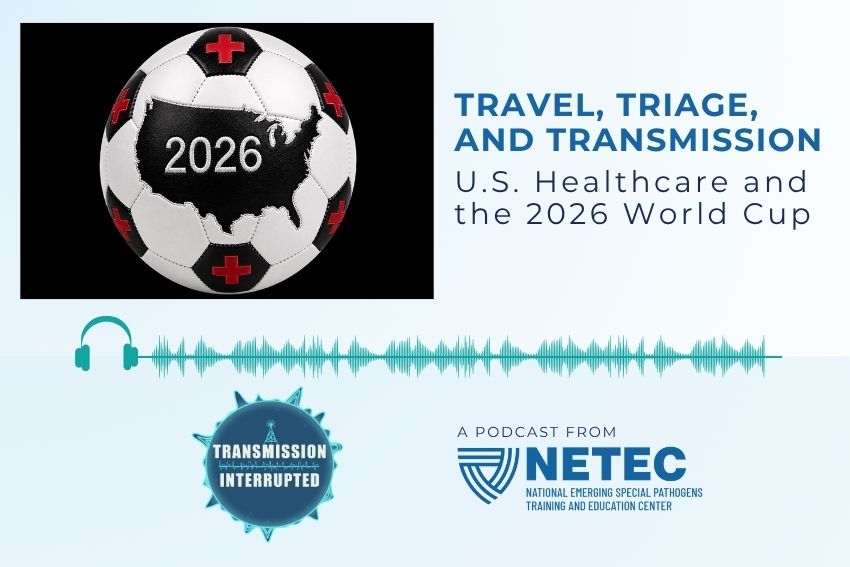
Travel, Triage and Transmission: U.S. Healthcare and the 2026 World Cup
Share this article
In this timely episode of Transmission Interrupted, host Jill Morgan sits down with Dr. Alex Isakov, Medical Director of the Emory Grady EMS Biosafety Transport Program, to explore the unique healthcare challenges presented by the 2026 FIFA World Cup. With eleven U.S. cities preparing to welcome visitors from 48 countries, the conversation digs into how the influx of international travelers brings both excitement and a complex spectrum of public health considerations. Dr. Isakov sheds light on the heightened vigilance required of frontline healthcare personnel, emphasizing the increased likelihood of encountering diseases not routinely seen in the United States, from vector-borne illnesses like malaria and dengue to the risks of global outbreaks such as measles or norovirus.
The discussion also broadens beyond infectious diseases, touching on the operational demands that mass gatherings impose on health systems, including the management of injuries, heat illness, and crowd-related incidents. Dr. Isakov and Jill offer practical advice for both travelers and providers, highlighting the importance of vaccination, hand hygiene, and staying informed about evolving health risks. They stress the need for preparedness not just within host cities but nationwide, as World Cup attendees are expected to venture far beyond stadiums, making readiness a shared responsibility. As the countdown to kickoff continues, this episode offers essential insights for anyone charged with safeguarding public health during one of the world’s largest sporting events.
Guest
Alex Isakov, MD, MPH
Alex Isakov is the founding executive director of the Office of Critical Event Preparedness and Response (CEPAR) and a professor of emergency medicine at Emory University. He directs CEPAR’s initiatives to enhance disaster resilience at Emory and in the broader community. He is also the director of Emory’s Section of Prehospital and Disaster Medicine and leads Emory EMS. Alex serves as a co-lead for NETEC’s EMS Workgroup.
Host
Jill Morgan, RN
Emory Healthcare, Atlanta, GA
Jill Morgan is a registered nurse and a subject matter expert in personal protective equipment (PPE) for NETEC. For 35 years, Jill has been an emergency department and critical care nurse, and now splits her time between education for NETEC and clinical research, most of it centering around infection prevention and personal protective equipment. She is a member of the Association for Professionals in Infection Control and Epidemiology (APIC), ASTM International, and the Association for the Advancement of Medical Instrumentation (AAMI).
Resources
- NETEC – Countdown to Kickoff: 2026 World Cup HCID Preparedness
- NETEC – Global Visitors, Local Preparedness: Dr. Laura Evans on World Cup Health Strategies
- NETEC – Summer Travel Q&A: Expert Tips for Staying Safe and Healthy
- NETEC – World Cup 2026 Resource Library Exhibit
- NETEC – Transmission Interrupted Podcast
About NETEC
A Partnership for Preparedness
The National Emerging Special Pathogens Training and Education Center’s mission is to set the gold standard for special pathogen preparedness and response across health systems in the U.S. with the goals of driving best practices, closing knowledge gaps, and developing innovative resources.
Our vision is a sustainable infrastructure and culture of readiness for managing suspected and confirmed special pathogen incidents across the United States public health and health care delivery systems.
For more information visit NETEC on the web.
NETEC Consultation Services
Assess and Advance Your Readiness for Special Pathogens with Free, Expert Consulting.
NETEC offers free virtual and onsite readiness consulting to help health care facilities and EMS agencies prepare for special pathogen events. Our targeted support services are delivered by experts selected and assigned to each inquiry based on the unique needs of your organization. Have a question? Ask a NETEC expert.
For more information visit NETEC’s Consultation Services.
Transcript
Hello and welcome to Transmission Interrupted.
Jill Morgan:My name is Jill Morgan.
Jill Morgan:I'm a nurse here at Emory University Hospital, and for those of you not yet
Jill Morgan:familiar with NETEC, our mission is to set the gold standard for special pathogens
Jill Morgan:preparedness and response across health systems in the U.S. with the goals of
Jill Morgan:driving best practices, closing knowledge gaps, and developing innovative resources.
Jill Morgan:NETEC works alongside and in cooperation with the CDC and is
Jill Morgan:funded by ASPR, the Administration for Strategic Preparedness and Response.
Jill Morgan:I am excited to talk to Dr. Alex Isakov today.
Jill Morgan:Alex joins me from here in Atlanta.
Jill Morgan:He is the medical director of the Emory Grady EMS Biosafety Transport Program.
Jill Morgan:He's also a Division Chief of Pre-Hospital and Disaster Medicine and
Jill Morgan:the Co-Lead of NETEC's EMS work group.
Jill Morgan:I think for today's topic we're gonna be talking about World Cup prep and there
Jill Morgan:has been nobody that I know of that's more embedded in this, than you Alex.
Jill Morgan:So welcome and I'm looking forward to hearing more about everything having
Jill Morgan:to do with World Cup and the worries of healthcare and healthcare workers.
Alex Isakov:Well, thanks for having me, Jill.
Alex Isakov:It's always great to get on Transmission Interrupted.
Jill Morgan:So let's start with a little bit about, like, this planning
Jill Morgan:has been going on now for literally years, and what is your place in that
Jill Morgan:planning, just as a quick overview?
Alex Isakov:I'm a frontline healthcare worker, as an emergency medicine
Alex Isakov:physician at Emory University Hospital.
Alex Isakov:And I run a division of physicians that focus on pre-hospital care.
Alex Isakov:And so because Atlanta is a host city our team has been working to
Alex Isakov:ready agencies for a large number of visitors coming to Atlanta.
Alex Isakov:And then, as you know, like you, I'm also active in the special pathogens community.
Alex Isakov:So,I also think it's important that our front line healthcare personnel,
Alex Isakov:whether they be first responders or first receivers, are best prepared
Alex Isakov:to manage a patient so that they can make best decisions for the
Alex Isakov:patient, but also good decisions about protections that are necessary.
Alex Isakov:Caring for them safely and preventing transmission to others.
Alex Isakov:I participate in Atlanta's host city medical committee and, you know, this
Alex Isakov:is among the things that have been considered in advance of World Cup.
Jill Morgan:How is World Cup prep different than anything else that
Jill Morgan:brings a lot of visitors to the city?
Alex Isakov:There are a few things that distinguish it, Jill.
Alex Isakov:I think the first is the duration of the games in any particular host city.
Alex Isakov:In Atlanta, for example, they will be host to eight of the matches.
Alex Isakov:If you look across the United States.
Alex Isakov:There are eleven host cities in the U.S. There are a total of
Alex Isakov:16 host cities in North America.
Alex Isakov:And there are 48 teams and their fans coming to North America to play matches
Alex Isakov:over the course of a month to six weeks, and it will be in the middle of summer.
Alex Isakov:It will be different than any other type of event that we've hosted here,
Alex Isakov:because the duration of the World Cup for over one month between June and July.
Alex Isakov:And it'll bring more visitors from different parts of the world to all of our
Alex Isakov:host cities than we might otherwise have had for a Super Bowl or a World Series
Alex Isakov:or other types of mass gathering events that cities are ready to respond to.
Jill Morgan:Yes, because it seems like most of the things that any big city might
Jill Morgan:prepare for like a sporting event or huge concerts and things like that, I can't
Jill Morgan:imagine even, you know, like following Taylor Swift around as its own, I'm
Jill Morgan:sure, mass casualty sort of prep thing.
Jill Morgan:But, you know, you think about those being largely U.S. based people.
Jill Morgan:You might get an influx of people, but they're largely
Jill Morgan:coming from the United States.
Jill Morgan:And I can't imagine how difficult it is to do this prep when right
Jill Morgan:up until the end you're not even sure which countries are coming.
Jill Morgan:I mean, is it decided even yet exactly who will be here?
Alex Isakov:They have 48 teams that are qualified from all over the world, and
Alex Isakov:of course the host cities are identified.
Alex Isakov:Now there are team home base cities that I think have yet to be finalized.
Alex Isakov:They know which 48 teams are coming, but the fan base may go beyond the
Alex Isakov:48 countries that are represented.
Jill Morgan:Sure.
Jill Morgan:and those 48 countries, some of them, I'm sure all of them, we
Jill Morgan:all have our own flu season.
Jill Morgan:We all have our own strains of things.
Jill Morgan:And then there are some countries that have some endemic diseases
Jill Morgan:that I know are of a concern to us.
Alex Isakov:Yeah, that's right.
Alex Isakov:You know, this is part of what makes World Cup unique in that regard is
Alex Isakov:that you'll have visitors from all over the world coming to eleven different
Alex Isakov:cities in the United States, and you're right, where there's different endemic
Alex Isakov:diseases in these various countries.
Alex Isakov:And the American healthcare enterprise knows how to assess patients, and does a
Alex Isakov:very good job at managing their illness all the way through severe critical care.
Alex Isakov:Frontline healthcare personnel, they do this in the United States every day,
Alex Isakov:but they have an increased likelihood of encountering, diseases that they
Alex Isakov:wouldn't routinely see because of the large number of international visitors
Alex Isakov:that'll be coming, to the United States.
Alex Isakov:Even if we pick one that's non-communicable, Jill, like malaria,
Alex Isakov:we're all trained as frontline healthcare personnel to consider malaria on
Alex Isakov:our differential diagnosis when we have somebody with a travel history,
Alex Isakov:and fever, and constitutional signs or symptoms, and it's important to
Alex Isakov:consider malaria in patients with a travel history, especially as they're
Alex Isakov:coming from a malaria-endemic area.
Alex Isakov:Because, if you miss that diagnosis, for some patients it
Alex Isakov:can have serious consequences.
Alex Isakov:And so, being in a World Cup host city, or in a city that will attract
Alex Isakov:visitors from around the globe, it's important to increase your vigilance
Alex Isakov:for those types of illnesses that you might not routinely see day-to-day..
Jill Morgan:Yeah.
Jill Morgan:I think about even some of the other ones, you mentioned malaria, doesn't
Jill Morgan:have person to person spread.
Jill Morgan:Dengue, yellow fever, even some of the other ones that I think
Jill Morgan:we think of as Caribbean, like Chikungunya and things like that.
Jill Morgan:We have the mosquitoes to transmit an awful lot of things here, even if we
Jill Morgan:don't typically have those pathogens.
Jill Morgan:And I guess, if you're coming a really long way to a host country and to a host
Jill Morgan:city, I'm willing to bet that some of the people coming also may travel to
Jill Morgan:other places that have nothing to do with World Cup, like our national parks.
Jill Morgan:Like, Disney World and Disneyland and, you know, the Grand Canyon.
Jill Morgan:So there isn't a place in the country that really is excluded from needing
Jill Morgan:to think about the concept of travel, and symptoms, and keeping our eye out.
Alex Isakov:You're right on target that the people that are visiting the United
Alex Isakov:States, Canada, and Mexico, for World Cup, are not going to limit themselves to
Alex Isakov:the host cities where the stadiums are.
Alex Isakov:This is something that while you may have a concentration of people in
Alex Isakov:those host cities, there'll be people that'll be traveling all over the
Alex Isakov:United States who've come, to the U.S. Because of World Cup, but are not gonna
Alex Isakov:limit themselves to that geography.
Alex Isakov:So, everyone has to be a little bit more vigilant.
Jill Morgan:I wanna pivot for just a second, because normally, of course,
Jill Morgan:we're talking about transmissible diseases here and infectious diseases,
Jill Morgan:but there are a lot of other things that I think could cripple a healthcare
Jill Morgan:system if we had some other things that can happen during these large events.
Jill Morgan:Some of those, of course, Atlanta is very familiar with the Olympic Park
Jill Morgan:bombing,s I mean, that's still way too fresh in many minds here in Atlanta.
Jill Morgan:But also, I think just what happens when you get lots of people together.
Jill Morgan:We have people coming from the southern hemisphere where it's flu season.
Jill Morgan:We have people coming with their own pathogens from wherever, but also
Jill Morgan:enthusiastic fans, and fireworks, and just the kind of rivalry stuff that we
Jill Morgan:would worry about with other injuries.
Jill Morgan:And I just wonder, what does this look like in other world Cup events?
Jill Morgan:I'm gonna separate Qatar because I know that was a completely dry
Jill Morgan:World Cup and probably a little different than perhaps typical of
Jill Morgan:fan activities and things like that.
Alex Isakov:I think all World Cups are different in many ways, Jill.
Alex Isakov:In the way that you say Qatar was unique, if you were hosting World
Alex Isakov:like was the case in I think:Alex Isakov:infrastructure there, it's just distinct from what it is in the United States.
Alex Isakov:And so every World Cup host country is going to have unique,
Alex Isakov:elements that need to be managed.
Alex Isakov:But there are also things that are common, like what we're talking about
Alex Isakov:here as it relates to communicable and non-communicable diseases, and readying
Alex Isakov:the health system and the public health enterprise to Be ready to detect those
Alex Isakov:illnesses and to respond if needed, not just to clinically manage a patient, but
Alex Isakov:if there's need to isolate someone with a communicable disease or conduct a case
Alex Isakov:investigation and subsequent contact tracing, that those measures are in place.
Alex Isakov:You mentioned some issues as it related to security concerns, risk for violence,
Alex Isakov:risk for injury, consequences from alcohol consumption, and that's all real
Alex Isakov:and needs to be anticipated as well.
Alex Isakov:There's not a tremendous amount of data that's been available for us to
Alex Isakov:review as it relates to increased demand for health services during World Cup.
Alex Isakov:So there's some planning assumptions that have been made to anticipate
Alex Isakov:increased numbers of people seeking care.
Alex Isakov:I think for us in the United States, and because of the time of year that
Alex Isakov:we're hosting the games, I think heat injury is something that we
Alex Isakov:really should be on the lookout for and have mitigation plans in place.
Alex Isakov:And maybe review protocols among first responders and first receivers about how
Alex Isakov:to manage the most serious consequences of heat injury, heat stroke for example.
Alex Isakov:I think that would be worthwhile.
Alex Isakov:In terms of consequences of alcohol consumption or violence, most
Alex Isakov:U.S. cities are prepared to manage patients with trauma and intoxication.
Alex Isakov:We have robust health systems in all the U.S. host cities that
Alex Isakov:should be able to manage that.
Alex Isakov:If we start to consider issues around mass casualty management that will challenge
Alex Isakov:really any city, but it'll be important then for first responders to have their
Alex Isakov:patient triage guidelines top of mind.
Alex Isakov:Reminded how to perform lifesaving interventions for patients in the
Alex Isakov:field that need them and then look at their patient distribution plans.
Alex Isakov:And also recognize that in the history of mass casualty incidents there's always a
Alex Isakov:large proportion of people that self-refer to the nearest hospital for care, and so
Alex Isakov:that's all part of the consideration for hosting mass gathering events as well, and
Alex Isakov:cities take measures to prepare for that.
Jill Morgan:I'm wondering about some of the details of that.
Jill Morgan:I think this idea of moving people around, like if need be.
Jill Morgan:Certainly hospitals outside of Atlanta or outside of any of the
Jill Morgan:host cities would then be responding.
Jill Morgan:And I assume that essentially the conops that you might have in place
Jill Morgan:for other things really get brought to bear with these kind of situations
Jill Morgan:where if you need to offload patients somewhere else, EMS becomes just this
Jill Morgan:incredibly strong network of agencies that can respond and move people around.
Jill Morgan:It sounds like it would be a logistical, I mean, I'm grateful that there are
Jill Morgan:people who are focused on just those logistics because I think to the rest of
Jill Morgan:us, that sounds like just a nightmare.
Alex Isakov:I think it'll be challenging for any US community, depending on the
Alex Isakov:number of casualties and the nature of the injuries that they need to manage.
Alex Isakov:That's not an easy day for anyone if you have a large number of
Alex Isakov:casualties that need management.
Alex Isakov:You're right, the EMS community have a role in trying to mitigate
Alex Isakov:the challenges, the consequences of that type of an incident, and there
Alex Isakov:are frameworks that help to have those procedures Better, placed.
Alex Isakov:Like the healthcare coalitions that are funded by the federal government through
Alex Isakov:the HPP or Hospital Preparedness Program, contribute to a community's readiness
Alex Isakov:and engagement of health systems.
Alex Isakov:This concept of medical operations coordination, to try and redistribute
Alex Isakov:patients to where the resources are and away from health systems that
Alex Isakov:are operating under surge conditions is an important concept to try and
Alex Isakov:get best outcomes for patients.
Alex Isakov:We know that health systems operating under surge conditions, there's a greater
Alex Isakov:likelihood of having bad outcomes in health systems that are operating
Alex Isakov:beyond capacity, so that those load balancing techniques are important.
Alex Isakov:But bringing it back to infectious and communicable diseases, Jill.
Alex Isakov:For the Transmission Interrupted crowd.
Alex Isakov:I think podcasts like this are important to increase awareness about some of
Alex Isakov:those illnesses that we talked about that we don't more routinely see, which
Alex Isakov:is one of the risks of having a large number of international travelers come.
Alex Isakov:And you'd mentioned a number of them.
Alex Isakov:We talked about malaria, we talked about dengue, I mentioned
Alex Isakov:c hikungunya as an example.
Alex Isakov:Then there are also illnesses that are just perhaps more impactful
Alex Isakov:because of the concentration of people that you have in places.
Alex Isakov:And so, while they may not seem that exotic, they certainly can be disruptive.
Alex Isakov:And when we think about norovirus and the importance of safe food and safe
Alex Isakov:water, and how disruptive a neurovirus outbreak can be, and how important it
Alex Isakov:will be to have cleaning and disinfection protocols in place, and isolation
Alex Isakov:recommendations in place to mitigate that.
Alex Isakov:And we rely heavily on our public health partners for that type of guidance.
Alex Isakov:Also as you'd mentioned, there are people coming from the southern
Alex Isakov:hemisphere where flu season is active.
Alex Isakov:And so, in close quarters you're more likely to have transmission of
Alex Isakov:respiratory illnesses, and that can include influenza and it can include
Alex Isakov:COVID-19, and we can't say measles is eradicated in the United States anymore.
Alex Isakov:And so, there's risk whether they're travelers from a neighboring state
Alex Isakov:or travelers from another country.
Alex Isakov:If they have been in infected with the virus that causes measles, then
Alex Isakov:they're at risk for transmitting.
Alex Isakov:It's the most contagious disease that we know, and so when you have people at mass
Alex Isakov:gathering events in close quarters, and here in Atlanta, Mercedes-Benz Stadium,
Alex Isakov:that's an example, is an indoor venue.
Alex Isakov:But it's not just the stadiums, it's going to local restaurants, and going
Alex Isakov:to bars, and going to other places where if you have measles, you can
Alex Isakov:increase the likelihood of transmission.
Alex Isakov:And so that's something for us to consider.
Jill Morgan:Absolutely.
Jill Morgan:So along those lines, Alex, and I guess just thinking about sort of, to wrap
Jill Morgan:this up with some good advice from you.
Jill Morgan:I know that you have done a fair amount of traveling for this preparation.
Jill Morgan:What's your advice to travelers?
Jill Morgan:Whether they're traveling for the World Cup or whether they happen
Jill Morgan:to be traveling when everybody else is traveling around the country, or
Jill Morgan:internationally, during this event.
Jill Morgan:Do you feel like people should take more precautions or be extra careful?
Jill Morgan:Whether that's masking or hand hygiene, or what do you suggest?
Alex Isakov:Probably a few things.
Alex Isakov:One, for vaccine preventable diseases, try to be vaccinated.
Alex Isakov:I think that's good advice for all of us day to day.
Alex Isakov:Certainly good advice for people that routinely go into areas where
Alex Isakov:you're in close quarters with others.
Alex Isakov:I think it's especially important if you have some underlying medical
Alex Isakov:conditions that would put you at risk for more serious illness, even for
Alex Isakov:influenza, because of age or some other underlying medical conditions.
Alex Isakov:So, get vaccinated for vaccine preventable diseases is one
Alex Isakov:great way to prevent transmission of infection and consequences.
Alex Isakov:I think the second is that if you are ill don't go to crowded
Alex Isakov:rooms and mass gathering events.
Alex Isakov:If you have a fever and a cough then you should just stay home until
Alex Isakov:those symptoms improve and you can look to the public health authority
Alex Isakov:about guidance when you're less likely to be shedding the virus or
Alex Isakov:whatever it else that made you ill.
Alex Isakov:People come to enjoy the games and they're going to wanna participate
Alex Isakov:in all the social engagement, whether it's in the stadium or outside.
Alex Isakov:If you're sick, probably stay home until you feel better.
Alex Isakov:If you do have underlying medical conditions then I think you have to
Alex Isakov:also just follow the advice of your doctor about the wisdom of going into
Alex Isakov:a crowded space where the likelihood of illness transmission is higher.
Alex Isakov:Those are broad and general recommendations.
Alex Isakov:I think if you have hand sanitizer available, always good
Alex Isakov:to exercise good hand hygiene.
Alex Isakov:I won't go as far as to say you should wear a procedural mask
Alex Isakov:going into a mass gathering event.
Alex Isakov:I think that's a personal choice for many.
Jill Morgan:I think it's a great answer and I think you're absolutely right.
Jill Morgan:Vaccine preventable.
Jill Morgan:Get vaccinated.
Jill Morgan:Absolutely number one.
Jill Morgan:And I think hand hygiene, the number of times we touch our face,
Jill Morgan:the number of times we touch other things and then touch our face.
Jill Morgan:The odds of probably getting a direct inoculation from another human, of
Jill Morgan:course, they're gonna go up in a confined space, in closed quarters.
Jill Morgan:But even if you're out in open air stadiums or traveling, or in streets
Jill Morgan:and restaurants that are open.
Jill Morgan:You're still touching things, and then unfortunately what we do is
Jill Morgan:we shove these pathogens right into our own nose, mouths and eyes, and
Jill Morgan:that's probably just as responsible as anything else for how we get sick.
Jill Morgan:So, it's a great warning to remember your hand hygiene.
Jill Morgan:Take some hand sanitizer with you, and then at least wash your hands
Jill Morgan:please, when given the opportunity.
Alex Isakov:Yeah, I think that's right.
Alex Isakov:You know another thing we haven't talked about, but I think it's
Alex Isakov:important in readiness for mass gathering events and for FIFA World
Alex Isakov:Cup:Alex Isakov:You can learn more about that at NETEC.org.
Alex Isakov:But I think it's important for all of us as frontline healthcare providers to be
Alex Isakov:familiar with illnesses that are among those that the public health department
Alex Isakov:wanna know about, the reportable diseases.
Alex Isakov:So we wanna be able to identify them.
Alex Isakov:We also wanna be able to identify illnesses that would pose a risk
Alex Isakov:to other patients, or to us as healthcare personnel, as clinicians
Alex Isakov:or to visitors and bystanders.
Alex Isakov:And so going back to the discussion around measles would be a good example of that.
Alex Isakov:We want to be able to identify a case of measles as a frontline healthcare
Alex Isakov:provider, In addition to other illnesses, so that we can take steps
Alex Isakov:to properly isolate that patient and apply an appropriate hierarchy
Alex Isakov:of controls and personal protective equipment for our own safety.
Alex Isakov:And then alert the public health authority that we have a case of suspected measles.
Alex Isakov:They wanna know about that.
Alex Isakov:On this show, Jill, we often talk about Ebola Virus Disease.
Alex Isakov:Marburg Virus Disease, Middle East Respiratory Syndrome, all
Alex Isakov:high-consequence infectious diseases.
Alex Isakov:But really, while it's important for us to be ready for them, we're far
Alex Isakov:less likely to encounter a patient with one of those HCID's than we would
Alex Isakov:be a case of measles, and so it's important for us to just be reminded.
Jill Morgan:That's a great reminder, and I will say, in adult medicine, adult
Jill Morgan:emergency medicine, we may not be used to asking a vaccination history, right?
Jill Morgan:Because unless somebody's got an injury for which they might need a
Jill Morgan:tetanus shot, we kind of can skip over vaccination sometimes, and we're
Jill Morgan:more likely to ask that of children.
Jill Morgan:But we have a lot of adults around the world who might be un, or under
Jill Morgan:vaccinated, and not immune to measles.
Jill Morgan:And so it becomes something that we have to keep in a list of things that
Jill Morgan:we're at least considering for them.
Alex Isakov:Yeah.
Alex Isakov:Just increased awareness about that and travel history.
Alex Isakov:Dengue, for example, It's a vector-borne disease.
Alex Isakov:So, if we miss warning signs of a patient that presents with dengue, or maybe didn't
Alex Isakov:even consider it in our differential because we didn't consider that the
Alex Isakov:patient recently traveled, even from a place like Puerto Rico or the USVI, we
Alex Isakov:may miss an opportunity to intervene early and get a better result for the patient.
Jill Morgan:Absolutely.
Jill Morgan:Absolutely.
Jill Morgan:Alright, well, Alex is there something else you definitely want to get across?
Jill Morgan:Otherwise I will thank you and we'll wrap this up.
Alex Isakov:I'll underscore a few of the things that we talked about before.
Alex Isakov:I think Getting vaccinated against vaccine preventable diseases is important for
Alex Isakov:all of us as healthcare professionals, but just in the general population for
Alex Isakov:our own safety, safety of our kids, safety of our friends and neighbors, and
Alex Isakov:those that may have underlying medical conditions that may get a lot sicker.
Alex Isakov:Two, I think Identify, Isolate, Inform is a great tool for frontline healthcare
Alex Isakov:personnel to recognize illnesses that pose a risk to them, not just the patient,
Alex Isakov:but to the healthcare provider, other patients, the visitors, and bystanders.
Alex Isakov:And then the third is there's probably some value in reviewing some of these
Alex Isakov:non-communicable diseases just to increase your awareness and your being alert to
Alex Isakov:them as a frontline healthcare provider.
Alex Isakov:And that includes things like chikungunya and dengue as examples, or malaria so
Alex Isakov:you're better ready to recognize them.
Alex Isakov:I think we should all be prepared to have a great summer, and enjoy
Alex Isakov:the World Cup in North America.
Jill Morgan:I know I'm really excited about World Cup.
Jill Morgan:I've gotten more excited over this spring.
Jill Morgan:I think it's gonna be fun.
Jill Morgan:I'm looking forward to it and I'm also hoping that everyone will remain well.
Jill Morgan:So, thanks, Alex.
Jill Morgan:It's been a pleasure to talk to you.
Jill Morgan:We're gonna be doing several episodes about World Cup prep
Jill Morgan:and things that people should be concerned about or looking out for.
Jill Morgan:So I really appreciate you kicking this off with some very
Jill Morgan:reasonable, doable warnings.
Jill Morgan:Like if you can get vaccinated against it, go ahead.
Alex Isakov:Absolutely.
Alex Isakov:And you know, don't forget to have fun.
Jill Morgan:That's right.
Jill Morgan:That's right.
Jill Morgan:Well thank you so much.
Jill Morgan:We really appreciate all of you joining us today for another
Jill Morgan:episode of Transmission Interrupted.
Jill Morgan:We hope you'll join us for future episodes on this and a wide range of
Jill Morgan:other topics from healthcare worker safety to personal protective equipment
Jill Morgan:and infectious diseases of all kinds.
Jill Morgan:If you have any questions for NETEC or ideas for future shows, please feel
Jill Morgan:free to contact us at info@netec.org.
Jill Morgan:That's info@netec.org.
Jill Morgan:You can also find us on the web at NETEC.org/podcast where you can
Jill Morgan:also subscribe to future episodes.
Jill Morgan:So, thank you all for joining us and we'll see you next time
Jill Morgan:on Transmission Interrupted.