A Legacy of Leadership, Mentorship, and Preparedness: Remembering Dr. Bruce Ribner
Share this article
Longtime colleagues reflect on the physician, mentor, founding NETEC leader, and preparedness pioneer—and the quiet confidence that guided his work.
Dr. Bruce Ribner spent years preparing for a moment he could not know would ever come.
In 2002, he helped establish the Serious Communicable Diseases Unit (SCDU) at Emory University Hospital, creating a place where patients with highly hazardous communicable diseases could be cared for safely. For more than a decade, the unit did not care for a single sick patient.
Then, in 2014, Ebola arrived in the United States.
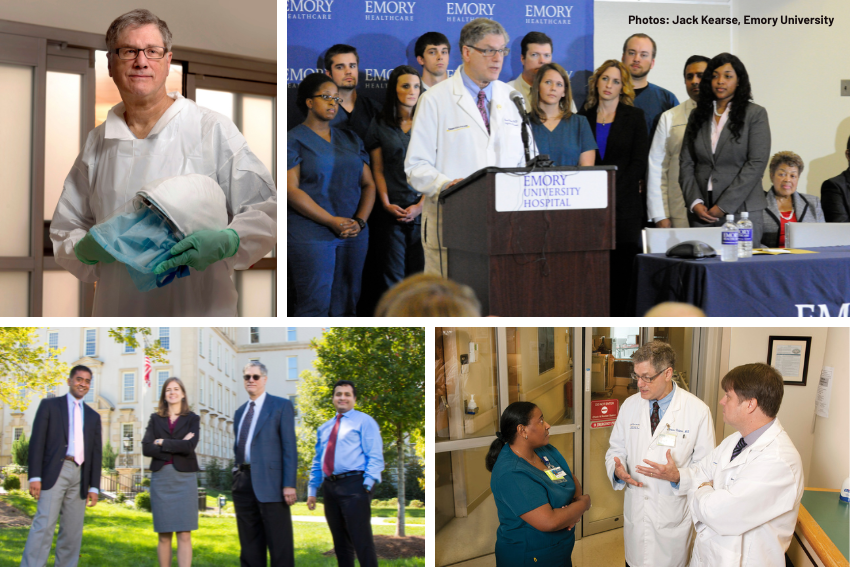
Under Dr. Ribner’s leadership, Emory University Hospital became the first U.S. hospital to successfully care for patients with Ebola virus disease during the West Africa epidemic. The experience demonstrated what years of preparation, training, and teamwork could make possible—and helped reshape the nation’s approach to special pathogen preparedness.
Dr. Ribner went on to help carry those lessons far beyond Emory. As one of the founding leaders of the National Emerging Special Pathogens Training and Education Center (NETEC), he worked alongside leaders from the University of Nebraska Medical Center and NYC Health + Hospitals/Bellevue to build a national collaboration dedicated to strengthening health care preparedness for special pathogens.
In a special episode of Transmission Interrupted, four of Dr. Ribner’s longtime Emory colleagues come together to remember the physician, mentor, educator, and preparedness leader whose influence continues to shape their work.
Host Jill Morgan, RN, worked alongside Dr. Ribner as a member of Emory’s biocontainment team, including during the 2014 Ebola response. She is joined by infectious disease physicians Colleen Kraft, MD; Jay Varkey, MD; and Aneesh Mehta, MD, who each worked closely with Dr. Ribner over many years—as trainees, mentees, colleagues, and members of the team caring for patients with high-consequence infectious diseases.
Their conversation offers something more personal than a retrospective on Dr. Ribner’s accomplishments. Through stories from their years working together, they reflect on what it was like to learn from him, care for patients alongside him, and ultimately carry forward the work he helped begin.
Preparing Before the Crisis
Dr. Ribner’s impact on special pathogen preparedness began long before the 2014 Ebola outbreak.
The biocontainment capability he helped establish at Emory initially served as an occupational health resource for the nearby Centers for Disease Control and Prevention. It put infrastructure, protocols, training, and expertise in place years before they would be called upon to care for patients with Ebola.
That long view of preparedness emerges as one of the most enduring themes of the conversation.
Kraft reflects on Dr. Ribner’s willingness to invest in work that might remain unappreciated for years—and might never be needed. He had the vision and patience to build something without knowing whether he would ever see it put into practice.
The SCDU operated for 12 years before caring for a sick patient. Yet that did not discourage Dr. Ribner. As Morgan reflects, the unit was there because being prepared was the right thing to do.
She compares that philosophy to having smoke detectors in your home: Their value does not depend on whether your house ever catches fire.
It is a lesson that extends far beyond biocontainment. Preparedness requires people willing to build systems, conduct research, train teams, develop protocols, and maintain capabilities without knowing when—or whether—their work will be put to the test.
Excellence Without Ego
Dr. Ribner’s colleagues remember a leader with an extraordinary command of infectious diseases.
Varkey describes his knowledge as “encyclopedic.” Kraft and Mehta recall moments during the 2014 Ebola response when Dr. Ribner recognized clinical developments before others on the team did.
But his expertise was paired with an unusual leadership style.
The physicians describe a leader who could be intimidating, direct, and exacting, yet who created an environment in which every member of the team had a voice. Morgan remembers the sense of equality among the physicians, nurses, and other professionals caring for patients during the Ebola response.
Dr. Ribner also gave younger colleagues room to learn.
Mehta recalls an early surprise drill in the SCDU when Dr. Ribner sat behind him taking notes but resisted stepping in. He allowed Mehta to work through the situation himself, intervening only when necessary for safety.
That combination—giving people room to develop while knowing when leadership needed to take over—is something his former colleagues say they still try to emulate.
Keeping Patients—and Each Other—Safe
For Dr. Ribner, clinical excellence and health care worker safety were inseparable.
Mehta recalls a lesson after he removed a patient from airborne isolation earlier than hospital protocol allowed. Dr. Ribner reviewed the policy with him and emphasized that even when clinicians are confident in their judgment, there is always a margin for human error.
That error might affect a patient. It could also affect a colleague.
For Mehta, the lesson captures an important part of Dr. Ribner’s legacy: delivering excellent clinical care while creating systems that help everyone involved return safely to their families.
His colleagues also came to recognize how often Dr. Ribner quietly absorbed the pressures surrounding the team. During the Ebola response, Kraft recalls, he handled difficult decisions and external pressures so others could focus on providing safe, high-quality care.
From Emory to a National Network
The lessons of the 2014 Ebola response did not stay at Emory.
Dr. Ribner was one of the founding leaders of NETEC, working with colleagues at the University of Nebraska Medical Center and NYC Health + Hospitals/Bellevue to create a national collaboration focused on strengthening health care preparedness for special pathogens.
The philosophy that guided his work at Emory also helped shape NETEC: preparedness is not something that can be built in the middle of a crisis. It requires sustained planning, training, collaboration, and continuous improvement.
His influence remains embedded in NETEC’s work today—and in the broader national system of special pathogen preparedness that grew from those early efforts.
Do Important Work for the Right Reasons
Perhaps one of the most enduring lessons Dr. Ribner’s colleagues describe is also one of the simplest: Do important work for the right reasons.
Dr. Ribner spent more than a decade building and maintaining a capability he could not know would ever be needed. He did not need a crisis—or recognition—to validate its importance.
Morgan describes the “quiet confidence” that came from knowing his true north. Dr. Ribner knew that what he was doing had value, whether or not it was recognized and whether or not the moment ever came when it would be needed.
It is a lesson Morgan extends to everyone doing preparedness work today: the researcher who does not know whether an experiment will make a difference, the infection preventionist who feels like they are “shouting into the void,” or anyone building a capability they hope never has to be used.
Dr. Ribner’s legacy lives in the systems he helped build, including NETEC. But it also lives in the physicians, nurses, infection preventionists, researchers, and preparedness professionals he taught and mentored—and in the people they now teach and mentor themselves.
You may not know when the moment will come. You may not know whether the work will ever be recognized.
Do the work anyway.
Listen to The Many Legacies of Dr. Bruce Ribner on Transmission Interrupted.